The federal government recently announced that in response to concerns surrounding the impact of increasing numbers of international students on the housing market, they will be placing a cap on student permits over the next two years.
It is in the hands of each individual province and territory to decide how permits are distributed among their respective universities. The number of permits to be distributed in 2025 will be reevaluated at the end of this year.
According to a recent CBC article, Marc Miller, the Minister of Immigration, stated that in some provinces the total cut to international student visas will be 50 percent.
Following this announcement, MUNFA and CFS have released statements in response to the impact this decision will have on international students moving forward.
MUNFA response
The headline of Memorial University’s Faculty Association’s (MUNFA) release reads “International Student Visa Cap will not Address Chronic Underfunding”
President Josh Lepawsky describes the recent announcement as further exemplifying the scapegoating of international students for the ongoing crisis for education, healthcare, and housing. He emphasizes the decision as “pinning blame on people who arrive in Canada as students—and who pay substantially higher tuition than others, pay all the same taxes as anyone else, and add to local economies by paying rent and purchasing daily needs, and yet who cannot vote—is a particularly cynical move by the government.”
International Student Visa Cap will not Address Chronic Underfunding
The MUNFA Executive stands in solidarity with international students impacted by these visa changes
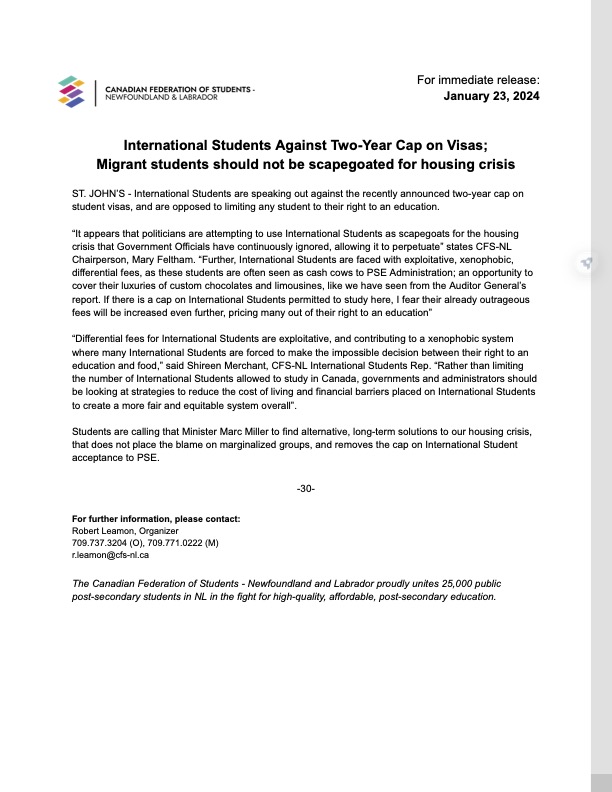
In a similar vein to MUNFA, the Canadian Federation of Students (CFS), affirms in their media release that “Migrant students should not be scapegoated for housing crisis.”
Mary Feltham, CSF-NL Chairperson, states “International Students are faced with exploitative, xenophobic, differential fees, as these students are often seen as cash cows to PSE Administration; an opportunity to cover their luxuries of custom chocolates and limousines, like we have seen from the Auditor General’s report. If there is a cap on International Students permitted to study here, I fear their already outrageous fees will be increased even further, pricing many out of their right to an education.”
Further asserting, “Differential fees for International Students are exploitative, and contributing to a xenophobic system where many International Students are forced to make the impossible decision between their right to an education and food,” said Shireen Merchant, CFS-NL International Students Rep. “Rather than limiting the number of International Students allowed to study in Canada, governments and administrators should be looking at strategies to reduce the cost of living and financial barriers placed on International Students to create a more fair and equitable system overall.”
According to the media release, “Students are calling Minister Marc Miller to find alternative, long-term solutions to our housing crisis, that does not place the blame on marginalized groups, and removes the cap on International Student acceptance to PSE.”
Credit: Canadian Federation of Students (CFS) press statement
Students compete for a place in the National Improv Tournament: January 31 – February 2nd, 2024 at LSPU Hall, St. John’s.
The Canadian Improv Games is a national nonprofit that spotlights the uniqueness of Canadian youth through the skills of improvisation. This February, teams from across Newfoundland will compete at LSPU Hall for the CIG Newfoundland tournament. Audiences are encouraged to cheer for all teams and enjoy the showcase of Newfoundland’s incredible improv talent.
“The joy of loving competition is an experience like no other. I’m so proud to be a part of a community that puts kindness over competing,”
Regional Producer, Elizabeth Glenn
The Canadian Improv Games teaches young people skills they need to succeed in life through competitive improvisation. Skills like listening, teamwork, creativity, and collaboration have been cited by graduates as skills they learned from the CIG that they apply to their everyday lives.
Teams play four of five, semi-structured events judged by a panel of CIG-certified judges. The events are evaluated on a rubric of skills for life in and out of improv including listening, taking risks, advancing the scene, commitment, and teamwork. Events are judged out of a total of 59 possible points and the top five teams at the end of the preliminary round advance to finals where their scores are erased and they compete to earn a spot at Nationals, held every spring in Ottawa.
The Canadian Improv Games has been the launch pad for many amazing Canadian actors over the last 38 years. Notable alumni of the CIG include Golden Globe winner and Emmy nominee, Sandra Oh of Grey’s Anatomy; Emmy winner, Tatiana Maslany of She-Hulk, and a slew of up-and-comers.
“The Canadian Improv Games is the best place to watch young talent thrive!” says Glenn. “As a player, the confidence our programming instills in students is what helped make me who I am today. I’m glad I get to be a part of helping the students of today reach their potential!”
Tickets can be purchased at LSPU Hall or through improv.ca/eventdates. After two semi-final performances, finals night on February 2nd will see one team proceed to the National Tournament in Ottawa. Read more about CIG at improv.ca, or reach out to newfoundland@improv.ca.
Nominations for the 2024 MUNSU By-Election are open as of January 10th.
As a MUNSU representative, you can represent the undergraduate students from your faculty for the remainder of the academic year, until April 30, 2024.
Voting in the 2024 MUNSU By-Election will take place on January 29 and 30 and nominations will close on Wednesday, January 17, at noon. At that point, vacancies will be accepting applications until Friday, January 19th at 3 pm.
A complete list of the currently vacant positions and policies is available here: munsu.ca/elections
Any undergraduate students interested in running in the election can get a nomination form at the MUNSU Office (UC-2001), the MUNSU elections webpage munsu.ca/elections or by emailing Derek Semerad, the MUNSU Chief Returning Officer who will be overseeing the election, at cro@munsu.ca.
The following is a list of vacancies for the 2024 By-Election, applications are due January 17th. These positions will be for February to April 2024, and require 20-40 student signatures to apply:
Constituency:
Student Parents
Trans
Womens
MacPherson College
Faculty:
Music
Medicine
Social Work
HSS (2)
Education
Pharmacy Students’
Science Students’ (1)
Following the constitutionally required By-Election in January, February 7th will see the opening of the MUNSU General Elections. This will feature openings for the 2024-2025 Academic Year, May 1, 2024, to April 30, 2025.
There will be a follow-up email for the General Election the week of February 7th.
MUNSU Executive Director positions, featuring a year of 35 hours a week paid work and staff support, will be open for application on February 7th.
Director of Campaigns
Director of Finance and Services
Director of External Affairs, Communication, and Research
Director of Advocacy
Director of Student Life
Faculty and Constituency representatives, with the expectation of biweekly stipends and weekly committee work, will be elected for all faculties and the following constituencies on February 7th:
HSS Students (3)
Business Students (2)
Education Students
Engineering Students (2)
HKR Students
Nursing Students
CNS Students
Pharmacy Students
Science Students (3)
Social Work Students
Medicine Students
Indigenous Students’
International Students’
Queer Students’
Students with Disabilities
Music
Student Parents
MacPherson College
Paton College
Burton’s Pond
Sustainability
Students of Colour
First Year Students’
Undeclared Students’
Part-Time Students’
Women’s Representative
Trans+ Students’
MUNSU is also seeking Membership and Leadership in the following Resource Centers for the following academic year:
MUN Sexual and Gender Advocacy
MUN Intersections, Resource Center for Marginalized Genders
MUN International Students Resource Center
MUN Circle of First Nations, Inuit and Métis Students
Student Parents Assistance and Resources MUNL
Students Older than Average
Disability Information and Support Center
Faculty/School representatives must be registered in the faculty/school they are seeking to represent. Constituency representatives must be a member of the ward they represent; First Year Students’ Representatives must be a first-year student, and the residence reps must be currently living in the residence they are seeking to represent. The Trans* Students Rep must identify as Trans* (including non-binary), et cet.
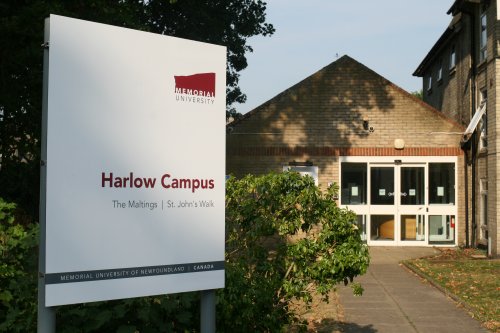
Three graduate students in MUN’s School of Music were informed on October 12th, 2023 that they owe the university $1900 in fees for the Harlow trip. This information came five months after they had all already completed the program.
Christina Acton, Laura Wakeman, and one other grad student are part of the MUN Music Graduate program. After being notified of the university’s mistake, they have all requested for the fee to be waived or reduced.
“We did Harlow in June of 2023 and then on October 12th of this year— we got an email from the program administrator in the School of Music saying that the cashier’s office had notified them of an error that the $1900 program fee was never charged to our account and now we have to pay it, and it had been like 5 months since it was due,” explains Acton.
2022 Harlow program
To backtrack, the Harlow program was first advertised to music students in December 2022. Acton states that, at that time, they were provided with a single sheet of paper vaguely outlining the program. Following the meeting in December, they never again received a slip or document explicitly stating the sum of each payment and what they would be paying for.
All the students then committed to the program with a $500 deposit in February 2023. They then began having more meetings, discussing the program and necessary preparations.
“By April 20th— myself and the two other grad students were told there was going to be a $1900 program fee on top of [our] $1200 semester tuition, and we were told that in one email in April,” explains Acton. “Then what they said was everything that is due for Harlow you have to pay by May or you can’t go; all your fees and stuff, everything is due by May 8th, and you pay it through your student account.”
Once May 8th rolled around, all that showed up in their student accounts was the $1200 tuition fee. Although at the time Acton explains that to them it made sense.
“We were like well this makes sense,” says Acton, “We booked our own flights so that must be why there’s no $1900 program fee showing up, and you know, May 8th was approaching, we paid all our fees, May 8th passed, it was showing that everything had been paid off and we were like great! Everything is handled.”
Acton clarifies that as of right now the fee is showing up in their account as $1400 as the initial $500 deposit was deducted, as well as a $200 deduction due to them not having spent all of the collective program fees.
“So, somehow that means that we went from $1900 to $1400,” says Acton. “Which still feels a little nutty because, between the $500 and the $200, I don’t totally know how we got to that number. It was like $1600 for a little bit and then it was $1400 so it’s still a little confusing. Currently, the account is showing up as $1400.”
No direct communication with ‘the university’
Following the initial email from the School of Music informing Acton and the other grads of the money they owe the university, none of the communication has come from the cashier’s office, or even the university itself. All communication has gone through the School of Music.
“We keep getting emails from the School of Music being like, ‘the university has said this,’ we don’t know like who is the university? We don’t know because none of them will talk to us directly, it’s all been this weird pipeline,” states Acton.
The students then set up a meeting with Lisa Mcdonald, the Senior Administrative Officer for the School of Music, to explain why they were so surprised by the situation. Mcdonald explained that after speaking with the university, she was informed that waiving or reducing the fee is not possible. Unhappy with the response, the students proceeded to contact the Dean of the School of Music, Dr. Karen Bulmer.
Potential payment plan
“[Dr. Bulmer’s] been really helpful,” says Acton, “she has essentially set up a payment plan for us that is completely separate from the rest of the university and she’s like we can take that off your student account and have you pay it over nine months directly to the School of Music and then it won’t impact your ability to pay for courses and to graduate. Which is super helpful but came from the School of Music.”
Laura Wakeman explains that the process has been unorganized and unnecessarily confusing. Following the recent meeting with Dr. Bulmer, the payment plan discussed has been taken off the table as a potential solution.
Now, all three graduate students are required to pay it off before convocating, if they want to graduate.
Wakeman says, “They did say that they have taken the financial hold off of our accounts.” However, she remains unsure of what she can do about the situation as she is living month-to-month along with many other students.
Similar to Acton, Wakeman states she was explicitly informed that “Everything had to be paid by May 8th, 2023, or [they] could not go,” stressing that “[she] took that very seriously.”
She emphasizes that “It was a fantastic experience,” stating that “Memorial University’s Harlow campus is able to offer an experience really unlike any other.”
Nevertheless, five months later, they had already moved on with their lives and had planned out other essential expenses for the following semesters.
In their initial meeting with the Dean of Music and financial advisor for the School of Music, Wakeman says “It just came across as they were trying to make it seem like we were the ones that were being unreasonable, by us suggesting that we shouldn’t be held accountable for their mistake.”
Whereas, Wakeman explains “If that other amount of money had shown up there, of course, I would have found a way to work around that but that was six months ago, life has changed a lot since then.”
The third grad student, who has requested to remain anonymous, was charged late fees on top of the fee that the university mistakenly forgot to place on their accounts back in May. After numerous back-and-forth emails with admin, the student was finally able to get the additional late fees removed from the total sum they now owe.
Agreement has yet to be reached
As of now, the three graduate students have yet to come to an agreement with the university. They are still required to pay the fee in full prior to graduating.
Acton says, “[They] have emailed everyone [they] can think of now, including the interim VP of admin and finance.” Moving forward, the students will continue to communicate with the university in hopes that an agreement will be reached that satisfies both parties.
My name is Meghan Button and I am a third-year Bachelor of Education (Primary/Elementary) student who completed my internship in Harlow during the Fall 2023 Semester.
Leaving home for the first time
Photo credit: Meghan Button
I have lived with my family for all 22 years of my life. Not only was I leaving home for the first time which was scary in itself, but I was leaving home to live on a completely different continent. As scary as it was, I really pushed myself to do it because I knew I had to take this opportunity.
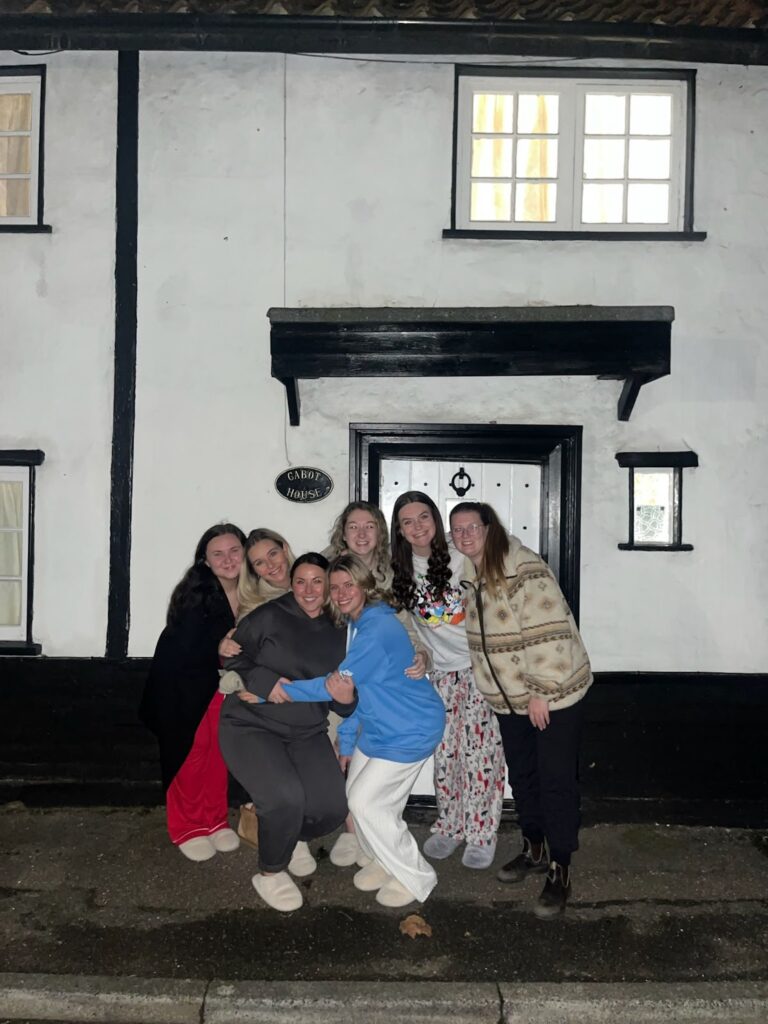
Myself and six other education students (now my best friends) stayed in the Cabot House at the Memorial University Harlow Campus. We had our own rooms and shared a kitchen and living room area. It quickly became our home. We would come home from school and do our work together, and every night we would grab a mug and have tea time in the living room. It was even more of a comfort to use a Newfoundland mug that former students had left behind.
Amazing staff
Photo credit: Meghan Button
We were greeted by the most amazing staff on campus to help us settle in. We were gifted welcome packs with loads of information on transportation, food, and even health care if we needed it.
In the dining hall, Nick and Ginette made sure we were always taken care of when it came to supper, dessert, fruit and anything else we might have needed. Some of us had our birthdays while staying at Harlow campus, and I in particular have never had a birthday away from home. Ginette made sure I had a fabulous birthday by making me a cake and providing a party in the dining hall with the rest of the students.
School life
I came to the Harlow Campus to complete my 65-day teaching internship. I was lucky enough to be placed in Hare Street Primary School in a Year 2 Classroom. I was placed with the most amazing mentor teacher, class and fabulous staff all around. My head teacher knew how to make us feel at home, as every morning we would come in and he would say “Whaddya at bys!” It felt just like we were in Newfoundland!
I could not have imagined my internship going any better. Seeing a different school system has allowed me to gain so much knowledge and broaden my experiences outside of what I have seen in Newfoundland schools. I feel so prepared to use knowledge from both places to develop my future classroom.
Travel
Photo credit: Meghan Button
Although we were in school Monday-Friday, we really made the most out of our weekends by doing as much travelling as we could. We spent many days in London, which was only an hour from the Harlow Campus!
Besides the United Kingdom, I travelled to 8 other countries while studying in Harlow. With Stansted airport just a 20-minute drive away, the travel opportunities were endless. It is crazy how much you can pack into one weekend! One of our favorite group trips was our most recent one, once we finished school, in Switzerland. We flew into Zurich and took the train to Zermatt. We stayed basically in the mountains and went over 12,000 feet up the Matterhorn Mountain. It really didn’t feel like real life, that we were doing something like this! These dreams are possible when studying at the Harlow Campus.
Summary
There are no words to summarize how amazing these four months were. It was the absolute best experience of my life, and I would recommend it to anyone.
If you are on the fence about going, GO!
I promise you, you will not regret it. It may be scary at first, but these memories will last for the rest of your life. We said on our first trip “We are so lucky’ and it is something that we said on every single trip that we went on. It was the only thing we could say to sum up how grateful and lucky we are to have had this experience.
In a time when every club, team, and group is having their end-of-semester meeting/game/event, I want to steal your attention for a second and introduce you to some hidden gems of the MUN club community: the musicians of MUN’s School of Music. We’re tucked away over in the M.O. Morgan building across from Shiwak, so if you don’t know about the School of Music’s Fall Concert Series, that’s ok! Let me get you up to speed.
The School of Music runs concerts and events throughout the academic year, all of which are open to the public and have student pricing (or are entirely free!).
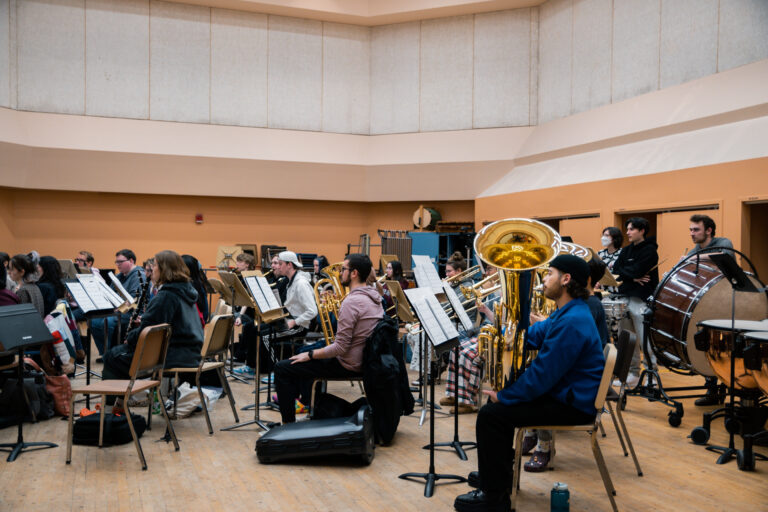
One of the best and most exciting of these events is the end-of-semester Ensemble Series, which offers the School of Music’s ensembles a chance to showcase their work to their family, friends, professors, and the general public. Seeing as our ensembles just took their final bows for the semester, let’s do a little performer recap!
Eda Lu: 2023 Concerto Competition Winner and Chamber Orchestra Soloist
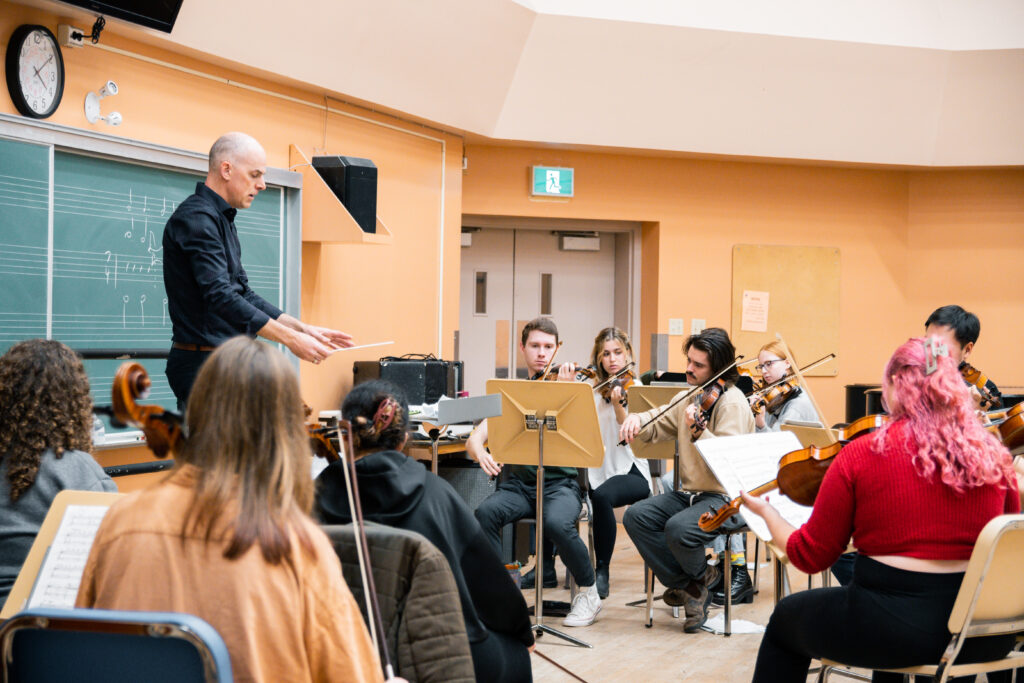
Chamber Orchestra (Photo credit: David Eguiguren))
Playing André Jolivet’s Flute Concerto No. 1 was certainly “a process” for Eda Lu, a 2023 graduate of the School of Music and the winner of that year’s MUN Concerto Competition.
When speaking about the work, Eda remarked that “the parts are crazy hard”, and that she’s been studying this piece on and off for over a year. “It’s tricky. It’s not like a Mozart concerto, there are a lot of tricky fingerings and a lot of tricky passages that aren’t exactly intuitive to the flute, so it was a process” she said, laughing. However, all the practice and study was worth it for Eda.
Though currently based in Montréal, she is glad to be home to perform alongside MUN’s Chamber Orchestra. “I haven’t been in the province for a while, so I really like interacting with all my old friends from when I was an undergrad. I really love playing with the orchestra. It was one of my favourite parts when I was here, playing concertos with the soloists.”
To put the cherry on top, this performance is also a full-circle moment for Eda. “It’s really cool that I’m now the soloist”, she said.
Christina Acton: Masters in Choral Conducting student and Featured Conductor of MUN Chamber and Festival Choirs
“The focus was always the choirs,” said Christina Acton, the Featured Student Conductor of Let My Love Be Heard, the fall concert for the MUN Festival and Chamber Choirs.
Now completing their second year of a Choral Conducting Masters degree, Christina knows their way around choral repertoire and leadership. Therefore, the most rewarding moment of their time with the choirs was not conducting for the packed house of the 200-seat D.F. Cook Recital Hall. Instead, when new students expressed their appreciation for the safe and welcoming space Christina had created in the rehearsal room, “that was the best feeling ever.”
“Seeing people who normally would not care about choir, smiling and laughing and having fun, I was like, yes, yes, yes!” they said with a fist bump. “Choir is fun, I swear, I swear!”
Their second most-loved moment? Introducing new choral repertoire to eager audiences. “Getting to introduce more people to these choral pieces that aren’t, like, super super well known is really exciting.”
Christina will perform their self-conducted graduating recital in choral conducting in February of 2024.
Nicole Lambert: Jazz Orchestra Voice Soloist
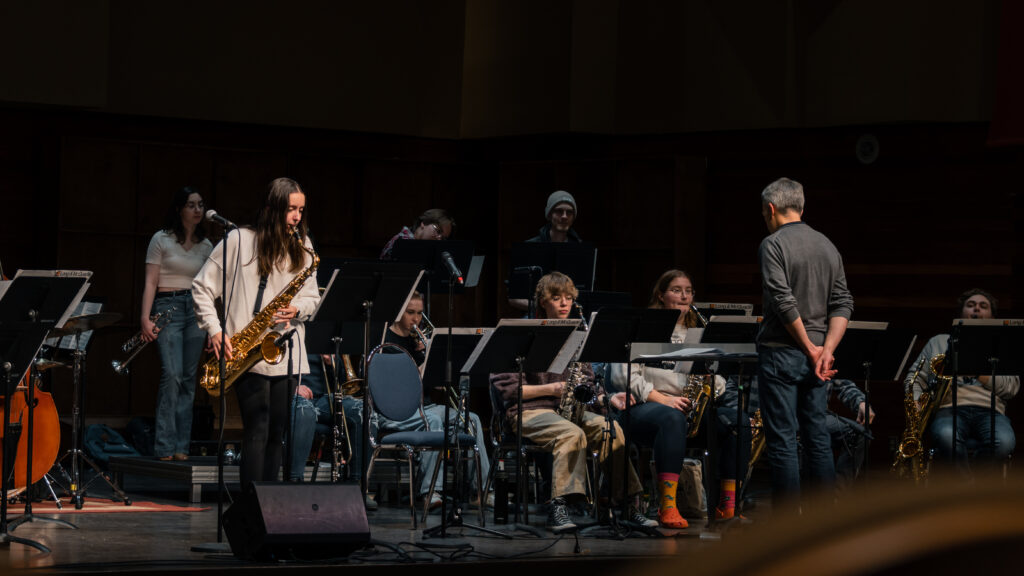
Jazz Orchestra (Photo credit: David Eguiguren)
Although Nicole has been singing jazz since her junior high days, her time as the Jazz Orchestra voice soloist was still full of learning.
“It’s not like classical at all, you have to completely rewire [your voice]” said Nicole, comparing the balancing of her jazz and classical singing to a kind of musical code-switching. Furthermore, training her ears was just as important as training her voice. When preparing to sing with the ensemble, Nicole spent as much of her practice time as she could familiarizing herself with this semester’s repertoire and the musical catalogues of the featured composers.
“My favourite part was being exposed to so many different composers… there’s a lot of trios I wouldn’t have come across, lots of material that I wouldn’t have found.”
Like Eda, Nicole found this work difficult but incredibly fulfilling. Recalling her first rehearsal with the ensemble in October of this year, she said, “I think it was about a month in, they put the vocals with the band and it was just, I was just really happy. I couldn’t stop smiling.”
Reanne Chapleau: Jazz and Wind Ensemble Trombone Soloist
Reanne is a Wind Ensemble and Jazz Orchestra veteran. She’s been a member of these ensembles since we started our degrees together in 2020, and she survived the proverbial dark ages (music school online), so catching up with her about the final fall concert of her degree was a big moment.
Her biggest takeaway from these ensembles? Community.
“[Wind/jazz ensemble] builds community with the faculty,” she said over the phone from her home in Ontario (we love a short exam season).
“We (faculty and students) come together twice a week throughout the entire semester, so it’s so rewarding to show everyone exactly what we’ve been working on and how much we’ve grown.”
The concerts are clearly a team effort, as “you feel close and connected because you just performed all your work together onstage.” Of course, the ensembles offer incredible learning opportunities in addition to community-building. When I asked her what stayed with her from her time with the groups, Reanne quickly and easily listed every lesson she’s ever learned, including but not limited to, “time management, ensemble awareness, ensemble etiquette, hard work, ensemble tonality, personal technique, tone improvement, aural distinction…” etc., etc. When I asked for a final quote about the groups, she offered, “I just love it.”
Clearly, the MUN Ensemble Series is the highlight of the semester for students. We love preparing our repertoire and love performing it for you even more. So, the next time you’re looking for something to do, take a look on the MUN Music website and find the next Ensemble Concert. We’d love to see you there, or even welcome you into the ensemble! Remember, all MUN Music ensembles are open to any MUN student who passes the (super relaxed) audition process. Get your next elective credit with us! See you soon!
Song suggestions/Listed music:
Orchestral
Flute Concerto No. 1, André Jolivet, 1949
Choral
“Ring Out, Wild Bells” from The Passing of The Year, Jonathan Dove, 2000
Esto les Digo, Kinley Lange, 2001
Sing, my Child, Sarah Quartel, 2017 (*see if you can find a video featuring the 700 person choir this piece was composed for!)
Jazz Ensemble
Orange Coloured Sky, Milton DeLugg and Willie Stein, 1950
Watch What Happens, Michel Legrand, Jacques Demy and Norman Gimbel, 1965
Mike Herriott is a Canadian classical and jazz composer and multi-instrumentalist from St. John’s, Newfoundland, whose expansive career led him to perform in many places across the world and collaborate with other notable musicians, from Maynard Ferguson to Michael Bublé and more.
Last month, Herriott released his first solo album since 2016, titled Tales of Tricksters and Vagabonds. In the meantime, Herriott worked on several projects with his wife, Ofra Harnoy, including Back to Bach in 2019 and On the Rock, a Newfoundland-inspired album, in 2020.
Herriott and Harnoy share quite the romantic story, first meeting in 1982 and rekindling their relationship after 35 years of separation. I have had the pleasure of interviewing Mike Herriott to discuss the new album, his creation processes, and the experiences that shaped him.
The creation process
Herriott prefers to dispel overly romanticized visions of work as a composer. “[I won’t be] sitting in my nightgown, smoking a pipe and drinking a martini, writing furiously on a piece of paper,” he explained humorously.
He emphasized the importance of academia in his creation process, as Isn’t Life Grand and Tales of Tricksters and Vagabonds were both born while he was working on his Master’s degree in composition at York University. All of the tracks featured on Isn’t Life Grand are the various assignments Herriott worked on over the course of his degree.
Before there was Tales…, there was Herriott’s thesis proposal.
A narrative perspective
His focus was on changing direction as a composer. His previous compositions were predominantly impressionistic, drawing on his interactions with his environment and his experiences, so, for Tales…, he challenged himself to approach composing from a narrative perspective, each piece telling the story of one character – the first two compositions, which he presented as his thesis, were Sir Jack and Rodion’s Republic, focusing on Shakespeare’s Sir John Falstaff, and Rodion Raskolnikov from Fyodor Dostoyevski’s Crime and Punishment.
Then, one day, as he and his wife were out on a walk, he mentioned his idea to expand this concept into a six-part suite, and so the album came to be.
Image credit: mikeherriott.com
Literary influences
To Herriott, Tales of Tricksters and Vagabonds is his way of reckoning with the unpleasant or unsavoury characters we may come across in our daily lives.
“Every character in this suite, they’re based on real people; they’re based on some experience that the author had that they had to get out of their system,” he explains.
The characters we read about may remind us of someone we know in real life, but on paper, they have no power or influence over us. For this reason, Herriott found himself fascinated by the more “off-kilter, to a certain degree antagonistic” iconic characters from folklore and literature.
Having already written about Falstaff and Raskolnikov, Herriott took to brainstorming together with Harnoy, to create a lineup of such characters that covers the whole spectrum between light-hearted mischief and genuine cruelty. Those other characters became Rumpelstiltskin, Puss in Boots, Romeo and Juliet’s Mercutio, and Uriah Heep from Charles Dickens’s David Copperfield.
Putting himself in the position of a narrator, Herriott drew both on the texts that the characters originated from, as well as on his own experiences, further illustrating the interconnectedness of reality and fiction.
“I see each character as a caricature of people I’ve known in my life, some personally, some that I’ve interacted with in other ways,” he expressed. Particularly, with Raskolnikov, he found himself inspired by the character’s false sense of self-righteousness that drew him to murder, which he compared to the personality of former U.S. president Donald Trump.
As previously mentioned, Tales… is also a project focused on changing one’s perspectives as an artist. Herriott detailed the ways in which he had to learn to think differently while composing. For one, the notion of conveying narratives in music, without the use of words, was initially quite a challenge.
“I felt like I had my professors standing over me, going, ‘Well, what’s that, then? How are you telling that part of the story?’ And I really had to shut that out,” he explains. Trusting the process was crucial to the album’s creation. “I had to get rid of the audience around me, I couldn’t progress with that in mind.”
Experiencing self-doubt
All artists, regardless of their level of experience, can struggle with feeling confident in their own work, especially when they’re trying to change their perspectives. What’s important is not to lose confidence and let yourself be discouraged by the inevitable setbacks during the creation process. Herriott admits that, currently, his favourite movement of the suite to listen to, Mercutio, was the one he had the most doubts about in the writing stage; it was only late in the recording process that he began to feel truly satisfied with it.
Herriott acknowledges the influence that his peers have had on him during the creation of the album. “In working with them, [I] spent a lot of time kind of getting inside their head. I’m always curious to figure out how somebody comes up with something that sounds so great, so I dig in to figure out all the elements,” he said.
Artistic influences
Among others, he listed Maria Schneider, Kenny Wheeler and Hugh Fraser as fellow musicians whose influences he can recognize in his own compositions.
However, Herriott is open to inspiration from a wide variety of sources. He mentioned drawing from Russian composers of the early 20th century, namely Igor Stravinsky and Sergei Prokofiev, as well as the band Steely Dan while composing Rodion’s Republic.
Herriott noted that in composition, similarities to other artists can often be inevitable, which can be a minor source of anxiety; to illustrate that, he recalled an anecdote wherein Kenny Wheeler was asked about how he felt when he would finish writing a piece of music. Wheeler responded that if he liked the composition, he would hope that no one else had written it yet.
Current and future projects
Right now, Herriott is working on promoting Tales of Tricksters and Vagabonds, as well as working on commissions. He takes delight in waiting for the right moment to take up another project.
“It could be next week; it could be three years from now,” he notes, adding that as a composer, you often have to “dig into [yourself]” to find the impetus for creation and that when life presents you with a reason to introspect and find inspiration within yourself, it makes the creation process more special. This philosophy seems to fall in line with Herriott’s subjective and impressionistic style.
Tales of Tricksters and Vagabonds is a light-hearted, whimsical album, a celebration of storytelling and a fundamentally interdisciplinary work of art. It’s also quite accessible; jazz can often be a challenging genre to casual listeners, but this album, just like the characters it represents, is classic and timeless.
The album was released just over a month ago, on October 27th, and is currently available on streaming platforms. Enthusiasts of physical media can also purchase the CD through Mike Herriott’s website.
We are about two weeks away from the end of the fall semester, and many students have expressed that this semester has been extra stressful, tiring, draining, maddening, or any other applicable adjective.
It isn’t unusual to feel burnt out as the semester comes to a close. For me, these effects really begin to sink in when daylight saving time ends and the sun starts setting before 5 pm, and I know many other students feel the same.
“I find the reduced daylight hours make it harder to maintain my energy and focus levels during evening study sessions,” says fourth-year biology student Erin Hopkins. “I find this shift disrupts my routine and adds an extra layer of difficulty to the semester.”
“I also typically find fall semesters more draining due to the adjustment of higher-level courses and the overall transition into the school year,” she says.
If you are feeling like this at all, know that you are not alone. The end of a semester is both exciting and terrible, but relief is just around the corner!
Combatting Stress
We are officially in the home stretch where it begins to feel like the assignments are never-ending, but there are ways to combat the stress of a heavy workload:
Scheduling
It is extremely beneficial to keep schedules, calendars, lists, planners, or anything that helps you stay on track with your assignments and other tasks.
This might seem like overkill, but keeping a physical planner and calendar, as well as a “Microsoft To Do” list, has really helped me throughout the semester. When I’m feeling especially burnt out, it helps to simply write or rewrite my to-do list to remind myself of what needs to be done.
Transparency
As students, it’s easy to forget that your professors were in your shoes once. No harm can come from being transparent with them about the stress you are experiencing.
Certain assignments allow for extensions, and you can always reach out for one where appropriate. Office hours are a great place to discuss with an instructor what you can do to improve and what you should be focusing on.
University can feel like a pressure cooker, and this often self-inflicted pressure may push you toward perfectionist tendencies. Transparency is key in these situations, and can really pay off.
Study Spaces
I tend to get antsy after studying in the same spot for over an hour or two and find it really helps to change things up. Go for a walk around campus, grab a coffee, or find a new spot.
I get the most work done in the single study rooms at the library, which are free to book at any time, and I gravitate to the UC or Jumping Bean if I’m feeling less productive, or just want to relax in between classes.
Sometimes campus becomes draining after a long day of classes, so you can always branch out to another study spot or cafe off campus, or simply just go home and sleep off the unproductivity.
Comparison
Comparison is a killer, and it can be hard not to compare yourself to others, especially during exam season. You should try to avoid this at all costs, everyone goes at their own pace, and your personal best will not always align with someone else’s. This goes further than just grades, if you are experiencing significant stress and another student isn’t, that’s completely normal.
Some people feel totally fine when they take 5, or even 6 courses, whereas other students struggle to take 3 during a semester. It’s important to go at your own pace and remember that everyone is different, every semester is different, so be kind to yourself as you navigate what’s best for you.
Resources
When things simply become too strenuous, it is never a bad idea to reach out for help.
The Student Wellness and Counselling Centre (SWCC), provides free, 24/7 virtual mental health support for MUN Students. Help is only a call or text away, you can contact them at:
1-844-451-9700 within North America
001-416-380-6578 outside of North America
If you are experiencing serious distress, you can contact the 24-hour mental health crisis line at:
Students from the Faculty of Education organized a public forum on Friday, November 24th. All attendees gathered in the education building to have an open discussion about the appalling conditions of the chairs in the faculty.
The discussion was mostly informal, with few planned speeches. Students, faculty, and staff were all present at the event, including some representatives from MUN administration. Other notable attendees included MUNSU’s Director of Student Life, the Dean of Education, and representatives from Facilities Management. While members of Memorial’s top administration, including President Bose were absent.
“My grandparents sat in these chairs.”
Among the key issues brought up by speakers and attendees was that the chairs at the university are well overdue to be replaced; with one student claiming that their “grandparents sat in the same chairs at MUN 50 years ago.” It has been revealed that the design has been in use since the 1970s and possibly the 1960s.
Another issue highlighted was the poor condition of the accessibility chairs provided by the Blundon Centre. According to one student, the accessibility chairs can cause those requiring them to “stand out and the chairs [don’t] belong in a modern learning environment.”
Financial woes
While unconfirmed, many students have speculated that the main reason for the chairs’ extended lifespan is budgetary constraints at MUN, highlighting the fact that while students sit in discomfort, the former president of the university spent thousands of dollars on a single table and chair.
The organizers also noted how when they complained about the chairs, their class was moved to a different location, and the students who had been using the classroom they were moved to, were then moved to the organizers’ original room with the original chairs.
University-wide issue
Students from across the university have chimed in over the past week about Memorial’s deplorable seating as well. If you have issues with the chairs available in your classes, students are encouraged to reach out to their instructors, deans, department heads, and university administrators.
The Muse recently had the opportunity to interview President Bose, getting answers on important university affairs; with a focus on transparency in hiring processes, housing and infrastructure concerns, student activism, and the Auditor General’s report.
Presidential search
Dr. Bose has been appointed to the position of president for a two-year term or until the next president is recruited.
While President Bose is not involved in the presidential search process, as it is led by the Board of Regents, he states “As president, one of my commitments is to prioritize leadership searches for roles that are currently occupied on an interim basis.”
Filling interim dean and senior exec positions
With numerous interim dean and senior executive positions vacant, we asked President Bose what progress has been made to fill these roles.
“The search for the vice-president (Grenfell Campus) recently concluded with Dr. Ian Sutherland as the successful candidate,” says Bose, “The search for the next provost and vice-president (academic) is in progress.”
He adds, “The new Dean of Education, Dr. Pamela Osmond-Johnson, will start Dec 1. Searches for four other deans are currently underway: Social Work, Human Kinetics and Recreation, Business Administration and Graduate Studies. Four other decanal searches are about to start; their search committees are being finalized. These four are Nursing, Science, Music and Medicine.”
Housing concerns for new and returning students
A lack of housing infrastructure and a rising cost of living resulted in many students struggling to find housing at the start of the semester.
When asked how the university is responding to this growing concern, Dr. Bose says, “Memorial is aware that students across the country and internationally (e.g. Australia) are having a hard time finding affordable rentals near their university, and Memorial is no exception.”
“To respond to this challenge, near the start of this semester, the university formed a Housing Issues Management Team to resolve emerging housing needs and engage in long-term planning on this topic,” he explains, “The team consists of staff from ten units at Memorial who intersect with students, and representatives from Marine Institute and Grenfell Campus as well.”
The findings from the Housing Issues Management Team are to be shared with the President’s Executive Council this month. Dr. Bose shared the following examples of how they assist with housing issues:
A partnership with local hotels to help situate students until they find rentals.
A new graduate wing was established in Paton College to house twenty graduate students.
An online form connected people in our community who have a room to rent with students looking for a rental.
Graduate students had the option to start their programs online, and move here when they found a place to rent.
The Internationalization Office worked with new international students to complete an intake form before the students arrived. This includes a checklist of questions to ensure they have secured a place to stay before arriving.
If an international student has followed arrivals protocols, Memorial staff greet them at the airport. At this time, the greeters provide assistance to a student in getting to their accommodation and help them troubleshoot temporary accommodation needs.
Professors asked to house incoming students
At the beginning of the fall semester, Memorial’s faculty and staff were requested to consider renting their available spaces to incoming students.
Following the request, MUNFA released a statement stating “We see this request as a blatant attempt to download the city’s housing crisis and the cost of living crisis facing students onto the backs of faculty and staff.”
President Bose states that this request was not an emergency measure specific to this semester.
“For St. John’s Campus, the Internationalization Office regularly sends that email to faculty, staff and pensioners. It’s been a practice for some time now, and is seen as a mutually beneficial arrangement. Grenfell Campus did the same this semester. The arrangement provides rental income for those with space available and rental space for students looking for something other than residences or what is available on the rental market.”
Infrastructure concerns
Concerns have been raised over the years by faculty, staff, and students regarding the worsening infrastructure on campus. Ceiling tiles that are crumbling, rats spotted on campus, and questions surrounding the fear of asbestos have persisted.
“Memorial is continually monitoring and addressing infrastructure concerns on its campuses,” states Bose.
He explains that “The following deferred maintenance projects have been approved by the Board of Regents to be funded in 2023-2024: deferred maintenance projects, and there are ongoing major and minor capital projects and a preventative maintenance program as well.”
One project mentioned is “an Energy Performance Contract (EPC) with Honeywell,” which “funds campus infrastructure improvement in 75 buildings across the St. John’s and Grenfell campuses through energy savings. It focuses on energy-efficient solutions designed to upgrade facilities, reduce operating costs, improve indoor air quality and reduce environmental emissions. This contract will see guaranteed cumulative cost avoidance to the university over the 20-year term of almost $53 million. $11.5 million has already been realized and this EPC has reduced greenhouse gases by approximately 1,634 tonnes each year since 2020.”
Rooms shut down in old science building
The start of this semester found students and faculty in the old science building confused as they noticed rooms they had previously occupied are now closed under lock and key.
“Eight to ten classrooms in the old Science building are no longer in use since the bulk of the building’s previous occupants moved to the new Core Science Facility, explains Bose, “This was a matter of operational efficiency and keeping costs down. Because most labs are now taught in the newer building, it was determined that 10 classrooms, specifically those in the least desirable condition, could be terminated as classrooms without impact.”
“Additionally, following completion of testing and swabs by Environmental Health and Safety to ensure labs are safe to use for other purposes, Facilities Management is in the process of decommissioning and cleaning labs no longer in use,” he says.
With concerns raised about asbestos and questions left up in the air, Bose affirms “There is no known cause for concern about asbestos, and hazardous materials were not a factor in the closing of any rooms in the Science building. The university has an asbestos management program to monitor the condition of our asbestos-containing materials as well as avoid disturbing them.”
Exclusion of BA students in recent career fair
Bachelor of Arts students have raised concerns following this year’s career fair stating that the overwhelming desire from employers for Bachelor of Science graduates left them feeling inferior and concerned about their job prospects following convocation.
“While Memorial hosts the Career Fair and welcomes employers to participate, the employers themselves identify which types of employees they will be recruiting,” explains Bose, “That said, Student Life does strive to bring a diverse group of employers to the Career Fair every year. This year, over 50 employers indicated that they were seeking to hire those with a Humanities and Social Sciences degree. With this feedback, we will continue to invite a diversity of employers to future fairs.”
Day of Action
On November 8th, Memorial students held a Day of Action in response to rising tuition fees.
President Bose commented on the decision made by students to rally together for more affordable education saying, “The university understands and respects its student community advocating for the best interests of students. Finding your voice and values is a vital part of the student experience.”
Transparency and accountability
With a heavy focus on transparency and accountability, we asked the President what progress has been made to ensure that Memorial’s students, staff, and faculty are kept in the loop on important university affairs.
President Bose says, “Firstly, I would say I am always happy to answer student questions through the university’s student newspaper as we’re doing here, so that students never feel out of the loop. Sometimes, people make assumptions rather than ask questions. I invite questions! I would also encourage students to check the Gazette for regular updates on university matters.”
He cites two examples:
Memorial recently announced it is moving away from its use of executive search firms for executive positions. Roles within the Department of Human Resources have been redeployed to support executive searches. Moving forward, Memorial will only use an executive search firm if the search committee for a position requests that approach, and the President’s Executive Council approves it. There are currently no searches proceeding with the use of a search firm.
The President’s Executive Council, mentioned above, is a recent change I have instituted to foster improved and more collaborative decision making at the university. Previously, Vice-Presidents advised the president on matters, but with a newly established President’s Executive Council, all vice-presidents are more actively part of the decision-making process. You can read more about these changes in this Gazette article, which also discusses the newly formed Senior Leadership Council. The intention of these two new councils is to improve transparency, collaboration and the flow of information to the university community by involving key leaders in discussions and decision-making processes.
Response to auditor general’s report
Following the release of the Auditor General’s report, we asked President Bose if the university is taking full accountability for the results of the report and how they will be responding to issues raised.
“The university has accepted the recommendations detailed in the AG Report, says Dr. Bose. “As President, I will continue to work with the board to ensure the recommendations are addressed appropriately and the conditions for success within the Canadian university sector continue to be met.”
“Over the last several months, the President’s Executive Council and Board of Regents have been focused on enhancing transparency and improving operations. Since the audit period, there have been significant changes at Memorial, and we are already working to address the concerns that have been raised.”
These changes include:
An increased focus on policy development and renewal that will address the instances of overspending highlighted in the report. Since December 2022 four policies have been approved by the Board of Regents. There are currently 13 policies in some stage of the review process with several more coming through the pipeline.
A new travel request approval process has been approved for Memorial’s president and vice-presidents. Travel requests for vice-presidents must be approved by the president and travel requests for the president must be approved by the chair of the Board of Regents.
Performance management for executives will be a priority moving forward. Performance objectives are built into the new president’s contract. Similarly, the current president has implemented a structured review process for all vice-presidents.
The Budget Office has implemented a more comprehensive monthly reporting structure for units.
Changes in the Department of Financial and Administrative Services will ensure a more robust focus on key financial processes at both the executive and board level.
More detailed financial updates will be provided to the Board of Regents to inform its oversight and decision-making.
Work has begun on a new budget model for the institution, with transparency at the core. This will progress over several years and will start with a tuition attribution model to academic units.
What actions will the university be taking to align with concerns raised about admin costs per student being higher than other similar universities?
“‘Administration’ also includes academic support services, including those that support online learning, graduate students and the research mission of the university,” says Bose, explaining that “there are three primary reasons why administrative cost per student looks so different at Memorial.”
These reasons are as follows:
Memorial is a comprehensive university with a medical school, which is an unusual structure. Most medical/doctoral universities have large overall student populations that Memorial does not have. There are high costs associated with a medical school coupled with a relatively small enrollment (about 500 students) which can skew cost per student.
The Marine Institute offers diploma and certificate programs, which are excluded from Stats Canada student enrollment numbers, yet the operating expenditures for the Marine Institute are included. This skews the data.
Finally, as the only university in the province, there are costs associated with maintaining a province-wide presence.
He concludes by stating “At the same time, it’s important to acknowledge that the proportion of Memorial’s operating budget that is allocated to administration (11.8%) is similar to that of comparable universities.”
With a continued emphasis on transparency and accountability, students, staff, and faculty at Memorial University can only hope that the university will follow through and continue to speak with and get input from the campus community about ongoing concerns and solutions being implemented.
Editor’s note: Special thanks to President Bose and the administration for taking the time to speak with The Muse.