2025 is shaping up to be yet another fantastic year for music, and local releases are no exception.
As we go in to summer, there will be a variety of shows, and many artists are gearing up to release music soon. We highly recommend checking out some local musicians, there’s lots of talent in this little province of ours, and surely something that will appeal to everyone. Here’s what The Muse listened to this May – from St. John’s and beyond.
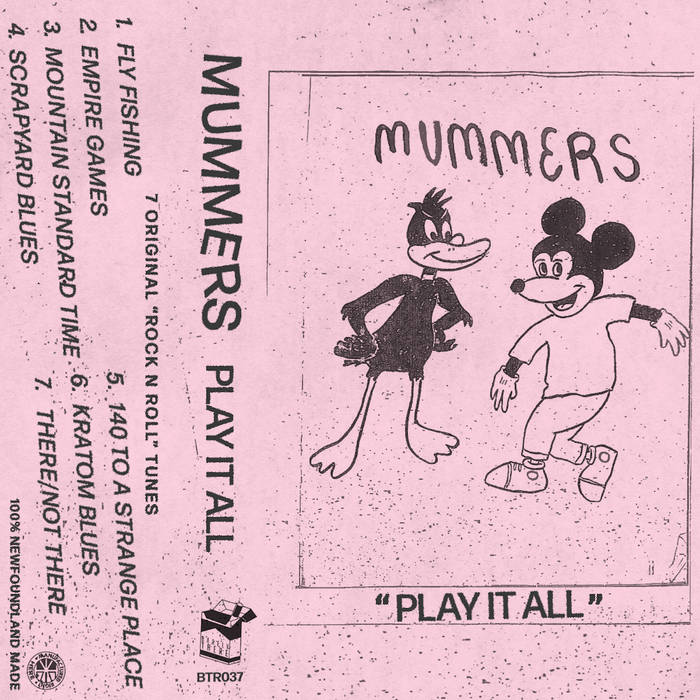
The 3 piece self-proclaimed “egg punk” band dutifully named after the iconic symbols of Newfoundland heritage released their first full-length LP titled PLAY IT ALL on April 18. This wonderfully fuzzed-out record is lo-fi and heavily distorted, hosting a plethora of delightful references to Newfoundland culture with songs like “FLY FISHING” and “SCRAPYARD BLUES.” It’s continuously interesting to see how musicians include allusions to Newfoundland culture within non-traditional genres.
Short and sweet, spanning only 12 minutes with 7 tracks, PLAY IT ALL is a majorly fun listen. Consisting entirely of songs played live at shows around town, and Lawnya Vawnya last year, the record has all the appeal of classic St. John’s punk and then some. Out now on streaming for listening that isn’t confined to live shows – though you should still go see them live!
It’s looking like it’s going to be a punk rock summer folks.
Flight Song Cover Art (via The Fencesitters’ bandcamp // art by @whereismylostdog on Instagram)
The Fencesitters designate themselves as “indie rock made by some people in the world in a country in a province in a city that as far as you know doesn’t exist” – that city being St. John’s.
Their most recent single Flight Song, details the terribly relatable sentiment of trying to book plane flights to visit friends abroad while facing skyrocketing prices and total economic upset. As a fellow broke student and avid airport hater, I agree with The Fencesitters, “they cost too much money, and I don’t know how else to get there!”
The breakdown in the middle of the song is eerily reminiscent of my feelings when a few colleagues and I got stranded in Toronto after multiple flight cancellations.
Released May 1, “Flight Song” is the second single from their upcoming album Picture Day, to come out later this year. The band’s name references the idiom which means to be hesitant or indecisive, most of their songs explore similar themes of uncertainty and variability.
Inspired by indie sweetheart Alex G, and drawing on the lead singer’s experiences living between Newfoundland and the United States, the band beautifully represents the daunting ambiguity that accompanies one’s early 20s.
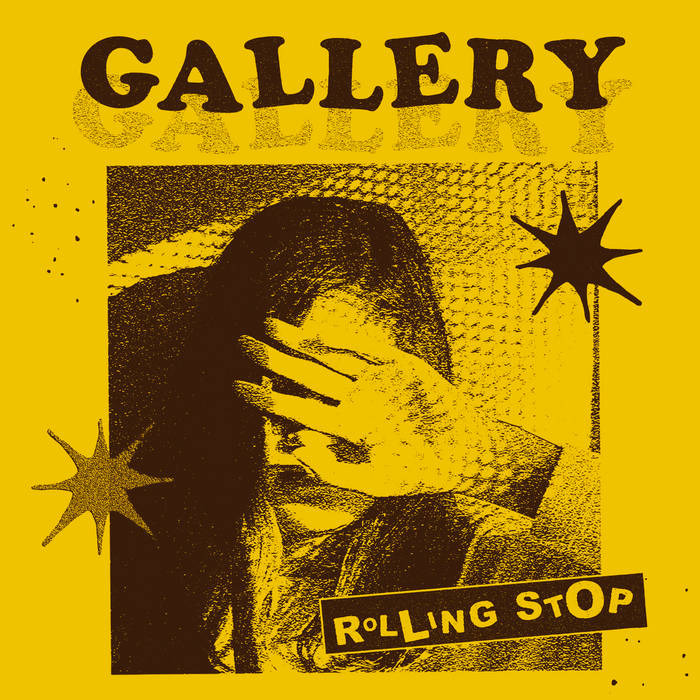
Frontman Nick Corcoran’s strong writing and overall artistry is commendable and is supplemented by tastefully warped instrumentals, Rolling Stop is a near–perfect shoegaze EP. Is shoegaze back for real? I think it’s safe to say yes.
Everyone’s favourite femme-fronted garage rock band has released the first single Never Change from their upcoming debut LP, set to come out at the end of this month. The song reads as the singer seeking reassurance, and finding comfort in consistency, while struggling with uncertain emotions.
Little Fauna will be performing at this year’s Lawnya Vawnya alongside Calgary garage rock band Miesha and The Spanks, and New Brunswick’s Penny and the Pits, the solo project of Penelope Stevens from acclaimed NB rock band Motherhood. It’s bound to be a great show, and lots of folks, myself included, are excited to hear the new Little Fauna songs.
There are also a few notable non–local recent releases that have been on repeat in The Muse office lately.
Released April 4th, this genre-defying album is densely packed with pop culture references, sampling Sonic games – most notably Mario & Sonic Olympic Winter Games – Fortnite, Pokemon, and even WiiU sound effects. Nostalgic for any 2000s kid who grew up on the respective games, and an overall very cool record that mixes hip hop, emo, hyperpop, rap, and EDM.
Revengezeekerz starkly contrasts Jane Remover’s last album Census Designated, and it’s an entirely unique record, you’re hard pressed to find anything else like it.
This all trans indie-punk band dropped their (kind of) self titled debut LP Um Comma Jennifer Question Mark on April 25. The record preaches to a fictional godlike figure referred to as “Jennifer,” presumably representing the cis-heteronormative standards relentlessly pushed on trans people.
A portion of the songs explore themes of queer joy and resistance against oppressing your own identity to appease others. Detailing the duo’s multifaceted trans experiences through matter-of-fact lyricism tinged with humour, and slightly punk-inspired instrumentation, this record is unapologetically queer, and simply, quite fun.
What are some recent releases you’ve been listening to lately? Share with us on social media @themuseyyt!
Lawnya Vawnya is a local non-profit organization focused on multidisciplinary artists and independent musicians. It hosts artists in residence year-round as well as an annual festival, putting in its dues to keep creative circles in the province alive and well. Running from June 4th-7th, this year’s festival will mark its 15th consecutive year of operation.
This year’s schedule is absolutely jam–packed with musical performances from both local and out-of-province artists, workshops, panels, film screenings, and a merch and print fair. The best part? A lot of the events are free or all ages. So if you’re a broke student you can still attend the festival and support all kinds of Canadian creativity.
Ever Deadly, a film collaboration between Chelsea McMullan and Tanya Tagaq will be screened online all day. This screening is all ages, however it should be noted that the film depicts sensitive subject matter.
A documentary detailing the expansive musical career of Tanya Tagaq, “Ever Deadly” explores Indigenous culture and identity, and overcoming trauma while being an artist.
Madeleine Thien and Marlaena Moore will be at Bannerman Brewing Co. at 6:30pm for a reading of Thien’s work, accompanied by endearing bedroom-pop performed by Moore. This event is 19+ with a $10 cover fee.
Hosted by drag performer Eda Kumquat, bands Swimming, Absolute Losers, and Book Club take on Gower St. United Church for a night of fantastically intricate noise, pulling inspiration from math rock, midwest emo, post-punk and shoegaze genres starting at 8pm. This event is all ages with a $15 cover fee.
Thursday, June 5
To start off the second day of the festival, a free all ages comic workshop hosted by local artist Elijah Janka will be held at Eastern Edge at 1pm, followed closely by an all ages film screening of HOME TV and Q&A from queer film collective IWant2BeOnTV at 2:30pm.
That evening, see enigmatic duo Beverly & Elizabeth Glenn-Copeland, and Topanga at First Light Centre for Performance and Creativity for an intimate showcase of thoughtful tunes inspired by the sounds of jazz, indie, synth and theatre. This event is all ages with a $30 cover fee, starting at 7pm. Please note that masks are required.
At 9:30, head to The Ship Pub for the musical stylings of art-rock sweetheart Sasha Cay, singer-songwriter Marc McLaughlin, and St. John’s favourite bilingual rock outfit, Liz Fagan Band. This event is 19+ with a $15 cover fee.
‘Food Fight’ poster by Charvel Rappos// @dofusnark on Instagram
Friday, June 5
Kicking off Lawnya Vawnya’s third day is a free all ages downtown music crawl, starting from Solitude Vintage (181 Duckworth St.) at 12pm.
Following the music crawl is a free all ages panel on Producing Music Videos, focusing on managing engaging narratives, marketing and varying budgets, hosted in the Alt Hotel’s Cyan Room at 3pm.
At 4:30 in the same room there will be a free all ages workshop hosted by producer and DJ Cleo Leigh, focusing on live mixing, and explaining introductory principles of electronic music for beginners. This workshop is part performance and part tutorial.
At 6pm, still in the Alt Hotel’s Cyan Room, attend Riddle Fence’s Issue 54 Launch, hosted by Canadian Writer Sharon Bala, featuring readings from various featured Lawnya Vawnya artists and musicians. This event is free and all ages.
At 8pm, head over to The S.P.A.C.E. at Eastern Edge for a Food Fight! Just kidding, no food will be thrown, but IWant2BeOnTv is presenting a battle of the bands in support of rampant food insecurity felt across our country. See Rad Gushue, Andy and The Dannys, and Ratt & Ratt face off in an epic musical battle.
The ‘food fight’ will be livestreamed across Canada and viewers are encouraged to donate in support of the cause. This event is all ages with a $10 cover fee, or free admission if you bring a non-perishable food item to donate.
9:30pm at The Rockhouse, hosted by \garbagefile, there’s a fantastically vibrant hip-hop showcase featuring Cartel Madras, Fraud Perry, and Albert Dalton you can see for $25 if you’re 19+.
If rap isn’t your jam, head to The Ship Pub with $15 at 9:30 for some femme-fronted garage rock from Miesha and the Spanks, Penny & the Pits, and Little Fauna.
After that, at Oiche club back on George St, tune in for some dynamic electronica and dance music by Liftkit, Cleo Leigh, and QUIN, starting at 11pm with a $20 cover fee. This event is 19+.
Saturday, June 7
The final day of the festival presents many free, all ages workshops and panels, such as:
“Releasing Records in 2025,” presented in the Alt Hotel’s Cyan Room starting at 12pm
Ableton Live recording workshop presented by Joe Fowler in the Alt Hotel’s Green Room at 12:30pm
‘Marketing “The Self” as an Artist’ workshop presented by Foreignerz, an art collective driven by underground scenes and authenticity. Alt Hotel Cyan Room, 1:30pm.
‘Wired For Sound, Rooted In Community: Building Artistic Careers Beyond Your City’ is to be hosted in the Cyan Room as well, starting at 3pm.
You can also visit the “Phonoautomat” at Eastern Edge from 12pm-3pm, an innovative project by Jake Nicholl that’s like a photobooth but with sound that you can take home on a cassette.
At 3pm, turn up to the Baird Building Garage for a free all ages punk show, in the garage, of course. See a variety of hardcore subgenres from Life Crisis, Durex, Snitfit, and Cell Deth.
See Bus People, Mantourage, and Steel Toe at The Ship Pub for a variety of genres such as new wave, folk rock, and power pop starting at 8pm. This event is $15 and 19+.
If that’s not your vibe, the Rockhouse is offering an equally stacked lineup, featuring Julianna Riolino, Laughing, and Andrew Smith Band, hosted by local drag performer Irma Gerd. This event is 19+ with a $25 cover fee.
To end off an absolutely fantastic 15th iteration of Lawnya Vawnya, make your way over to Oiche for another electronic set from Overland, Frankie Teardrop, and NANCY MUSIC, starting at 10:30pm. This event is 19+ with a $20 cover fee.
A merch and print fair will also be at Eastern Edge from 12pm-4pm on Friday June 5, and Saturday June 6. Including the festival’s own merchandise, band merchandise, and pop-ups from local creative organizations such as Riddle Fence, St. Michael’s Printshop, and even some visual artists and tattoo artists.
Visit Lawnya Vawnya’s Instagram page or their website for more information or to purchase advance tickets, or a festival pass, and look out for The Muse team at some festival events!
Student representatives from CFS-NL, MUNSU, and the Grenfell Campus Students Union, expressed their disappointment in the Board of Regents over a vote to reject a pause in planned tuition increase.
The Board of Regents was tasked with deciding whether to pause the 4% increase on tuition for the 2025-26 academic year. While some student activists expected a freeze on tuition after the provincial government halted cuts to the Tuition Offset Grant, the Board of Regents declined to do so.
In a press release, CFS-NL Chairperson Nicolas Keough called the decision “ridiculous” and “insulting to students’ intelligence.”
“Memorial’s argument that they ‘didn’t receive direction’ on how to use the Tuition Offset Grant is ridiculous and is insulting to students’ intelligence.”
Keough argued that the university’s stated lack of direction on the grant was ironic. “The government shouldn’t need to tell you that the Tuition Offset Grant is meant to offset tuition – it’s literally in the name.”
MUNSU’s Director of External Affairs, Nathan Gillingham, stressed the economic hardship faced by students at the time of this decision. “It’s disheartening to see the continued effort to price students out of post-secondary education,” said Gillingham.
Suggesting that the move will negatively impact enrolment rates, Gillingham argued that MUN’s mandate directs the university to provide “accessible education and economic opportunities to the community at large.”
“This decision today is a contradiction to this initial mandate,” said Gillingham.
Adding to the criticism, GCSU President, Tyson Jesso, called for the provincial government to intervene. “We need to see the provincial government step in and force MUN to use this money in a way that doesn’t put the burden on the backs of students,” said Jesso.
Jesso also argued that just recently, during the Fall semester, the province’s Auditor General criticized the university for misusing the Campus Renewal Fee, contextualizing student frustration with the university’s utilization of the Tuition Offset Grant.
Memorial responds to student leaders’ reactions
In an email to the Muse, Memorial spokesperson Courtenay Griffin says that
“The Board of Regents decided the $13.68 million one-time pause in [cuts to the] the tuition offset grant is to be used to invest in critical strategic investments, such as recruitment and retention, student engagement and technology to ensure that Memorial is a more efficient, sustainable and learner-centric institution.”
The Muse will continue coverage of this story as it develops.
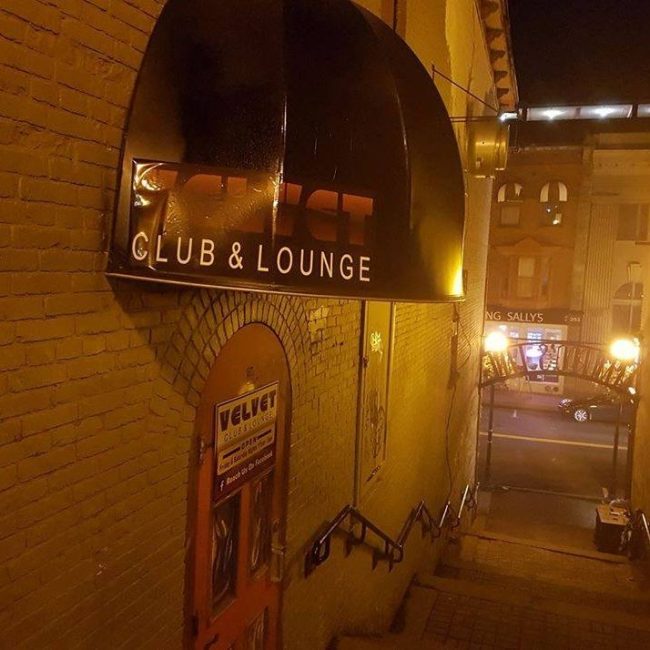
February 8th, 2025 was the last day of operation for Velvet Club & Lounge, St. John’s only remaining gay bar since the closure of Kaleidoscope in 2023.
St. John’s has had an ebb-and-flow of openly queer bars since the 1970s, but there has usually been at least one functioning at any given time amidst small gaps between closures and re-openings. Right now, St. John’s is left with no establishments for 2SLGBTQIA+ centered nightlife once again. The closure and rebrand of ‘Velvet’ as ‘Junctions’ has sparked many vital conversations about queer spaces, artist labor, and safety.
The Muse asked some St. John’s residents for their thoughts on queer spaces in our city.
Velvet closure and rebrand
A beacon for queer nightlife in St. John’s, Velvet served as a tangible meeting point for people of all genders and sexualities, and operated as the city’s main venue for drag performances since 2012.
The club garnered criticism after Canada’s Drag Race contestant and local performer Tara Nova revealed that drag performers at the venue only got paid $37.50 per performance. Another contestant on the show, Xana, says she receives a $200 flat rate in Vancouver venues.
It is understandable that the rates in St. John’s are lower, since it’s a smaller city with less demand for performers. However, viewers felt that $37.50 for work as physically demanding as performing was much too low – not to mention the expense of the costumes, wigs, makeup, shoes and other things generally necessary for drag.
In lieu of this controversy, Velvet canceled events organized by Tara Nova. Her revelation on the show had wide-ranging media coverage, and drag fans, both nationally and provincially, were not pleased with this development. In a wondrous display of community, people fiercely advocated for Tara Nova, supporting her in locating new venues speaking out against the mistreatment she received.
Following its closure, the club had plans to rebrand to its former name, ‘Junctions,’ and projected a shift to more varied performances such as stand–up comedy, live music, and DJs. Owner Luc Viau stated that Junctions would still host drag performances, but it seems unlikely that local performers will frequent the establishment given Tara Nova’s experiences.
Velvet reopened as Junctions on February 22, 2025 with a few DJ nights, but attendance rates were varied.
While this closure initially hit the drag community quite hard, especially from a job security standpoint in terms of a regular performance venue, performers seem to be making do with a host of events at various other venues in the city. There are also a few other notable queer spaces in St. John’s like Quadrangle and Intersections, as well as pop–ups organized by Queer Picnic St. John’s, but in terms of a designated gay bar, Velvet was it.
Some community members have expressed grievances about the club and additional concerns about participating in downtown culture and nightlife.
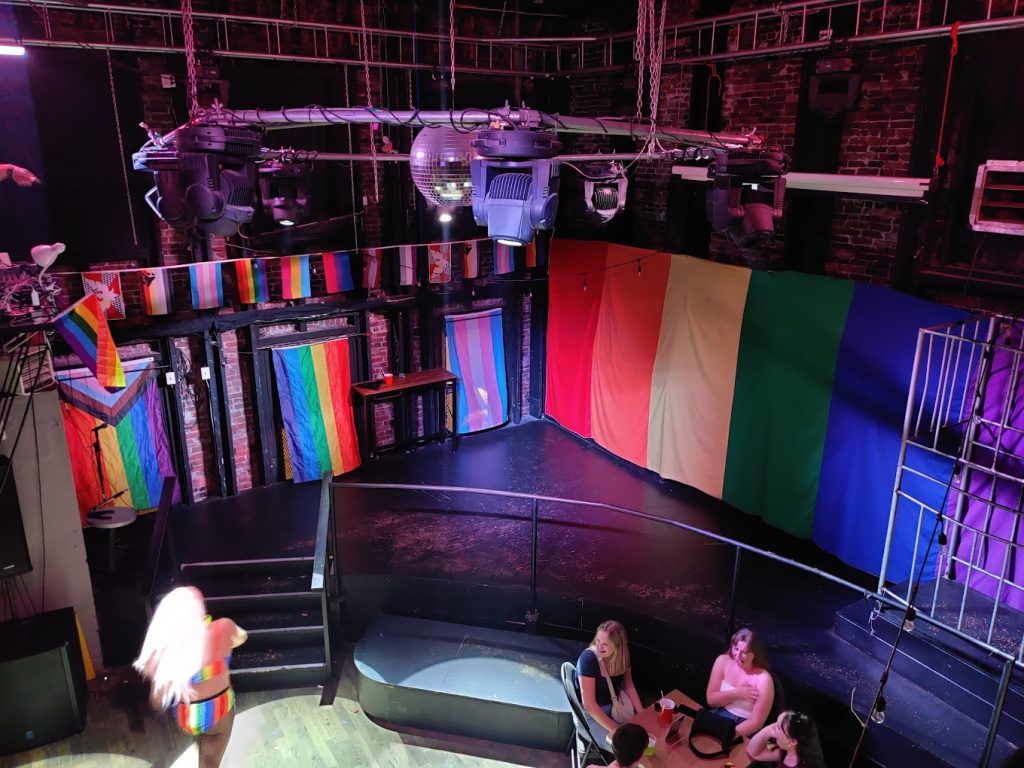
Velvet’s stage (via Facebook)
What this means for the queer community in St. Johns:
Some 2SLGBTQIA+ St. John’s residents gave their thoughts on the bar, its closure, and predictions for future queer spaces in the city.
Local trans rights activist and musician Aramaria Yetman said that “[the bar] is controversial in that the people who ran it weren’t queer themselves. They weren’t a part of the community and if they were it was not to my knowledge. It very much did feel like they were profiting off of queerness.”
She went on to cite her own experiences as a transgender woman, she said that in her opinion “trans women never really felt safe at Velvet to begin with…Velvet has always been something I have not seen as home. It was more home for the drag community and I think it was really important to them.”
Yetman emphasized the strength and resilience of the queer community in Newfoundland, saying that “we were here long before Velvet and we’re going to be here long after Velvet… We’re not a part of Velvet’s history, Velvet is a part of ours.”
She urged any prospective venture seekers to prioritize trans inclusion, by “[being] vehemently trans and queer. Accept queerness, don’t hide it. Don’t try to appease people that don’t like you.”
Morgan Moakler-Jessiman, a queer community worker, burlesque performer, and former Kaleidoscope employee offered their commentary on the bar’s rebrand. They recounted concerns surrounding bar operations and management during past performances at Velvet.
There appeared to be significant issues of infrastructural decay and privacy, with performers’ dressing room doors lacking proper locks, boundaries being consistently overstepped, and rodent sightings.
“When we create queer spaces it’s really important to focus on safety, but while we focus on safety we can be providing joy. Joy can be a driving force,” they said.
St. John’s resident Joseph Kade, a gay and trans man originally from rural Ontario, cited his first Velvet experience as something special, especially since frequenting George Street previously. “I loved seeing a bunch of people be authentically themselves without having to check their shoulder or be scared to talk to the wrong person,” he said.
“The rest of the times that I went to the club I had great experiences too, with the queens, staff, and patrons. I got to talk to an older queen from an outport community who was very sweet, and she talked to me about how no one in her life knows she does drag. It made me feel grateful and bittersweet.”
Kade discussed the stark differences between George Street and queer nightlife spaces like Velvet, opening up about negative experiences on George when he and his boyfriend went together, leading them to pretend to be friends at the bars out of fear of harassment or assault.
“It’s strange,” he noted, “because we just seem like buddies on George Street when in every other aspect of our lives we are lovers, and in Velvet we could be just that.” He acknowledged that not everyone had the same positive experiences at Velvet, but it evidently meant something to the queer community in St. John’s.
Given the current political climate, some people seem to have a quite pessimistic outlook, worrying that the gradual disappearance of queer space seems to be looming.
Recent Controversy
In an Instagram post, Junctions announced their annual Fetish Night, a yearly event that was highly anticipated and always saw a fantastic turnout when they functioned as Velvet. This was met with immediate backlash from the community, and people expressed frustration towards the establishment attempting to profit off of queer people in lieu of underpaying drag performers and, as many people say, “exploiting the community.” The posters were taken down shortly after.
Re-posted screenshots were shared around Instagram with the added tagline “allyship is not transactional,” and many community members urging folks to boycott the bar in protest.
The Muse contacted bar owner Luc Viau for his comment, but received no response.
(Fetish Night Posters//via Velvet/Junction’s Instagram)
Future projections
St. John’s is a relatively queer place – in fact, the metropolitan area has one of the highest rates of transgender people in the country. The city will likely have another queer center for nightlife at some point, it is just a matter of when.
Regardless, it will be interesting to see how the atmosphere of future spaces would differ compared to Velvet. Queer Newfoundlanders are hoping for an overall more welcoming space, especially for non-cisgender people, but in the meantime folks can support existing community-based organizations, and prioritize safety if they do choose to participate in nightlife.
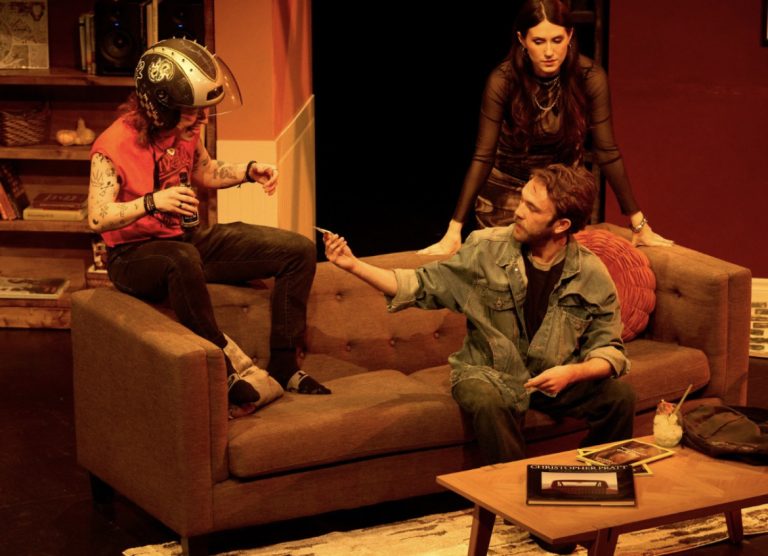
Have you ever had a quarter-life crisis? Well, so has Cole Hayley, and his experimental play exploring this, There’s Nothing You Can Do, presented at the Resource Center for the Arts Theatre LSPU Hall from May 7-11.
Written by playwright Cole Hayley, directed by Chelsea Dab Hilke, scored by a variety of St. John’s bands, including CUERPOS who wrote two original songs specifically for the play, and a cast brimming with local talent, There’s Nothing You Can Do is an entirely unique piece that is staunchly affectionate towards local creative scenes. The play tells the story of a group of recently reunited friends, all at different stages in life – but all experiencing that classic mid-20s existential dread – who get infected with a dancing plague.
Cole Hayley is originally from Elliston, Newfoundland. An alumnus of the National Theatre School and long-time writer, he’s worked on a plethora of projects over his creative career, but this one is particularly special. He cited it as “a play I could have only written at a specific time in my life, and I’m very happy that I managed to find it.” Though Cole Hayley was living in Montreal when the show was conceived, it is a play “born out of St. John’s.”
Inspirations + Creative Process
There’s Nothing You Can Do riffs on that “existential crisis” anxiety, using a metaphor of a dancing plague to explore the discordant crossroads the characters each find themselves in at a collectively uncertain time in their lives. Hayley credited the COVID-19 pandemic and the idea of the quarter-life crisis as inspiration for the play.
“I think a lot of people, for the first time in a long time, had a chance to pause and really consider their lives and reconsider what they want… Then I was reading about this dancing plague in Strasbourg [France] and it just seemed like the appropriate metaphor for not just the fact that we just went through an actual pandemic, but the main theory as to why these people were dancing in Strasbourg is because they were going through mass hypnosis because of huge amounts of stress they were feeling [following the Black Plague].”
A person’s early twenties are a tumultuous time, some of us are trucking through post-secondary, some people are travelling, getting engaged, married, having children – there are a lot of different life stages happening at once and it can feel incredibly jarring to watch others achieve milestones when you are uncertain what you might want, or perhaps if you imagined things might be different by now. These feelings are what There’s Nothing You Can Do aims to capture.
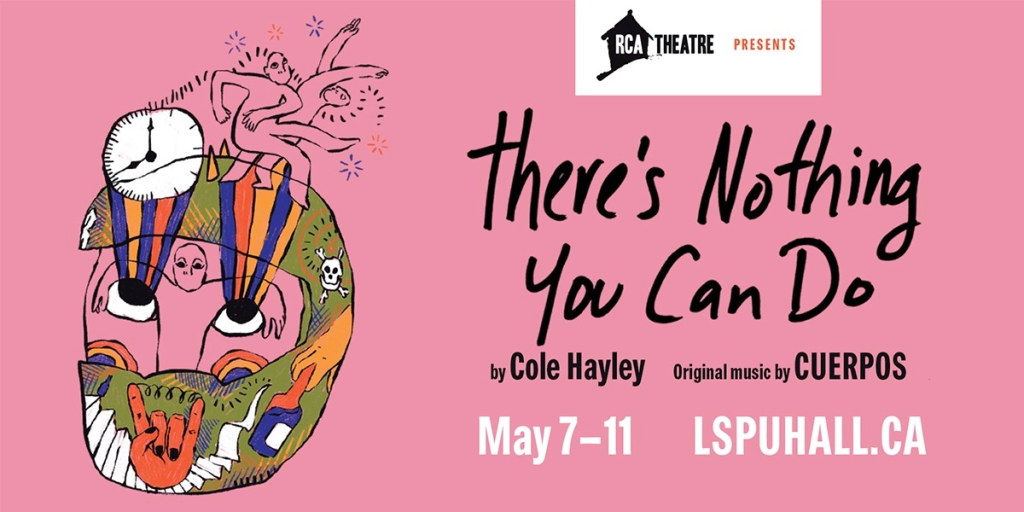
Show Poster (RCAT LSPU Hall)
Changing Target Audiences
During the process of workshopping There’s Nothing You Can Do, there was a directional shift in terms of the show’s demographic. While the play employs the quarter-life-crisis trope, Hayley said upon further development that he “didn’t want it to be a show that only appeals to people in their 20s. That was no longer interesting to me because everybody goes through these crises and these moments of pause…there’s a big decline in the midlife crisis for people because we have multiple crises instead of this one big crisis now.”
“Once I realized that I could make a show that is, yes, about young people but can be relatable to people no matter what age or what situation, that really blew everything open for me,” Hayley said.
Music and Relationships Influencing Writing
Hayley moved to St. John’s at 17 years old and was immediately inspired by the people he met at the shows he would go to.
With a score consisting almost entirely of local musicians, evidently, music influenced Hayley’s writing greatly. “Writing-wise I’m super influenced by music,” he said, “I’m a huge music fan, I love going to shows, I love making music, I love listening to music… so when I was developing this show and I was freaking out as most people in their 20s are freaking out, especially right now, I was really finding solace in the muse that I was listening to whether that was local bands here in St. John’s or just my favourite bands. That spirit of music lives through this show a lot.”
While There’s Nothing You Can Do is not explicitly autobiographical, there is some truth to the experiences depicted in the show. “There’s no character in the show that’s like ‘oh that’s my stand-in’ but they’re all fragments of me… every character is an anxiety that I have had,” Hayley said. He also discussed the interconnectedness of local creative communities, emphasizing the uniquely intimate nature of St. John’s and how people help one another out.
“Everybody knows everybody in the art scene. The people who are doing visual arts are going to the shows at The Ship by the local hardcore bands, maybe somebody from the hardcore band is an actor in a play…everything is very connected. Doing the show, having the support of all these different communities, is super exciting and was important to me… I think that’s my favourite thing about doing art here, it’s not like we have this huge profitable thing that can exist here, but we do okay because everybody comes and supports it, which I think is pretty awesome.”
No matter what stage of life you’re in, if you relate to feelings of uncertainty, you might like There’s Nothing You Can Do. An art gallery coinciding with the play’s run, with visual art from Anthony Charles Brenton and Luanne Dominix, was also available for viewing in the LSPU hall’s Cox & Palmer room.
Note from the Author
While I don’t think I have the authority to write a review since I know virtually nothing about theatre, I had the immense privilege of seeing the show on Thursday evening during the May 8th showing, and I was blown away. What a hilariously cynical but oddly hopeful piece. I left the theatre having somewhat of a crisis of my own but to me, all that says is the show achieved what it was meant to do.
The performances were fantastic, each actor embodied their character so well. I really loved the characters in general. Cole Hayley was able to playfully use archetypes without sacrificing depth or over-satirizing, and each one also had vulnerable moments where the audience got a window into what was going on. I’m also very impressed by the actors’ stamina; I could not dance nonstop for an hour; that’s quite admirable, actually. The original songs by CUERPOS fit perfectly, and I can definitely see where the love for music comes in with the inclusion of other songs from Swimming during the party scene, and Vancouver indie garage band Peach Pit in the living room scene.
Without spoiling too much, there is a clear break in styles midway through that is tastefully jarring when experiencing it as an audience member. During the existential-spiralling-dance-mania sequence when each character is having their respective breakdown, there was one line that really stuck out to me – the character Pierre said that “pleasure is the only defence against annihilation,” a very powerful statement and arguably one of the main messages of There’s Nothing You Can Do. Cole Hayley achieved everything he set out to do with this.
Memorial University has just announced the appointment of Dr. Janet Morrison as the university’s incoming President and Vice-Chancellor.
Dr. Morrison is set to begin her six-year term on August 11, 2025, complete with an annual salary of $485k, and potential for a contract renewal with an additional four-year term.
Since 2018, Dr. Morrison has been dutifully serving as President and pro-vice-chancellor of Sheridan College Institute of Technology and Advanced learning, a post-secondary institution in Ontario notable for its robust creative programs. Previously, she was appointed vice-president of Sheridan College, and prior to 2016, she held various leadership positions at York University.
Dr. Morrison’s academic background is quite notable, as she holds a PhD in higher education from Bowling Green State University in Ohio, and two Bachelor of Arts degrees in history from the University of Guelph and the University of Western Ontario, respectively.
Tackling the pervasive issues concerning Memorial is an ambitious undertaking, especially considering the $450 million in deferred infrastructural maintenance and looming threats to programs and research in the form of seemingly ever-diminishing budgets and funding opportunities, but Dr. Morrison looks like she’s up for the challenge.
(Janet Morrison // Sheridan College)
In an inaugural speech given at the Marine Institute campus, Dr Morrison stated that she aims to “be Memorial’s staunchest champion, ensuring Memorial is seen, supported and celebrated for the world-class institution it is… My immediate priorities will be to listen, learn and build relationships. Together, we will co–create a path forward that is learner-centric, collegial and purposefully designed to maximize the impact we deliver for individuals and the province of Newfoundland and Labrador.”
This decision comes after a long and arduous process of consulting with the Presidential Search Committee, a conglomerate of students, staff, faculty, regents, and one member of the public to find the best possible fit for MUN. This was done through extensive surveying of the Memorial community, as well as five town halls held across all 4 Memorial campuses and online for people to democratically voice their opinions and concerns to be taken into consideration when seeking a new President for MUN.
Some of the key priorities which the search committee outlined included community involvement – not just focused on the St. John’s campus – financial transparency,maintaining a positive relationship with the provincial government for funding interests,rectifying the university’s historically poor public image with more positive media communications, appropriately wrangling technological advancements affecting learning such as artificial intelligence, and enhancing student supports to name a few.
As universities and post-secondary institutions face slashes to funding and cuts to entire programs on a national scale, and students are navigating their studies amidst a cost-of-living crisis, it’s more imperative than ever to have strong leaders who advocate for students.
The subject of the Memorial University Presidency has been an especially contentious one, following Vianne Timmons’ controversial removal from the position in 2023, and interim President Neil Bose’s term, which faced criticism from both organizations like MUN Students for Palestine, as well as the broader student body for evading concerns about student issues.
Following Dr Morrison’s appointment as incoming President, some students at Memorial appear to be cautiously optimistic.
The board of the East Coast Music Association (ECMA) has released a statement on their upcoming awards ceremony in St. John’s, taking accountability for how they handled the release of their CEO this past January.
The ceremony has been in a difficult spot the last few months. Six nominees have dropped out, including Jeremy Dutcher, Mo Kenney, and Wolf Castle. This is in response to the ECMA letting go of CEO Blanche Israël in January, who was chosen to lead the event in March of 2024.
According to an official statement made by the board on their website on March 19th, the decision to part ways with Israel came due to multiple factors. The official statement says:
“There was lost institutional knowledge, decisions being made without Board approval, and legal risks we couldn’t ignore. At that point, we had to act to get things back on track. And, as unfortunate as it is, we had to make a difficult decision. We recognize and regret that the way we handled it left members feeling blindsided. That’s on us.”
“The event is not at risk,” said Michelle Eagles, the chair of the board. In a recent interview with us, she explained the current status of the ceremony. According to Eagles, the show is now back on track, thanks to a joint effort between the board and staff, as well as the contractors, who are now all back in place. “At this point, the event is in very good shape.”
ECMA Line-up
In terms of the artists, the ceremony features “one of the best award show lineups we’ve ever had,” according to Eagles. All artist slots for showcases and the accelerator program, their program to support up and coming artists, are completely full, with the latter having almost 100 delegates. In their official statement, the board stated that they are “fully prepared for the event in St. John’s, and there is no way we would let it be in jeopardy.”
The event features nearly 250 nominees across many different awards. MUN music prof Florian Hoefner is up for an award, being nominated for Classical Composer of the Year.
Florian Hoefner
“It’s always nice to see the recognition from the music community in the Atlantic provinces,” said Hoefner. “This nomination is special for me because it is in a new category. It’s my first time being nominated as a classical composer.”
After the ups-and-downs of the last few months, it looks like things are back on track, with members such as Hoefner being “glad that the Board is taking the concerns of the members seriously.”
The event is expected to bring in around six million dollars of economic benefit to the city of St. John’s and surrounding areas. The ECMA Awards will take place from Friday, May 9th to Sunday, May 11th.
We reached out to former CEO Blanche Israël via LinkedIn for comment, and will update with response.
To conclude a jam-packed week of festivities for Trans Week of Visibility 2025, Queer Prom will be held at the Breezeway on Friday, April 4th. The space-themed event promises to be “out of this world.”
Organized by a 2SLGBTQIA+ resource centre on campus, MUN Sexual and Gender Advocacy (SAGA), the event is to be hosted by Canada’s Drag Race Season 5 alumna, Tara Nova.
Prom-goers will also see performances from DJ A.N.O., and drag performers like the bowie-inspired sensation CJ Stardust, and the eclectic Gravy. Both CJ and Gravy debuted their drag personas at Queer Proms in previous years, so this one is particularly special for the performers.
Admission is pay-what-you-can, with all proceeds going to MUN student Dawn’s gender affirming surgery costs as she has to take off work for recovery. According to organizers, Dawn is financially independent due to a contentious family situation, and surgeries come with a host of additional costs, especially if recovery limits mobility, rendering the person unable to work for an extended period of time.
Queer Prom often donates event proceeds to aid transgender students – not only is it a night for celebrating queer joy, but also to lend community members support. Organizers encourage attendees to donate anything they can spare to help a fellow student.
The event is 19+, and will run from 9:30pm-12:30am, but if you’re underage, an all ages Queer Palooza will run from 6:30-8:30pm. Both events are to be held at the Breezeway.
Event Poster // MUN SAGA
A variety of on-campus events were organized for Trans Week of Visibility 2025 to highlight 2SLGBTQIA+ pride and emphasize the fight for trans rights. These events include:
Trans Day of Visibility Fair – Mar 31, 12-4pm at The Landing
Trans Support Craft Night – Apr 1, 6-8pm at Intersections
Museum of Trans Art Exhibition – Apr 2, 12-11pm at The Breezeway
YOUphoria Open Mic – Apr 2, 8-11pm at The Breezeway
TLGB Trivia Night – Apr 3, 8-11pm at The Breezeway
Queer Palooza (all ages) – Apr 4, 6:30-8:30pm at The Breezeway
Queer Prom (19+) – Apr 4, 9:30pm-12:30am at the Breezeway
F*ck Racism Rally – Apr 5, Colonial Building
In light of the current political climate, celebrating queer and trans joy and supporting one another has never been more important. Events like the ones planned for Trans Week of Visibility recognize the resilience and collective efforts of the 2SLGBTQIA+ community, giving people the opportunity to attend fun events while contributing to a tangible cause that directly helps their peers.
If you want a good time, and a chance to hang out with other queer folks or display allyship while seeing some fantastic drag performances, come by the Breezeway on Friday evening for Queer Prom or Queer Palooza.
The 2025 Canada Summer Games are 130 days away from kicking off here in St. John’s. An information session was held on campus featuring key event organizers, where they revealed plans for the Games.
The information session featured Jordan Wright, the lead organizer for the Canada Games at Memorial University and Karen Sherriffs, CEO of the 2025 Canada Games Host Society. The event also featured guest speaker Dr. Katie Wadden, a 2005 Canada Games Alumna in rowing and an assistant professor in the Human Kinetics and Recreation department at Memorial University.
What’s Happening?
The 2025 Canada Games will be taking place here in St. John’s, beginning on the 8th of August with the Opening Ceremony at the Mary Brown’s Centre that will feature performances to commemorate the opening of the games.
The games will span over the following two weeks, before concluding on the 24th of August, with the Closing Ceremony also taking place at the Mary Brown Centre. This event will celebrate the accomplishments of all the athletes who participated in the games, while also featuring local and national performers, before they pass the spirit of the Games on to the next host, Québec City in 2027.
National festivities for the Canada Summer Games will begin earlier, on June 11th the Canada Games Torch will be lit in Ottawa at the Centennial Flame on Parliament Hill. This will start the 2025 Canada Games Torch Relay, which event organizers say will travel through 16 communities in both Newfoundland and Labrador.
In edition to sports, this years Canada Games will also feature an Artistic Festival and Cultural Program from August 10th-24th featuring local and national performers and artists. Karen Sherriffs said more information about this program will be revealed 50 days before the event begins.
Canada Games at Memorial University
During the Canada Games, a lot of personnel will be located at Memorial University, with many athletes staying on residence. 23 venues will host various sports at the Canada Games, and three of them are on Memorial’s campus.
The Aquarena, currently under renovation since September 2023, will be the venue hosting the most events, with three aquatic sports taking place: artistic swimming, diving, and swimming.
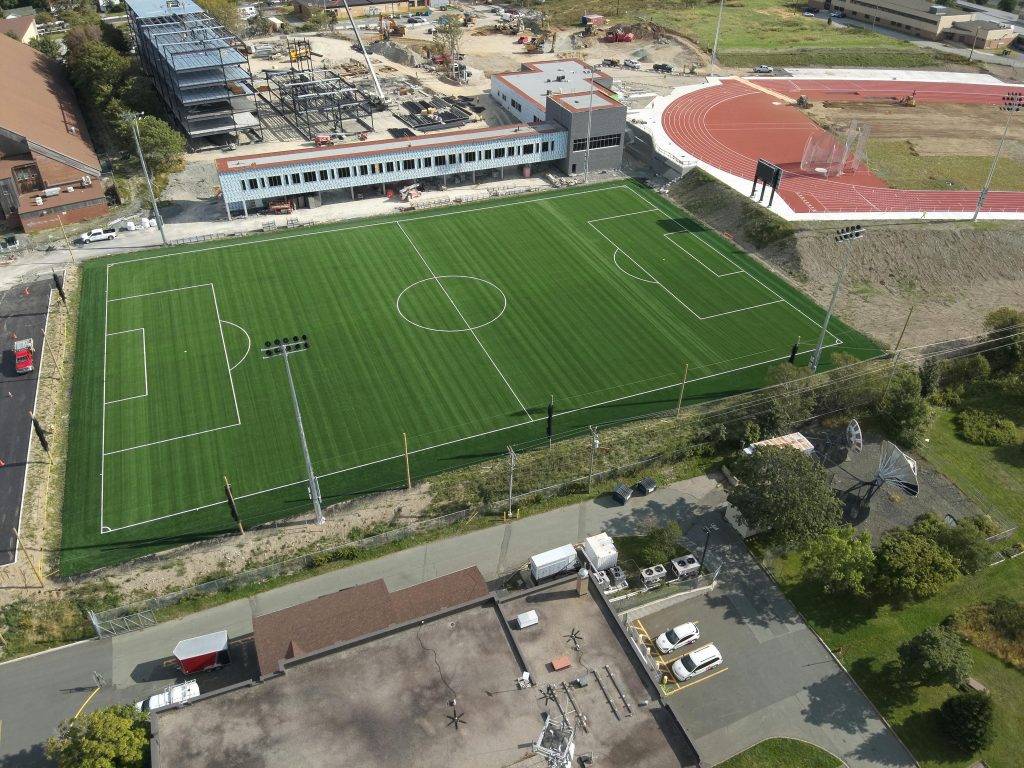
Across from the Aquarena The Works Field House, will host basketball and volleyball. Lastly, the Fortis Canada Games Complex, which is a brand new $34 million facility right next to the Aquarena, featuring state of the art training facilities was built to support the Canada Games.
The complex has a brand new soccer field with high quality artificial turf, along with a 400 meter, 8 lane track for athletics. It will host both athletics and soccer events.
While those three areas will be holding sporting events, there are still many other spaces at Memorial University that are expected to be used for athletes and personnel for the Canada Games. Listed below is a map of the Memorial University campus that shows all the spaces on campus that will be in use for the Canada Games, and according to Memorial is subject to change.
Map of the MUN Building and what buildings will be used during the Canada Games (via mun.ca).
All yellow areas on the map are buildings on campus that will be in “heavy use.” Those areas are the sporting venues along with certain residences at MUN which will be known as the “games village.” According to the map, the games village will use the residences at both Paton College and MacPherson College.
Areas on campus that are green are the buildings that will be in moderate use during the games. Those spots are the Physical Education building, which is set to be a warm-up and practice space, the Education building, for the mission offices and, finally, the University Centre, the location of the polyclinic. It will also be used as a social space for the athletes.
Areas in blue will be used occasionally, while the grey areas won’t be used except for the Fortis Canada Games Complex, which is listed as grey on the map.
According to the MUN website, there will likely be no access to the Aquarena, Field House and Physical Education building for MUN students, staff, as well as the general public during the Games.
Effect on MUN
The QEII Library is expected to continue its regular services during the Canada Games (via MUN Gazette).
With much of the event happening on campus, along with both preparing and tearing down the set up for the games, it will certainly affect the campus operations during the month of August.
The university calendar has been made with the Games in mind, the 14-week Summer semester will begin from the 5th of May, with classes ending the on August 1st, and the examination period ending August 5th. The 6-week Summer semester will begin the 23rd of June, and end at the same time as the other summer courses. This will allow organizers to set-up the MUN campus for the Canada Games from August 5th-7th.
The 2025 Fall semester will begin on Tuesday, September 9th, about a week later than it started last year. Tear down of the Canada Games will begin the day after the Games conclude on August 24th.
During the Games, the Queen Elizabeth II library will continue its access to its collections and regular library services. Other services like printing and mailing are also expected to run as normal.
Memorial’s Childcare Centre will have its annual closure from August 11th-22nd. Thesis defences will be delivered remotely while the Games take place.
At the session, organizers said some services at MUN will likely be busier than usual during the Games period, such as Facilities Management, Office of the Chief and Marketing and Communication. Organizers said to expect increased response time for non-emergent requests during the Games.
The Strategic Procurement Office is also anticipating a higher volume of procurement requests during the games. Games officials at the session also said that many units that are not providing direct support to the games will not be have reduced services, but are considering hybrid service models and reducing in-person services.
For some MUN staff, both work on campus and remote work will be available during the games period, however remote work will need to follow the “flexible work arrangements policy.”
Housing
One major concern students at Memorial have had about the Canada Games is the housing. Students who live in residence are concerned about where they are going to live during April to early September.
At the session an international student brought these concerns to Jordan Wright, the lead Games organizer at Memorial, and asked him if the University had any plans in place to help vulnerable students.
The student said many staying on residents will have difficulty to find alternative housing, including those who do not have family in the province. The student also said the only help they had received from the housing office was an email with a list of landlords the student could contact.
Wright said his main message to any student who had concern and uncertainty about their housing situation was to “reach out to the supports … international@mun.ca is my preferred option for anyone looking for support right now.”
According to the presentation, some residences are set to undergo maintenance, and according to the MUN website, students residing in Macpherson College, Paton College, and Guy and Gilbert Courts have been told they move out by the end of the contract date, April 23rd.
Some exceptions have been made, as students enrolled at the Marine Institute or other technical sessions, may stay on campus until June 30, 2025.
In an effort to support the many student who will require alternative housing, Memorial has an off-campus housing advisor to help. MUN is asking students who need help with housing to contact international@mun.ca.
Opportunities
The Games will also offer opportunities for students to be involved. Host society CEO Karen Sherriffs said they will need 5,000 volunteers across 150 different roles. As of March 14th, there are 3,100 volunteers signed up for the Games.
Many MUN students will complete work term with the Games, work on marketing, partnerships and administration. Many students and staff at Memorial are on the volunteer planning team.
Students also have the opportunity to participate in “Showcase Memorial.” These experiences can be done either on campus or digitally, and can include arts and crafts, interactive displays and digital activities. Expressions of interest applications to host an experience are open until the 31st of March.
Along with this initiative, there will also be a call for “Team Memorial Volunteers” made early in April. These volunteers will help with the showcase experiences, student recruitment, plus other opportunities as they develop over the coming months.
Team Memorial Volunteers will be given training when necessary, and will also be given volunteer t-shirts.
The Sports
The brand new $34 Million Fortis Canada Games Complex, which will host two events at the 2025 Canada Games, Athletics and Soccer (via Engage St. John’s).
The 2025 Canada Games will feature teams from all 13 Provinces and Territories across 20 different sports at 23 different venues.
Here is a list of each sport that will be taking place, along with the dates and the venue:
Artistic Swimming, August 21-24, Aquarena
Athletics, August 19-23, Fortis Canada Games Complex
Baseball, August 10-24, St. Pat’s Ballpark and Team Gushue Sports Complex
Basketball, August 10-16, Newfoundland and Labrador Sports Centre and The Works – Field House
Beach Volleyball, August 10-16, Paradise Park
Canoe Kayak, August 11-14, Quidi Vidi Lake
Diving, August 19-24, Aquarena
Golf, August 19-22, Bally Haly Golf Course
Lacrosse, August 10-24, Paradise Double Ice Complex
Mountain Cycling, August 20-24, Pippy Park
Open Water Swimming, August 15, Rotary Sunshine Park
Road Cycling, August 11-15, Downtown St. John’sand Marine DriveandTeam Gushue Highway
Rugby Sevens, August 11-13, Swilers Rugby Club
Sailing, August 11-16, Royal Newfoundland Yacht Club
Soccer, August 10-24, CBS Soccer Complex and Fortis Canada Games Complex and King George V Soccer Stadium
Softball, August 10-24, Caribou Memorial Softball Complex
Swimming, August 10-14, Aquarena
Tennis, August 10-16, Greenbelt Tennis Club
Volleyball, August 19-24, Newfoundland and Labrador Sports Complex and The Works – Field House
Wrestling, August 21-23, Glacier Arena
Opening / Closing Ceremonies, August 9th and August 24th, Mary Brown’s Centre
At the previous Canada Summer Games, which took place in 2022 in Niagara, Ontario, Newfoundland and Labrador finished with one gold medal, six silver medals and two bronze medals for a total of nine medals. It tied their all-time best result at the 2005 Canada Games in Regina, Saskatchewan.
The 2022 Canada Games was also the first time Newfoundland and Labrador won a gold medal at the Games since 2001, when Chris Weeks won gold in men’s swimming.
Newfoundland and Labrador’s men’s Basketball Team (Engage St. John’s)
High Expectations
At the session, Sherriffs expressed some of the high expectations the organizers have for this year’s Canada Games.
She said that the 2025 Canada Games are expected to be the greenest Games ever, putting an emphasis on sustainability. They hope that this will set a benchmark for future games to come.
Sherriffs also said that this edition of the games is trending to be the largest Games ever, with the largest numbers of athletes, coaches and staff ever expected to participate in the Games this year.
This will also be the first ever Canada Games with a safe sport program, working with the Canadian Olympic Committee and the Canada Games Council to receive funding for four significant safe sport initiatives.
Lastly, this will also be the first Canada Games with an app, which is available on both iOS and Android. This app contains schedules to the events and breaking news.
According to presenters, these plans are still subject to change, however if you want to know more about the games the session was posted to YouTube, and features other plans for the Games as well as a Q&A session with organizers.
Now signed to independent Boston record label, Candlepin records, 4 piece St. John’s alternative/slowcore outfit Gallery is back with another single after nearly a year. Gallery features Nick Corcoran (vocals, guitar), Liam Ryan (guitar), Nick Hunt (drums), and Maria Peddle (bass).
Mastered by Dead Air, self-recorded by the band’s guitarist Liam Ryan, and mixed by Jacob Cherwick, Hoarders (Buried Alive) dropped on March 21. The single was announced only one day before its release, in anticipation of their upcoming debut EP Rolling Stop, expected to come out on May 1.
Rolling Stop is set to have 5 songs, and will be accompanied by a cassette tape available to pre-order prior to the EP release.
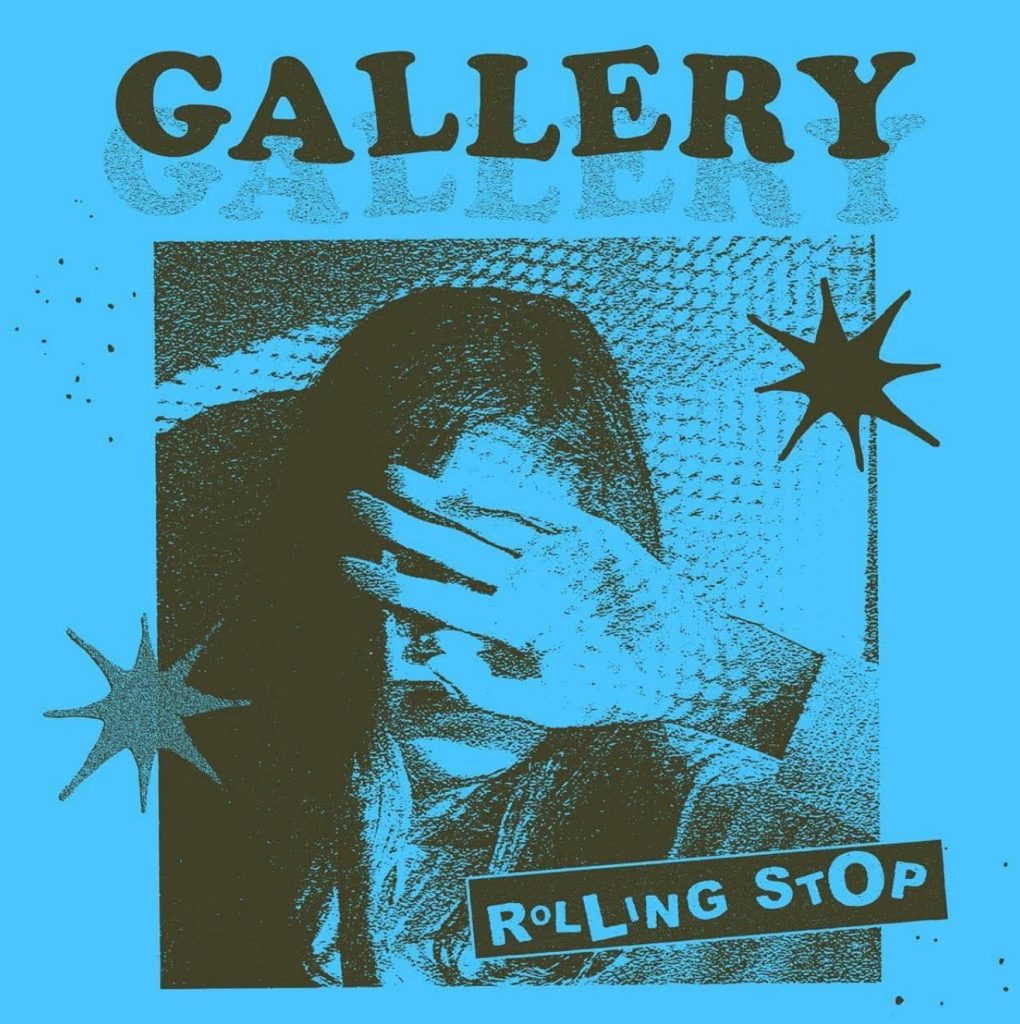
Rolling Stop cover art, by Smoking Room (via Gallery’s bandcamp)
In pure Gallery fashion, the song pulls inspiration from genres like shoegaze with a substantial 90s influence, heavily distorted guitars, and resonant, dreamlike vocals by Nick Corcoran.
The track Hoarders (Buried Alive) features pensive lyrics about knowingly holding on to unnecessary hurt, and the suffocating feelings that go along with ruminating on things left unsaid. As they put it in the song, “I know it’s not worth it // I am made up of all of this useless stuff” – very fitting considering it’s name.
The last shows the band played were part of a mini-tour with Swimming and Andrew Smith around Bonavista last August. Before that, they played at Lawnya Vawnya in June of 2024 with Blunt Chunks and Ribbon Skirt, formerly Love Language.
Before this release, the band had one other single titled Sand out on streaming, so it’s safe to say that fans in the local scene are excited for the new EP.