
Home Blog Page 16

OPINION: Residential school denial should be criminalized

0

This article includes discussion of sensitive subjects and may be upsetting to survivors and their descendants. Please take care in reading.

In May 2021, Tk̓emlúps te Secwépemc First Nation announced the discovery of 215 unmarked burial sites on the grounds at the former Kamloops Indian Residential School.

In 2021, the country mourned. In 2021, Canadians across the nation said, “every child matters.” In 2021, it seemed that the Canadian public were finally beginning to understand the seriousness of Canada’s atrocities against Indigenous people, especially harms committed against children.

That July, many non-Indigenous Canadians reconsidered celebrating Canada Day and cancelled their usual festivities. Many understood there was nothing to celebrate. A sociocultural shift was on the horizon… or not. 

Years have passed since the announcement that sent shockwaves across the country. For many Indigenous people, it was heartbreaking, but not surprising.

Many Indigenous communities have heard stories passed down from Elders for decades about children that would go missing from residential schools, never to be seen again.

These stories are told by survivors and survivors’ descendants or relatives. These truths have long been known and held by Indigenous people, but for much of Canada’s history, cries for justice have gone unheard.

It took years of sustained pressure from Indigenous communities and legal action from survivors to even compel the Canadian government to investigate the crimes of residential schools.

In the mid 80s to 90s, survivors started to join together to launch class action lawsuits against the Government of Canada for mistreatment suffered at residential schools.

In 2007, the Indian Residential Schools Settlement Agreement was implemented, and a commission was established to thoroughly investigate the history and legacy of residential schools.

After six years of research in collaboration with survivors and their families, the Truth and Reconciliation Commission released its final report in 2015 concluding that the residential schooling system amounted to “cultural genocide,” and indicating that at least 3,200 children were killed as a direct result of residential schools.

The TRC outlined 94 Calls to Action necessary to implement to achieve justice for survivors and victims, and move forward on a path to reconciliation. 

Despite this valuable work, very minimal progress has been made towards Truth and Reconciliation; only 15 Calls to Action have been followed through on by Government.

In many ways, we are regressing on our journey to reconciliation, as it is impossible to seek reconciliation without first upholding the truth.

The truth is that the Government of Canada, in collaboration with various Christian churches, created residential ‘schools’ as a way to facilitate the erasure and genocide of Indigenous peoples by “killing the Indian in the child.”

The truth is that the history of Canada includes forcibly separating families, kidnapping children and locking them away in institutions where they would be physically, emotionally, and sexually abused, and stripping them of their culture, language, and identities.

The truth is that many children were killed due to these ‘schools,’ due to disease, mistreatment, weather exposure while trying to flee, and those who later took their lives because they could not live with the memories of what they had suffered.

This happened because of the actions of the Canadian government and the apathy of the Canadian public. This is not a tale of fiction. This is real life, and there are still many Indigenous people who bear the scars of it.

The legacy of residential schools has left many Indigenous people facing intergenerational trauma, contributing to worse health outcomes and socioeconomic outcomes compared to the non-Indigenous population.

image
MacMillan Mission School in Nain, c:1980. One of five residential schools that operated in the province; four in Labrador and one in St. Anthony, Newfoundland (Credit: Them Days Archive).

In 2021, the country mourned the truth. In 2025, the truth is under attack. Residential school denialism is on the rise in Canada.

Similar to other forms of genocide denial; Holocaust denial minimizes or outright rejects harms inflicted, such as claiming the Holocaust death toll is inflated or overblown.

There is a spectrum to the falsehoods of denialists, but all denialists share one tactic in common, promoting false and misleading claims to undermine the credibility of survivors and to bury the truth about the atrocities of residential schools.

Residential school denialism may present as claims that mass graves found at the sites of residential schools are a ‘hoax,’ or that residential schools were not abusive institutions.

Some denialists will acknowledge that maybe there were some incidents of abuse, but also that those instances do not reflect the majority student experience and that these ‘rare’ moments of abuse were the cause of some ‘bad apples’ at residential schools.

At its core, denialism attempts to warp conclusive historical facts and call into question the personal experiences of survivors. This is causing undeniable harm to survivors and Indigenous communities, along with reconciliation in general. 

Some may argue that, while denialists use reprehensible rhetoric, they should still be free to express their differences in opinion, since we live in a democracy.

I argue that this goes beyond opinion differences because said ‘opinions’ are rejecting established truths and causing real, tangible harm to the survivors that we are supposed to be honouring and protecting.

Residential school denial should not fall under protected speech; it should be rightly classified as a sort of hate speech. Without legislation to recognize residential school denial as hate speech, there is very little way to prevent discourses of denial from being propagated.

We need a framework to respond to denialists who continuously harass survivors, advocates, and researchers who are working to preserve the truth of residential schools.

We need to lift up the stories of survivors and the missing children who are not here to tell their stories. Currently, if victims of denialist’s attacks would like to defend themselves, they have to embark on costly legal battles which they are not guaranteed to win.

Many survivors may simply not have the money, time, or resources to legally defend themselves. Not only is this financially costly, but it is emotionally costly, as well.

The target of denialist claims are always residential school survivors because it is survivors, and their families, who are most impacted by denialism.

It is survivors who are retraumatized as their personal experiences of abuse are interrogated, as they are called liars, as they are forced to defend their own traumas to people who have not walked a step in their shoes.

Although these feelings are impossible to understand for those of us who have not been directly impacted by residential schools, I would like readers to take a moment to reflect, and consider what it would be like if your biggest emotional wound was constantly reinjured by those who do not know you.

Maybe you have had traumatic experiences dismissed. Now imagine if this impacted your entire community. This is what is happening to survivors every single time a denialist is permitted to publicize a statement that minimizes, justifies, or rejects the harms of the residential schooling system.

Denialism is not just private thoughts; it is a concerted effort to erode the truth.

We must not allow the testimony of residential school survivors to be open for public ‘debate,’ the same way we do not allow the testimony of Holocaust survivors to be debated.

Passing a law that makes residential school denial a criminal offence would not be a new or unprecedented legal change. In Canada’s Criminal Code, Holocaust denial is illegal under 319(2.1) which clearly states, “Everyone who, by communicating statements, other than in private conversation, wilfully promotes antisemitism by condoning, denying or downplaying the Holocaust is guilty of an indictable offence and liable to imprisonment for a term not exceeding two years; or is guilty of an offence punishable on summary conviction.”

There is nothing except the lack of political will that prevents passing a similar law for willfully promoting anti-Indigenous racism through residential school denial.

NDP Member of Parliament, Leah Gazan, introduced a private member’s bill to add residential school denialism to the Criminal Code in September 2024, but the bill has yet to progress past the first reading, and it remains to be seen if either of the major parties will support the bill.

I do not see a way forward if we refuse to reckon with residential school denialism. Residential school survivors, and this country, will never fully heal if the wounds of the past and present are incessantly aggravated by assaults on the truth.

image

Credit: First Light NL

This September 30th, Orange Shirt Day, National Day for Truth and Reconciliation, let us all do our part to stand with survivors.

We must honour truth-tellers, learn to recognize the signs of residential school denialism and ensure zero tolerance for anti-Indigenous racism in our homes, communities, schools, and workplaces because Every Child Matters.

Looking for a tangible action to take? Donations may be made to local organization, First Light Friendship Centre, here. 

St. John’s unveils proposal for development plans around MUN

0

On September 16th, the City of St. John’s announced plans to further develop neighbourhoods in the surrounding areas around Memorial University. The University Area plan is among many others included in the City’s Housing Accelerator Fund Action Plan.  

The main goals for development are detailed on their website, stating, “The City of St. John’s has a strategic direction to be a Sustainable City, planning for land use while preserving and enhancing the natural and built environment for residents.” 

University Area Boundaries 

The university area covers many of the streets nearby and is heavily connected with Memorial University. The plan area boundaries include Freshwater Road, Prince Phillip Drive, Pippy Park, Allandale Road, Bonaventure Avenue, Newton Road, and Parade Street. 

image
Plans for university area development / City of St. John’s

Adapting to Residential Growth 

The city’s neighbourhood development plan aims to accommodate the growing population around the university. New zoning is proposed for Elizabeth Avenue and Newton Road to allow new infrastructure development and current building improvements. Additionally, buildings will be allowed to reach four storeys in height.  

These plans also aim to support connections with local businesses in the historical Rabbittown area. According to the city’s website, these plans intend to “help recognize and legitimize the legacy of commercial businesses located throughout the area,” and “further strengthen and support the existing community and heritage character.”  

For students, this could mean more housing opportunities near campus and improvements to existing options. Students living off-campus will have a better chance to live a convenient distance from MUN.  

Mobility and Accessibility Improvements 

According to the City of St. John’s, growing the area’s accessibility options will allow residents easier access to transit and jobs. The city announced there will be new paths created to grant residents more options to commute without a vehicle. The plan includes: 

  • Crosswalk upgrades  
  • Additional bike parking 
  • More signage for easier navigation 
  • Introducing more seating, art, and landscaping  
  • Consider reducing vehicle lane widths 

This would make the university area easier to navigate for students without a vehicle. Students who commute by foot or bike will have safer paths with positive atmospheres.  

image
View of The Works from Elizabeth Ave. (City of St. John’s)

Public Transport Improvements 

The city plans to work alongside MUN, Metrobus, and the Pippy Park Commission to allow easier access to public transportation. These organizations intend to improve the Memorial University transit hub, placing it in a convenient location. The other changes include: 

  • Better pedestrian connections across Prince Phillip Drive 
  • More efficient bus circulation 
  • More connections between the hub to Pippy Park trails  
  • Better lighting and crime prevention features 
  • Improved winterization of bus stops 

These changes would allow Metrobus routes to become more reliable and easily accessible. Students will also have safer routes for commuting across roadways or at night.  

Financing and Further Steps 

The University Area plan was presented at a council meeting on September 16th alongside a similar plan for Cowan Heights. These improvements will be funded through the Canada Mortgage and Housing Corporation’s Housing Accelerator Fund (CMHC), from which St. John’s has allocated $10.4 million to invest in housing opportunities and development.  

The next steps will involve provincial review and a public hearing held in 2026. If both run according to plan, changes could begin in upcoming years. Currently, the city is asking residents to provide feedback on the proposed plans. Residents can submit any thoughts on engagestjohns.ca or by emailing engage@stjohns.ca.  

A Tippling Adventure: A Newfoundland twist on a classic concept

0

A Tippling Adventure, directed by Benjamin Noah, takes the idea of a western treasure hunt, and pumps it full of Newfoundland culture and identity, and adds a breath of fresh air to a classic story.

It’s a simple story, one that many have probably heard before. A man walks into a bar, on the hunt for a hidden treasure, and meets plenty of interesting characters with murky motivations along the way.

A Tippling Adventure Poster 2025(1)
A Tippling Adventure Poster by Mike Feehan (Submitted)

It’s a typical western story, a genre that is not often set in Newfoundland.

The four-part mini-series makes incredibly effective use of what makes it stand out amongst westerns: the setting. These types of stories usually take place in some arid plains or a dry desert.

Set in early 19th century Newfoundland, A Tippling Adventure stands out, and it knows it.

Rhiannon Morgan as Micaela, The Ale Wife
Rhiannon Morgan as Micaela, The Ale Wife (Submitted)

There are many shots of the sweeping Newfoundland landscape, with waves crashing on the cliffs, and snow dusting the rocky landscape and dense forests. Director Benjamin Noah makes effective use of these elements to ensure the show stands out from other westerns.

The visuals are far from the only thing that makes the show stick out from the crowd, however. The show is not just set in Newfoundland, but makes effective use of the island’s unique culture. Between the cast, you see both Newfoundland hospitality, and how, for lack of a better word, blunt the people here can be.

The historical aspect also shines through, and not just in the immediately obvious ways, such as the costumes and props, but what the characters say. Additionally, the music is perfect, and expertly sets the stage for this story, while also letting Newfoundland culture shine through.

2024 Behind The Scenes Of A Tippling Adventure. Director Benjamin Noah (middle) w Rhiannon Morgan Andrew Ravindran. Photo By Em Oatesjpg
Behind The Scenes Of A Tippling Adventure. Director Benjamin Noah (middle) with Rhiannon Morgan and Andrew Ravindran. (Em Oates)

Cast includes local great Andy Jones, Terry Ryan from Shoresy, the star of Hudson and Rex John Reardon, and his costar Kevin Hanchard. The performances across the cast are all great, with Andrew Ravindran as Baji being the standout of the cast.

Ravindran perfectly portrays that Baji is in a place he’s never been before, with a culture unlike anything he’s seen. This contrast is perfectly portrayed by the rest of the cast, which features considerable local talent, who all show off the culture of Newfoundland.

The only part of this show that seemed strange was the pacing, which was a bit all over the place. Sometimes the show is slower paced, taking plenty of time to set up the story and let the characters interact for a while.

Terrance and Baji wading through the forest in ATA
Terrance and Baji wading through the forest in A Tippling Adventure. (Submitted)

At other points, the pace feels incredibly quick, bouncing from one point to another with barely any time to process what is happening. These are the two paces the show bounces between on several occasions, and it can be a bit jarring at times.

Overall, despite pacing issues, A Tippling Adventure remains enjoyable the whole way through. It’s a well put together historical western mystery, with a local twist that is sure to engage audiences. The team behind the show have proven that Newfoundland’s distinct culture is sometimes all a show needs to stand out amongst the crowd.


Rating: 8/10

Muse Reviews: Red Oak restaurant at The Rooms

0

Newfoundland’s biggest history hub, The Rooms, is home to one of the most breathtaking restaurants in St. John’s. Perched on the top floor, Red Oak restaurant has many floor-to-ceiling glass windows, offering a magical, uninterrupted view of the harbour and the rows of colourful houses in our downtown area.

The light streaming in during the day creates a warm, inviting atmosphere, making it the perfect spot to enjoy a leisurely meal or a quiet coffee break. After wandering around the museum, it is a delight to dine in such a visually pleasing setting. 

Red Oak / Rebecca Jennings

Red Oak features an exquisite selection of meals and beverages, and the veggie burger caught my eye. The burger was accompanied by a garlic-toasted bun, mozzarella, aioli, and miso-glazed mushrooms and onions made for a beautiful combination. While the patty itself was a little on the dry side, it was beautifully presented, and came with a side of delicious roasted potatoes – crispy on the outside and perfectly tender on the inside. The service was friendly and professional, ensuring that the dining experience felt welcoming and thoughtful. 

For those seeking vegetarian options, Red Oak offers a variety of choices, which is always appreciated to accomodate dietary preferences or restrictions. Hummus, falafel wraps, and wild mushroom stir fry are just some of the options for vegetarian folk, the latter being fully vegan.

For anyone who is gluten sensitive, sandwiches can be made with gluten-free bread, though I always recommend double-checking with your server just to be safe.

Another positive is that Red Oak displays the menu on The Rooms’ official website, offering hungry museum-goers a glance beforehand so you can feel confident that you’ll find something you will enjoy. Prices are a bit higher, but they felt fair given the generous portions and the quality of ingredients.

The restaurant view / Rebecca Jennings

Overall, Red Oak at The Rooms is a delightful place to visit, whether you’re drawn in by the food, the current museum exhibitons, stunning views, or overall atmosphere. It’s the kind of restaurant where you can take your time with a meal, look at the scenery, and enjoy a moment of calm in the heart of St. John’s.

I recommend that anyone give Red Oak a try, plus MUN students have free access to The Rooms with their MUN student IDs on Fridays, which is certainly a bonus. 

St. John’s Comic Arts Festival: More than just doodles

0

Comics are one of the most expressive mediums out there. They give artists and writers the chance to visually and textually express so much of themselves, emotions, the world around them, or fictional worlds, into just a few pages, and the comics scene in Newfoundland is no exception.

From September 6-7, the St. John’s Comic Arts Festival took place on MUN campus. The event celebrated comics, not just as a medium, but as a facilitator of community. The festival aimed to platform and highlight local artists, as well as the work of the larger comics scene across Canada.

The event featured many artists, sharing and selling the work they’ve put plenty of time and care into. Many of the works showcased throughout the festival pointed out that, despite being viewed as a more niche medium, comics are still important today.

St. John’s Comics and Arts Fest / stjohnscomics.com

“There are things you can do in comics that you can’t do in other mediums, and potential is overlooked,” said Mike Feehan, a local comic artist. One key element he believes is important is how the artist expresses themselves in their work. “You see pieces of the artist in every piece of art they do; you see so much of the artist expressing themselves in comics.”

Comics, like many other forms of art, are primarily a form of expression. Artists draw from their own interests, experiences, positionality, fantasies, and the world around them to create pieces of art that not only reflect where they come from, but also allow the artist to express themselves in ways that other mediums may not allow.

One artist who embodies these conventions is Kevin Woolridge of Heavy Sweater Comics, a local indie comic publisher. “For me, it’s an escape, an opportunity to play in multiple media at the same time,” said Woolridge.

He underlined how comics allow him to express himself and his experiences, but on his own terms, at his own pace, free of scheduling conflicts. “I have a background in theatre, and this is a chance for me to play around in something without a crew, and take my time and make my own worlds.”

St. John’s Comics and Arts Fest promo at the Farmers Market / stjohnscomics.com

Imperative roles in the comics industry aren’t limited to just visual artists, either. There are writers, editors, layout and storyboard planners, marketers, and more. If you’re not talented at drawing, you’re not out of the race by any means. There are plenty of other important jobs that might suit your particular skills if you’re interested in the industry.

Jason Lapidus of Group of 7 Comics also elaborated on how someone can get involved.

“Collaborate, find a project that you want to work on that fits your skill set,” said Lapidus. “If you’re entrepreneurial, help other artists get their work out there. No matter your skills, there’s a way to get involved in comics.”

So long as you have ideas and a passion for your work, there’s a role for you to play in the comics scene. “Bring the skill set and passion you have to the medium of making comics; there’s room for everybody,” said Lapidus.

Comics have been around for a long time; the medium has been around for well over a century now. The scene here in Newfoundland dates as far back as the 1970s, and if showcases such as St. John’s Comic Arts Festival are any indication, they aren’t going anywhere anytime soon.

‘Blocks on the Rock’ LEGO convention knocked our ‘blocks’ off

0

In a time where technology is infiltrating so many aspects of our lives, hands-on creativity has become more important than ever – and no one understands that better than NewfoundLUG, the Newfoundland and Labrador LEGO Users Group.

Blocks on the Rock, an annual LEGO convention in St. John’s, was held at the Ramada Inn from September 6-7, where many members of the community showcased their collections of vintage and rare sets, as well as many custom creations for all to see.

These custom builds exemplified the immense creativity of the local LEGO community, showing how someone can make something amazing with just a couple of inventive ideas.

Blocks on the Rock / Ian Mills

Naturally, some of the builders drew inspiration from their own communities and surroundings. One such builder is James Spencer, who built a complete replica of his workplace, St. Mary’s Anglican Church in Clarenville, as well as the one in Burgoyne’s Cove.

“These were inspired to be a token of appreciation to the people I serve,” said Spencer. Both models were fully accurate to the real buildings, with a scale matching the size of a LEGO minifigure, where one stud equals one square foot. “They were mostly designed just because I wanted to display them inside their churches, and have them for the people there. I like it when I’m able to combine my work as a clergy with my passion for LEGO.”

Replicas such as this are just one example of the infinite number of possible builds with LEGO bricks, yet they all share one common element: they take time, and often a considerable amount of it.

Blocks on the Rock / Ian Mills

Another local builder, Chris Mitchell, was displaying photographic mosaics he created entirely out of LEGO pieces, depicting a range of images from a picture of the Celtic Hearth in downtown St. John’s, to portraits of musicians, such as Ozzy Osbourne and Steven Tyler of Aerosmith.

Mitchell said that “a typical two or three colour mosaic might only take a week or so. Something more detailed with more colours might take around three months.” That much time spent on a single mosaic is considerable, especially when multiple mosaics are being created and displayed at once.

You may have one simple question: why spend so much time creating these massive projects, like mosaics, churches, flower walls, and miniature-scale cities? Everyone has their own reasons. Some just like the creative process and find building therapeutic. But for others, displaying their creations to the world is the most satisfying part.

“The kids are tugging at their parents’ arms like ‘[the LEGO builds] are as big as me’,” said Christopher Butler, a local builder who makes large creatures out of LEGO Technic parts, some over a metre tall. “The coolest part is the looks on their faces, knowing that I made someone’s day.”

The convention emphasized the importance of play – regardless of age – stressing how creativity is needed now more than ever. No matter how rare traditional forms of creativity and play may seem nowadays, NewfoundLUG shows that it will always be around, even in unconventional forms some may not consider at first glance.

Open letter calls on government to ensure safety of activists joining Gaza flotilla

0

An open letter has been circulating in support of the local activists joining the Gaza Freedom Flotilla.

The letter expresses concern for the safety of volunteers Sadie Mees, Devoney Ellis, and Nikita Stapleton, three current and former activists with MUN Students For Palestine who are currently in Italy preparing to set sail to Gaza with humanitarian supplies such as food, water, medicine, and baby formula. 

The Global Sumud Flotilla, another civilian coalition setting sail to Gaza, has reported multiple drone attacks on their civilian-led vessels in Tunisia since announcing the most recent flotilla mission in August.

The letter, which has been signed by members of the Memorial community, including faculty, undergraduate & graduate students, and alumni, outlines the severity of the crisis in Gaza, which has been confirmed as genocide by a United Nations inquiry on September 16.

The letter demands the Government of Canada take immediate action to uphold international law and ensure there will be a swift response in the event of interception or sabotage by Israeli forces.

At present, there has been no official response from Memorial University or the Canadian government regarding the civilian-led humanitarian mission.

The letter is available to view and sign here.

OPINION: Premier Hogan, invest in our future and bring back the freeze

0

What kind of province are we building if we don’t prioritize the future?

In the leadup to the imminent provincial election, students across Newfoundland and Labrador are launching a campaign called Bring Back the Freeze.

Our message is simple: if you care about the future of this province, don’t vote for candidates who refuse to stand up for students.

Don’t vote for those who turn their backs on public education.

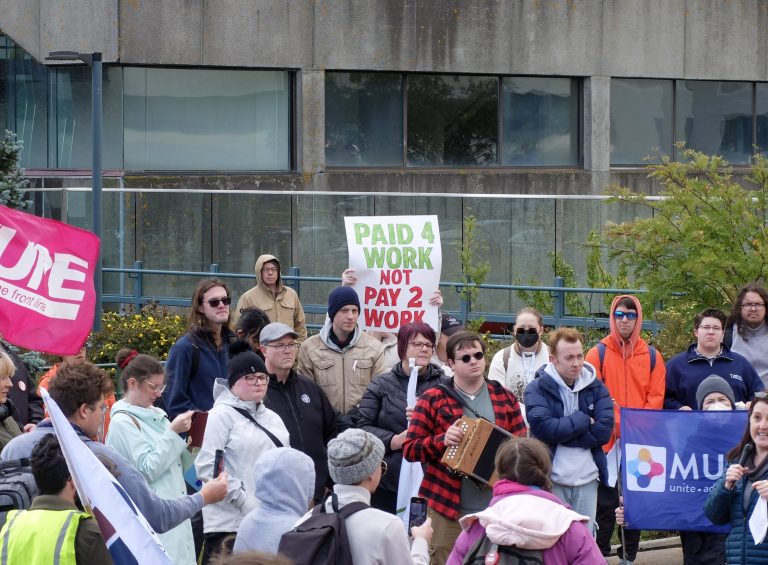
Why? Because the last four years have shown us exactly what happens when education is neglected. Tuition at Memorial and CNA has skyrocketed – and since the 2022 increases, we’ve seen the sharpest drops in student enrollment in decades.

At Memorial, undergraduate enrollment has now dropped below 13,000 students for the first time since 1983 — a direct consequence of these short-sighted tuition hikes and funding cuts.

In the very first year of the tuition increases, first-year enrolment dropped by over 19%, and the campus food bank shut down due to overwhelming demand — a stark reminder of how financial pressure is affecting not just education, but contributing to the cost-of-living crisis faced by students.

Newfoundland and Labrador has one of the lowest rates of educational attainment in the country—making meaningful investment in post-secondary education not just important, but essential.

Only 16.6% of adults in the province hold a university degree, the lowest rate among all provinces. NL also has the highest proportion of adults without a high school diploma, and persistent gender gaps continue to disadvantage both men and women compared to the national average.

The divide is even more stark in rural communities, where just 1.8% of residents have a degree, compared to 17.4% in urban areas. These aren’t just statistics—they’re a reflection of deep, systemic inequities that are limiting workforce development, driving young people away, and holding back economic growth.

IMG 5806
Nicolas Keough speaks at Bring Back the Freeze press conference (Submitted)

Unlike other provinces with multiple universities and college networks, Newfoundland and Labrador relies heavily on just two public institutions—Memorial University and the College of the North Atlantic. That’s why the affordability, accessibility, and long-term sustainability of these institutions are not optional—they’re vital to the province’s future.

Provincial politicians, over the last ten years, have slowly backed away from previous promises of accessible education and have instead begun the process of defunding our institutions and increasing tuition fees.

It’s not the administration who bears the cost of these cuts — it’s the students. Students who are already struggling to make ends meet, now facing program cancellations and cuts to the few support services they have left.

Students who walk through campuses where the buildings are literally falling apart. Students who are left wondering what kind of institution their education will be tied to in ten years — and what this province will lose if the economic and social benefits of CNA and MUN are allowed to erode any further.

We put six clear demands to every candidate running in this election:

1. Roll back tuition to pre-2022 levels and freeze it there.

2. Use the Tuition Offset Grant to reduce costs for students.

3. Eliminate differential fees for international students.

4. Increase operational funding to MUN and CNA.

5. Fund paid placements for nursing, social work, education, and pharmacy students.

6. Expand student aid eligibility to international students.

If we can’t meet these standards, then we’re not valuing education, students, or the future of our province.

Over the next few weeks, as candidates share their commitments, we’ll be posting them on our brand-new website: BringBackTheFreeze.ca.

The website will have information on our platform, background on the impacts of recent changes to post-secondary education, and additional ways to get involved.

Everyone in this province — everyone who relies on a strong economy, a skilled workforce, and a vibrant future — depends on the health and success of our university and college.

That’s why we’re offering a new vision for Newfoundland and Labrador. A vision where education isn’t treated as a cost, but as the foundation of our future.

A province where young people don’t feel they have to leave to build a life, but can see themselves staying, thriving, and contributing.

A province that’s growing, not shrinking. One that proudly leads the country once again in accessible, affordable post-secondary education. As a young person in this province, I want to believe in that future.

Before you cast your vote in October, check BringBackTheFreeze.ca. See where the parties stand. Email your candidates and ask them questions. And if they won’t support students, don’t give them your vote.

We know that the tuition freeze works for Newfoundland and Labrador. Students can’t wait, and our province can’t wait. It’s time to Bring Back the Freeze.

St. John’s International Women’s Film Festival celebrates 36 years: Festival Breakdown

0

The St. John’s International Women’s Film Festival (SJIWFF) is celebrating its 36th year, making it the longest-running women’s film festival in Canada. The 2025 schedule showcases 7 feature-length films and 34 short films from women and gender diverse filmmakers. 

This year’s SJIWFF will run from October 21-25, featuring film screenings at St. John’s historic Majestic Theatre, forums for aspiring filmmakers to network with industry professionals, and Q&A discussions with the directors/writers of select films.

A manifold of voices and stories are featured throughout the festival, including notable names in the Canadian film and television industry, as well as many filmmakers hailing from our beloved home province of Newfoundland.

About 30% of the featured submissions are from Newfoundland and Labrador filmmakers.

Film subject matter ranges greatly from Indigenous pride to queer-nightclub zombie apocalypses, to elderly best friends plotting their grand escape from the nursing home – there’s bound to be something for everyone, whether you’re looking for some sweet indie film charm, or looking to diversify your movie taste. 

Some events require industry accreditation; however, anyone can purchase a ticket for individual screenings. 

Still from Blueberry Grunt / SJIWFF Press Conference / Lee Hurley

Tuesday, October 21

The Majestic Theatre, 7pm: Blueberry Grunt dir. Sherry White

The first night of the festival opens with sophomore feature film written and directed by Newfoundlander Sherry White. With an impressive resume and many festival features, White has made a name for herself in the film and television industry as a prolific writer for the screen. Past projects of hers you might know include Rookie Blue (2010-2015), Pretty Hard Cases (2021-2023), and Crackie (2009). 

Soaked with Newfoundland culture, Blueberry Grunt tells the story of waning married couple Vivian and Harold, whose relationship reaches a tipping point when faced with treacherous circumstances on a blueberry picking trip for their anniversary. 

There will be a Q&A following the screening. 

Wednesday, October 22

The Majestic Theatre, 7pm: Modern Whore dir. Nicole Bazuin

A partial documentary based on co-writer Andrea Werhun’s memoir of the same name, Modern Whore confronts the nuanced realities of being a sex worker in our modern age. 

Co-written by Bazuin and Werhun, the latter of whom worked as a creative consultant on Oscar-winning film Anora (2024), which tackles similar subject matter, this movie aims to represent the actuality of sex work through a series of true stories, challenging the often-negative image of sex workers represented in mainstream media. Modern Whore was screened at Toronto International Film Festival (TIFF) just a few weeks ago and received quite positive reviews.

Q&A following the screening

The Majestic Theatre, 9:30pm: Wednesday Late Shorts – “Main Character Energy”

A series of featured short films will also be screened Wednesday evening.

  • Fantas dir. Halima Elkhatabi
  • The Men’s Land dir. Mariam Khatchvani
  • Siren (Sirène) dir. Marilour Carachecchia–Pelletier
  • Resilience (Résilience) dir. Marie Rock-Hervieux
  • The Monkey King is a Girl (少女悟空) dir. Yue Zhang
  • On a Sunday at Eleven dir. Alicia K. Harris
  • Power dir. Jordan Canning
  • A Place to Wait and Watch dir. Vaida Vaitkutė
IMG 0135
SJIWFF Executive Director Jenn Brown at a Press Conference / Lee Hurley

Thursday, October 23

The Rooms, 2:30pm: Rising Through the Fray dir. Courtney Montour

Full of Indigenous culture, supplemented by the purely awesome female rage often expressed in the sport of roller derby, Rising Through the Fray tells the story of the first all-Indigenous team to compete at the Roller Derby World Cup.

This documentary contrasts tender moments of family, female friendships, loss, and shared culture with the high-energy nature of roller derby, giving viewers insight into the world of the largely non-male sport and its interesting conventions (anyone else wondering what their derby name would be?).

Largely focused on a few select derby skaters and representing over 30 Nations, award-winning director Courtney Montour blends representation with a niche sport in Rising Through the Fray. 

Q&A following the screening

The Majestic Theatre, 7pm: Dancing on the Elephant dir. Julia Neill, Jacob Smith

Ever seen those Facebook memes your Mom reposts, tagging her best friend from University, that are all to the effect of ‘the two of us besties will be tearing up the nursing home in 20 years‘? Well, Lisa Hagen wrote a movie about exactly that. 

Directed by Julia Neill and Jacob Smith, Dancing on the Elephant tells the story of Retirement Home residents Nora and Edna, particularly their grand escape from the home to indulge in one last epic adventure. Largely confronting issues of monotony, the interplay between physical and mental health, and the power of friendship – even in old age – Dancing on the Elephant appears to be a film with wide appeal that balances humor with emotional vulnerability. 

Q&A following the screening

The Majestic Theatre, 9:30pm: Thursday Late Shorts – “Am I The Drama?”

A series of short films will also be screened Thursday evening.

  • Paradaïz dir. Matea Radic
  • Second Place dir. Andrea Dunne
  • Oranges dir. Nyah Williams
  • Lost Wax dir. Omorose Osagie
  • Passing By (지나가는 것) dir. Hanna Kang
  • At The End dir. Isabelle Deluce, Lilli Beaudoin
  • And, Scene dir. Brianna Russell
  • Mudder’s Mess dir. Nadia Duman
  • Last Call dir. Tricia Hagoriles

Friday, October 24

The Majestic Theatre, 7pm: Dinner With Friends dir. Sasha Leigh Henry

Following a practically-estranged late 20s/early 30s friend group over the course of a few dinner parties at rare times they’re all free, these 8 friends reconcile with the realities of growing up as they set tables and presumably get way too intoxicated for a regular evening.

A very relatable sentiment for Gen Z’er’s and Millennials as they enter their “adult” lives, graduate, get jobs, move away, et cetera, Sasha Leigh Henry’s directorial debut Dinner With Friends explores the complexities of interpersonal relationships amidst coming-of-age in a – let’s not mince words – horrendous sociopolitical landscape. 

Did one friend hook up with another friend’s ex, and everyone’s about to find out at the dinner party? Is there loads of secret drama? Is someone moving away and keeping it a secret from the group? I don’t know, but I’m excited to see this and find out. 

Q&A following the screening.

The Majestic Theatre, 9:30pm: Mile End Kicks dir. Chandler Levack

From Chandler Levack, and starring Barbie Ferreira, who viewers may recognize from HBO’s Euphoria, Mile End Kicks looks to be just as delightfully Canadian as Levack’s previous film-buff feature, I Like Movies.

Set in the Tumblr-era-indie-renaissance of 2011, Mile End Kicks follows Grace, a twenty-something music critic from Toronto, who intends to write a book about Alanis Morissette’s Jagged Little Pill over the course of a single summer spent in Montreal. 

In the summery, dazed-out throes of music writing, Grace ends up falling in love with two members from the same struggling indie rock band after promising to take on additional work as their publicist. It’s bound to get messy and endearingly pretentious. 

Still from Modern Whore / SJIWFF Press Conference / Lee Hurley

Saturday, October 25

Majestic Theatre, 12pm: Saturday Noon Shorts – “Acts of Service”

A series of short films will be screened on Saturday at noon.

  • At See dir. Serena Dykman
  • Sosuke the Duck dir. Bekky O’Neill
  • Lana dir. Laetitia Angba, Julie Redon Lissouba
  • A KIN SIN dir. Gulzar
  • Lorraine dir. Allison Basha, David Gosine
  • Inkwo for When the Starving Return dir. Amanda Strong
  • THIS IS NOT AN EMERGENCY DIR. Sydney Agans
  • Woman–Made dir. Vicki Murphy, Michaela Benoit

Majestic Theatre, 2:30pm: Saturday Afternoon Shorts – “Golden Girlies”

A series of short films will be screened on Saturday afternoon.

  • No Matter the Weather (Beau Temps, Mauvais Temps) dir. Florence Lafond
  • Anotc ota ickwaparin akosiin dir. Catering Boivin
  • Dandelion dir. Fiona Obertinca
  • The Muse dir. Wanda Nolan
  • Going Off dir. Jessica Brown
  • Egg dir. Jamie Kiernan O’Brien
  • Sandbread dir. Heidi Atter

Majestic Theatre, 7pm: Nika & Madison dir. Eva Thomas

A vulnerable investigation into the Canadian justice system’s ignorance towards sexual assault, and flagrant biases against Indigenous people, Eva Thomas’s Nika & Madison is set to close this year’s St. John’s International Women’s Film Festival. 

When childhood friends Nike and Madison reunite, now starkly different in their lifestyles and ambitions, they’re faced with police encounters and sexual violence that call into question the ethics of self-defense. Thomas takes viewers through a whirlwind runaway plot revolving through backdrops of reserves, wilderness, and big cities.

In a story that righteously pushes back against a flawed system, Nika & Madison explores ever-drifting friendships reignited through tragedy, and spurs necessary conversation around the blatant dismissal of Indigenous issues within Canada.

Q&A following the screening

Is the Breezeway ‘back’?

0

Originally an outdoor quad between the old Science and Chemistry/Physics buildings, now located on the first floor of the UC, MUNSU’s student bar, ‘The Breezeway,’ has long been a place for MUN students to attend shows and events, play games, find community, and engage in general intoxication-induced debauchery.

Considering the bar’s track record of being well-attended and hosting noteworthy performers like Blue Rodeo, Mother Mother, and Alvvays, since The Breezeway’s grand reopening in 2022 following extensive renovations, some students seem to think the bar ‘fell off.’ 

This year’s lively Fall welcome suggests that the Breezeway might actually be ‘back,’ hopefully for real this time.

History & Renovations

The Breezeway during renovations / mun.ca

A few folks aren’t fond of the recent renovations, saying the beloved bar now looks ‘sterile’ – and I do contend that there needs to be better seating options. The primary reason for renovations was to address accessibility concerns and optimize the space for multi–use.

At this time, MUNSU also decided to shift the business model to function as a cafe, recreational, and study space during the day, and a bar in the evenings.

Many domestic students whose parents are MUN alumni may have heard wild tales of the famed campus bar. One look through the Muse archives in the library’s Digital Archive Initiative (DAI) will paint a vivid picture of the types of buzzing events held there practically every night. 

Some people’s parents first met at the Breezeway, and many moments in St. John’s music history cite the student watering hole as a significant location, most notably Da Slyme’s first-ever show that practically turned into a riot.

Maybe you’ve even heard the classic MUN folk legend where the student unions of old plummeted into hundreds of thousands in debt after getting Snoop Dogg to perform as a ‘joke’ in 2009. 

The campus bar – in all of its forms – has been an important location in Memorial’s history, as well as broader Newfoundland goings-on over time.

MUNSU & Welcome Week

IMG 0152
Nick Earle at The Breezeway / Photo by Bailee J @b_ail_z on Instagram

I highly doubt that many folks are having Breezeway meetcutes anymore, but this year’s welcome festivities have brought huge crowds.

Students love to criticize our union and associated organizations, as is well within their rights. Providing constructive feedback is encouraged, of course, but we need to give credit where credit is due. MUNSU has successfully pulled off one of the biggest “Welcome Weeks” in years; it would honestly be more fitting to call it “Welcome Month.”

The kickoff concert featuring student band NFRARED opening for Nick Earle & the Reckless Hearts seems to have set the tone for the semester so far, Tuesday night trivia has been packed, the Silent Disco was a hit, and the good ol’ fashioned Newfoundland-style kitchen party is coming up this Friday.

During MUNSU elections in March, Director of Student Life Blake Colbran ran on a platform of increasing student engagement. This is an especially pressing issue on a largely commuter campus in a chronically online, post-COVID world. Fall Welcome 2025 has appeared to fulfill that promise.

This year’s schedule saw a well-rounded balance of student activism, professional development, and fun, and it’s still not over.

Musings

Perhaps the far-reaching effects of lockdowns and isolation have finally trickled away, maybe it’s that most people just aren’t overwhelmed by schoolwork yet, but either way, student camaraderie and campus busyness seem more prominent than I’ve ever seen in my time at Memorial post–COVID. 

We’re still quite far from returning to the level of student involvement and campus buzz experienced before COVID. Based on the practically mythological stories, it’s doubtful whether campus will ever return to that state of liveliness. 

So – is the Breezeway officially back? I would claim yes, but only time will tell.

What do you think? Do you like the Breezeway? Share with us on social media @themuseyyt.