
Though the Newfoundland Regiment has certainly seen some ups and downs in its inaugural season, the team enters the second half of the season as a team that could do some damage.
Before the Trade Period
Entering the December 16th trade period, Newfoundland was in the midst of two very different halves of the month of December. Early on in the month, it was on its best streak in team history where it scored 19 goals in four games, winning all but one of them.
The team had gotten its record four games above .500 and sat in 8th in the overall QMJHL standings, the top half of the league.
After that, it was a different story, the team went on a long road trip and lost three of four games ahead of the trade period and Christmas break. This time, the players struggled to score and to keep the puck out of the net.
Its record fell back to just one game over .500, and it fell to 11th place in the standings, still comfortably in a playoff spot, but not where a team of its calibre was hoping to be.
Entering the season, many pundits believed the Regiment was a top-5 team in the league, and while it wasn’t (and likely still won’t) compete for a championship, it was evident it would at least attempt to be competitive, which proved to be true.
Trade Period
Louis-Antoine Denault headlines a big trade deadine period for the Regiment (nlregiment/Instagram).
One area of concern for Newfoundland ahead of the trade period was goaltending, as it statistically had some of the worst goaltending in the league. The team addressed this need by acquiring Louis-Antoine Denault from the Quebec Remparts.
Standing at a staggering 6’8″, Denault was the fifth ranked goaltender in the league statistically when Newfoundland acquired him, and so far in six games with the Regiment, he has only lost one game and has been performing better since the move.
Another move the team made was acquiring defenceman Alexis Mathieu from the Baie-Comeau Drakkar. Mathieu, a fifth round draft pick by the Anaheim Ducks in the NHL, is known for his physical style of play and overall defensive ability. He was also brought in to help the Regiment improve its penalty kill, which ranks dead last in the league.
In that same trade, Newfoundland brought in forward Ryan Dwyer, whose father, Gordie, is actually both head coach and general manager of the team. Dwyer was brought in as a depth forward, and has been playing on the fourth line. He has been a very underrated addition so far, scoring in his first shift at the Mary Brown’s Centre.
The last move Newfoundland made was yet again with the Baie-Comeau Drakkar, this time adding forward Alexis Michaud. Michaud was brought in to help bolster the teams offence, and in three games so far he has bounced around the lineup.
That being said, he has scored a goal and added two assists, meaning he’s a point per game so far in Newfoundland. He has yet to play in front of the home crowd.
Newfoundland exits the trade period as one of the leagues most improved teams, improving offensively, defensively and goaltending.
What’s Next?
The Regiment sit 7th in the QMJHL (chl.ca).
Since returning from Christmas break, the Newfoundland Regiment have won six of eight games, and are returning home the next two weekends for a set of series’ against the Rimouski Océanic and the Drummondville Voltigeurs, which will be the first time in franchise history it will meet both teams.
While the Newfoundland Regiment are a distant 3rd place in the Eastern conference, sitting behind the two best teams in the league in the Chicoutimi Saguenéens and Moncton Wildcats, it is currently 7th in the league standings, very comfortably in a playoff spot.
The team has 46 points and hold a 22-16-2 record. A good weekend against Rimouski could potentially see them move all the way up to 4th in the league.
The MUN Sea-Hawks returned to action this weekend for two games against the University of Moncton Aigles Bleus, winning both times.
It was the first time since November that the Sea-Hawks were back in action, and entering this series vs. Moncton, coach Sydney Rohm said they were expecting “a lot of very good defense. They’re the scrappiest team in our league.”
And that proved true, as both the second and third sets on Friday night were very back and fourth. That being said, the Sea-Hawks managed to pull through, winning 3-1.
The following day, the Sea-Hawks would win in straight sets over Moncton, winning 3-0. While Moncton was unable to win a set in this game, the team kept it very close in the first two sets, only losing 25-23 and 25-21 respectively.
Moncton lead for a good chunk of the second set. Memorial played their best volleyball in the third set, winning decisively 25-14.
This win means that Memorial now sits at 7-5 on the season and has also moved up ahead of Saint Mary’s for second place in the AUS, who they will play against next weekend on the road in a crucial series with huge standings implications.
Fourth year setter Karen Greek says it was great seeing the fan and community support (Udantha Chandraratne).
This weekend also saw the Sea-Hawks draw their biggest crowd of the season, which gave Memorial a huge boost.
After the game, when talking about playing on home court for the first time since November, fourth year setter Karen Greek said “it was awesome, we actually had some of our biggest crowds, we had our club girls out here so that was awesome. It’s always great to see club teams here and seeing them cheering us on… it’s really awesome seeing the support from the fans and the community.”
“We all know about intoxicants” says Peter Whitridge, Professor at Memorial’s Faculty of Archaeology.
From abusing caffeine during finales, to drunken nights on George Street, and the piles of cigarette butts outside of the library, even if we do not partake or acknowledge it, we have been surrounded by drugs our entire lives. As university students, we often live by them.
This semester was the third time Peter Whitridge has taught Archaeology of Intoxicants: a survey of “drug use from the Paleolithic to the present.” The class looked into the archaeological evidence of drug use, and its wider “social, political, economic and cultural implications.” Such intoxicants included psychedelics, alcohol, cannabis, opioids, stimulants, and more.
In this way, Archaeology of Intoxicants may be one of the only classes that you’re better off going into for a better understanding of drugs and their effects may be useful.
To Whitridge, ”Intoxicants are a really important part of not only individuals’ lives, to some extent, but society at large.” As our culture, economy, and daily lives have been drastically affected by drugs and their impacts, this has taken place over tens of thousands of years.
Whitridge says that “although it’s not always easy to see, if we dive into the archaeological record, we can begin to see a universal human experience of intoxicant use.” From apes eating rotten fruit and mushrooms to multi-trillion dollar industries, intoxicants have been in use for a long time, and this class is a deep dive into why, how, and what it’s done.
Peter Whitridge (MUN Archaeology Faculty)
Whitridge has “always been interested in the things that archaeologists aren’t really paying attention to.” He saw interesting evidence spread across times and places that was yet to be drawn together in a cohesive perspective.
Archaeology of Intoxicants creates a unifying perspective on this phenomenon. It highlights how people in wildly different places and times sought out drugs; a course, in many ways, built around his personal interest.
According to Whitridge, when he initially pitched the course, it received an overall positive reception: “Many archaeologists in the department have worked on sites where they’re full of tobacco pipe stems, glass bottles, and so on. So people recognized it as interesting.”
According to Whitridge, there were some comments from people in other departments, “but none were negative,” more excited, like, “you should look at this as well.”
Although the course is not always available, “it will continue to be offered every couple of years, as long as there’s interest.”
Whitridge says “there are a lot more archaeologists thinking about intoxicants, and the literature is quickly growing.” In this way, it will be interesting to see where the course goes and if it continues to grow.
2025 was an abundant year for new music, perhaps the best year for new releases of the 2020s so far. Here are 10 albums we really loved.
I write this fully aware that this list ranking will likely change drastically upon re-listening — the list of contenders to pare down to arrive at a top ten was over 60 albums long.
I will also acknowledge my inclination towards certain genres; however, I will always urge people to not only explore more music within their preferred genres, but also to branch out to others and look beyond the headlines and ratings of major music media outlets for what to listen to.
Taste is subjective, of course, and becomes complicated when faced with an overwhelming volume of fantastic options, but because ranking things is fun, here are the Muse’s top records released in 2025.
10. Happy Birthday – Finn Wolfhard
I won’t lie — I somewhat surprised myself with this one, but Stranger Things actor Finn Wolfhard has achieved a stellar feat with his debut solo record, Happy Birthday. Actors going into music is often hit-or-miss, but I’ve never been so pleased to be proven wrong.
It’s catchy, charming, sincere, it’s ‘simple’ done exceptionally well. Wolfhard’s inaugural solo project is, plainly, a masterclass in indie rock; you can tell it was written by someone raised on the genre. The actor/singer/songwriter/director is a workhorse, clearly. He has a staggeringly impressive resume at his young age of 23, and this record is a shiny gold star to add to it.
Happy Birthday is a clear step up, a palpable and well-earned maturation from Wolfhard’s previous group, Calpurnia, which disbanded in his mid-teens, and remains distinct from his other current group, The Aubreys. Balancing the perfect mix of captivating melodies and grit without veering into egregious lo-fi, the record doesn’t overcomplicate indie rock, and it doesn’t have to either. This album is just so perfect to throw on, which earned its place in the ranking.
9. Snocaps – Snocaps
In my opinion, everything that Katie Crutchfield of Waxahatchee has ever touched is absolutely beautiful, and this collaborative record with her sister Alison was no exception.
Having not worked together on music since their pop punk group, P.S. Eliot, broke up in 2011, the sisters’ comeback was highly anticipated, and Snocaps was impulsively dropped on Halloween.
Yet another band to join what I call the steadily growing ‘MJ Lenderman musical universe,’ the pair invited the quippy alt-country star to join them on drums. Snocaps leans into the lyrically rich style of the Crutchfields, warranting the album a place in the indie/alt-country renaissance currently happening.
Impressively, it was recorded in just one week, Snocaps tackles topics of love, sisterhood, change, dependence, and how, sometimes, slowing down is a necessary salvation — all undercut by the classic Crutchfield twang.
8. Old – Swimming
What was meant to be somewhat of a throwaway record for math rock hometown heroes ended up being on par with heavy hitters in the genre.
It’s no secret that we’re big fans of Swimming here at The Muse — I’ve written about this album before, and its praise is warranted. Old is a nostalgic yet bittersweet love letter to old friends and growing up, and is expertly performed. Its twinkling guitar riffs make for an all-around great record. Screaming this in the car or at a show is wonderfully cathartic.
Not only does Swimming consistently put out top-notch music, but the band members play pivotal roles in cultivating and maintaining the alternative music scene in Newfoundland.
Mentoring up-and-coming musicians, organizing and putting off countless shows with bands from here and away, and offering support to young people in the scene who are excluded from 19+ shows, Swimming’s importance to St. John’s goes well beyond their music — though it definitely helps that this record is perfect.
7. Of the Highway – Oldstar
Folks, it’s official: loser-y (endearing) people don’t make midwest emo or folk punk anymore, they make countrygaze — and this record is probably the most perfect example of that newfound, fake-sounding genre I’ve come across.
Of the Highway is almost painfully slow at times; it feels reeled in, able to be interpreted in one of two ways.
The first one is songs about always being on the move, landmarking memories by place. The second is more like being stuck somewhere, just watching time pass, fantasizing about leaving, but never doing it.
Either way, Oldstar’s newest release is lo-fi, confessional perfection with an alt-country twist. A great find on a late-night music discovery rabbit hole.
6. The Scholars – Car Seat Headrest
The band promised a rock opera, and that’s definitely what The Scholars delivered. Many songs veer into ballad territory, and others are 10+ minute whirlwinds divulging the concept album’s robust lore, set to the intricate guitar stylings of Ethan Ives, who also sings on this album for the first time.
The storytelling on The Scholars works as both its greatest strength and to its detriment, following a group of 8 characters attending a fictional college reconciling with spirituality and coming-of-age. It’s a beautiful story, though largely inaccessible to the casual listener, which may hinder the listening experience.
The Scholars revels in its references, though — Car Seat Headrest drew inspiration from Shakespeare, The Who, and Bowie, and it shows, in a good way.
Don’t get me wrong, this album is absolutely remarkable, especially if you take the time to delve into the “plot,” — it could easily be turned into a book or a real rock opera — but it is ideally experienced in full.
There’s nothing wrong with a record best listened to in one sitting, but in our current moment of playlist culture, a 2-hour work that is effectively inseparable from itself does not lend itself well to playlist creation, which is what earned it the number 6 spot.
5. Losin’ – Colin Miller
Recommended to me over the summer by a local musician, Losin’ by Colin Miller was in heavy rotation this year.
An established musician and member of MJ Lenderman and the Wind, Miller’s newest record, written to “try to make sense of change and loss,” is quiet, understated, and incredibly earnest. He creates a world in which love is measured by where you put your shoes, and hope is a scarce emotional currency.
Primarily focused on states of “having been,” it becomes clear why Miller titled his album Losin’. While his interpretation of grief and change reads as pretty sad at times, Miller’s songs have this air of acceptance and inquisition to them, often ending in softly sung repeated confessions, which gives this album a particularly interesting vibe to me. I think that every indie/folk artist should have pedal steel like this.
4. Revengeseekerz – Jane Remover
Revengeseekerz resists easy classification. An initially puzzling but delightful hybrid of hyperpop, glitchcore, rap, hip-hop, EDM, and post-rock, Jane Remover surprised fans with this record back in April, and I can confidently say I’ve never quite heard anything else like it.
Hyperpop artists are known for their sampling, but this record is a treasure trove of nerdy popular culture soundbites, including Pokémon, Fortnite, Mario and Sonic Olympic Winter Games, Guitar Hero, and Neon Genesis Evangelion.
Narratively, Revengeseekerz facilitates a necessary conversation around parasociality, entitlement, mental health, and the crushing pressure that accompanies being heavily perceived as an artist. It feels like an album completely born out of the internet, however, absolutely not in a bad way.
3. Getting Killed – Geese
Cameron Winter, prolific slack-jawed singer with seemingly endless emotional ballads, has been on everyone’s mind and social media feeds lately. It’s been a very hard pill to swallow, but yes, sometimes rich nepo babies can make some of the best music around, and that’s okay!
Pitchfork named “Love Takes Miles” off his solo debut album Heavy Metal, the number one song of the year, and Geese is making countless headlines for Getting Killed.
Getting Killed is starkly different from Heavy Metal in terms of sound, but Winter still yearns like no other musician working right now, describing romantic and familial love beautifully on “Au pays du cocaine” and “Half Real,” in particular.
Many fans predict that Geese might eventually be regarded as one of the best American rock bands, proclaiming that rock and roll is officially “back.” Only time will tell, but based on Getting Killed, I’d say it’s a fair prediction.
2. Bleeds – Wednesday
Bleeds soundtracked many a road trip around the bay and summer article writing session this year.
Recorded in the midst of a breakup with her partner and bandmate, MJ Lenderman (who really seems to be haunting this list!), Karly Hartzman has perfected marrying genres, leaning heavily into alt-country and loud, fuzzy, shoegaze sensibilities with this ever-so-charming LP.
Highly anticipated after the success of their last album, Rat Saw God, it’s a big genre shift, for sure, perhaps best indicated by the updated rendition of “Phish Pepsi.”
It’s a tad lighter emotionally than Rat Saw God, but reading Hartzman’s accompanying essays about the recording process and seeking out her cited inspirations for Bleeds, such as Merle Haggard, Harry Crews, and elements of Southern Gothic, adds immense depth to the record.
A large part of Wednesday’s appeal for many has always been their aesthetic inclination and genre-mixing. Hartzman approaches everything she does with a unique perspective and sense of intentionality, combining elements of country, oddly a “swamp” aesthetic sometimes, perceptive storytelling, and heavy distortion, all with a bit of a girly edge.
Though Bleeds implicitly deals with themes of nostalgia, loss, grief, and heartbreak, it cashes in on an immense whimsy factor, never taking itself quite too seriously, which makes for perfect peaks and valleys throughout the record.
1.Twilight Override – Jeff Tweedy
Wilco’s frontman offers listeners a sprawling triple album that is undoubtedly a highlight of Tweedy’s career. It’s borderline impossible to pick a favourite track off of this album; there are 30+ great ones. It took me at least a month to fully digest this record, and I’m still noticing details of Tweedy’s genius on each re-listen.
In an interview on Stephen Colbert’s Late Show during the press junket for Twilight Override, Tweedy discussed experiencing a persistent sort of uncanny valley feeling, which spurred the creation of the album.
He roughly defined its moniker as ‘finding ways to dispel that sense of impending doom’ which accompanies modern living and getting older. For the Wilco and Uncle Tupelo frontman with 30+ years in the business, creating is the only thing that makes this ‘twilight’ manageable.
Though I generally prefer Wilco over Tweedy’s solo projects, this particular album blew me away. It truly reads like the culmination of his entire career, as if everything so far has led to this moment, these specific stories, melodies, and trains of thought.
I had the immense privilege of seeing Wilco on tour in Calgary back in August, and perhaps that is why I’m so taken with Twilight Override, but seeing them play, you could just tell how much this musician loves to create things, play music, make art, etc., and it’s completely infectious.
Mark Carney’s response to the recent attack on Venezuela by the American military and the kidnapping of the Venezuelan president Nicolas Maduro by the Trump regime is alarmingly pathetic.
Carney’s impotent statement, which itself claims that “Canada calls on all parties to respect international law,” actually does a great deal to undermine any claim that Canada may have had to being a country that strongly supports an international rules based system.
One of the first actions taken by Canada’s new government in March 2025 was to impose additional sanctions on Nicolás Maduro’s brutally oppressive and criminal regime — unequivocally condemning his grave breaches of international peace and security, gross and systematic human…
By focusing his statement on Maduro’s “brutally oppressive and criminal regime” and “grave breaches of international peace and security,” while offering zero criticism for the brazen transgression of international law by the Trump administration, Mark Carney is justifying the degradation of the rules based international order that he claims to uphold and venerate.
In fact, he goes further than justifying it. He downright supports it. In perhaps the most sinister part of his statement, Carney asserts that “Canada has not recognised the illegitimate regime of Maduro since it stole the 2018 election. The Canadian government therefore welcomes the opportunity for freedom, democracy, peace, and prosperity for the Venezuelan people.”
By saying he “welcomes the opportunity,” he is explicitly saying that he supports the actions that the United States took, somehow believing that those actions will lead to some kind of “freedom, democracy [and] peace.”
The Trump administration ratcheted up tensions in an unprecedented manner with their deadly targeting of Venezuelan boats in the Caribbean Sea and their naval buildup off of Venezuela’s coast.
While elements of the Trump administration, including Trump himself, initially tried to frame these actions as part of the “war on drugs” – specifically the fight against the fentanyl epidemic – declaring Nicolas Maduro and the Venezuelan citizens killed in the boat strikes to be “narco-terrorists,” they eventually admitted their primary objectives were regime change and resource extraction.
Venezuela is an oil and mineral rich nation, and Trump has not been shy about his intention to leverage this conflict to allow American companies to pillage Venezuela for its resources. This is a notable shift from past US administrations, who used more careful rhetoric and spin to justify conflicts such as the invasion of Iraq.
Critics have long held that such conflicts were primarily driven by resource extraction, but there was at least an attempt to mask this by the ruling coalitions at the time. With the Trump administration, everything is out in the open and they’re not even trying to hide their true intentions – in fact, they’re proud to announce them.
The initial line about fighting “narco-terrorists” is still used as well, but is hardly believable when Venezuela is responsible for a whooping 0% of fentanyl that is trafficked into the United States. Instead, it’s clear that this military action was meant to oust Nicolas Maduro, a longtime enemy of American political and economic elites, and to set the stage for resource extraction by American companies.
In its attack on Venezuelan soil, the American military killed at least 40 people including multiple civilians, and its kidnapping of Maduro harkens back to the 70s and 80s when the United States ruthlessly pursued the defeat of governments in Latin America, including the infamous coup against Salvador Allende in Chile or the deposing and capture of Manuel Noriega in Panama.
The actions taken against Venezuela, and the the boat bombings that preceded them, are wildly illegal by any standard of international law, and you would be hard pressed to find a significant coalition of scholars or experts in the field who would tell you otherwise. Beyond the illegality, the precedent these actions set should terrify everybody. If China attacked Taiwan and kidnapped their president, or if Russia did the same to Poland, Mark Carney would have no trouble expressing how horrific of a violation of international law those actions would be.
But with the Trump regime actually engaging in these actions towards Venezuela, he did not manage to utter a single word of condemnation. Instead, he spent his time bemoaning the “brutally oppressive and criminal regime” of Nicolas Maduro and its “breaches of international peace and security, gross and systematic human rights violations, and corruption.”
To anyone who is familiar with the recent history of American foreign policy, this sounds awfully familiar to the justifications made by many Western leaders when it came to the United States’ involvement in countries like Iraq or Libya. Seemingly everyone looks back now and agrees that those interventions were atrocious mistakes which made bad situations worse and further destabilized the countries which America claimed needed to be “freed” from the dictators which ruled them at the time.
The last 80 years is rife with examples of American intervention destabilizing entire countries and regions, while shattering America’s reputation with much of the global population. And yet, the American ruling class engages in these invasions over and over again, with the military industrial complex and resource extraction justifying the capitalist desire to do so.
On the contrary, the Trump regime’s offensive has not only undermined the freedom and peace of Venezuela, but of the entire globe. It shreds the veneer of international law and drags us closer to an unapologetic ‘might-makes-right’ world where large and powerful countries act with impunity and where small weaker nations live in constant fear of having their sovereignty annihilated.
By decimating any legitimacy international law had left, after it has already been so thoroughly challenged in recent years by states such as Russia and Israel, the United States has just made the world a more volatile and dangerous place for everyone in it. Our Prime Minister not only rationalizes this, but supports it. And that is entirely unacceptable.
Earlier today the Newfoundland Rogues announced Doug Partridge as their new head coach, who formerly coached the MUN Sea-Hawks women’s basketball team.
Most recently he has worked with the Halifax Hoopers as assistant coach, and served as a consultant with the St. John’s Edge in 2018.
Partridge’s Sea-Hawks record
Partridge spent 23 seasons as head coach of the Sea-Hawks women’s basketball program, where he won a school record 450 games, and also claimed seven AUS basketball titles, making Memorial one of the top basketball powerhouses in the entire province.
In his final season with the Sea-Hawks, Partridge was suspended twice in a one month span. The first time it was by MUN’s Athletic Department for behaviour it called “innappropriate.”
CBC reported in 2015 that “he yelled at players, and at one point put his hand on a player’s chin to get her to look at him.”
The second time came a week later, when he got a two game suspension from AUS for comments he made to a game official.
In March of 2015, the University fired Partridge, and while no reason was given, according to an article by Scott Wood in the Muse, both Partridge and the University were at odds over what Wood called his “tempermental and aggressive intense coaching style.”
Muse article from 2015 on Partridges departure (DAI/The Muse)
What it means for the Rogues
The Newfoundland Rogues are entering their fifth season, and are likely hoping Partridge can give them some stability, which the Rogues have not yet achieved.
Not only do the Rogues often deal with a ton of roster turnaround every year, but their head coaching position has also been a revolving door, as Partridge will be the third head coach to grace the helm of the team in three years.
In a statement given by the Rogues, Partridge said that getting an opportunity to be a head coach at the pro level is something he “always wanted to achieve” and that “being able to do it in Newfoundland is extra special.”
The fall semester is always an exciting time for team sports in the AUS, with the soccer season starting in August and ending in November, while both basketball and volleyball seasons got underway in the middle of October.
Women’s Soccer
Sea-Hawks women’s soccer team made first run to the finals in over a decade (Vaughan Merchant).
The women’s soccer team went on a run all the way to the AUS finals after finishing the season with a W/L/T record of 7-3-2, a one win improvement from the season prior.
After opening their season with a loss, the Sea-Hawks would go on to win their following three games, including a monstrous 7-0 victory over the UPEI Panthers that saw Zoë Rowe score a whopping five goals in one game, which was tied for the second most goals scored in a single AUS game.
One of the more impressive Sea-Hawks results came early in October, when the defending AUS champions, Cape Breton Capers, came to town for a two game series. The Capers had not lost a game since September 2023.
In their first match-up against Cape Breton, Memorial would hand them their first loss in over two years by scoring three goals in the first half and won a commanding 3-0 in a huge victory. The Capers would avenge the result the day after, splitting the series.
MUN would then win their two final road games of the year, which included a huge 6-0 win over Mount Allison.
Finally, the regular season would conclude on home turf for the Sea-Hawks, where they would pick up two draws against StFX.
MUN would finish fourth in the AUS, and booked a quarter final date against fifth seeded Acadia, coming out on top 1-0 and advancing to the semi finals for an 11th straight season.
While it was their 11th straight season in the semis, MUN had yet to make a final since they won their last AUS title in 2014.
And they were in for a tough test against the top seeded Dalhousie Tigers, who had only lost one game on the season, however, the Sea-Hawks pulled it off, defeating the Tigers 2-1 after a thrilling penalty shootout.
In their first finals appearance since 2014, the Sea-Hawks would meet up against the defending champions Cape Breton Capers, where they unfortunately were unable to pull off the victory, losing a heartbreaker 2-1.
Men’s Soccer
Men’s soccer team finished season with 4-5-3 record, getting bounced in the quarter-finals (munathletics/Instagram).
The men’s soccer team squeaked into the last AUS playoff spot, finishing with a W/L/T record of 4-5-3.
They started their season off strong, going undefeated in their first four games of the season with a 3-0-1 record, and scoring nine goals in that span.
The wheels fell off a bit after that, as they would fail to win their next five games, losing four in a row before tying a match against Acadia.
A win on the road against Mount Allison got them back on track to a 4-4-1 record, before they would fail to pick up a win in their final two regular season games.
Luckily, they tied their last match of the season against StFX, which allowed them to squeak into the final AUS playoff spot.
Women’s basketball:
The Sea-Hawks women’s basketball team boast a 3-5 record late in November (Udantha Chandraratne).
Halfway through the season, the MUN Women’s Basketball team, as of November 22nd, sit in fifth in the AUS.
They started the season rough by losing three of their first games and boasting a 1-3 record, before winning two in a row against Dalhousie in a very good team effort to bring their record .500.
They would then suffer two hard losses to UNB late in November, bringing their record down to 3-5 and knocking them to fifth place.
The Sea-Hawks would end the semester on the road against the third placed UPEI Panthers, who boasted a 6-3 record, before opening the 2026 half of their season once again on the road against StFX, where they’ll look to exact revenge against them from opening week.
Men’s Basketball:
Sea-Hawks men hold a 3-5 record and sit in final playoff spot in AUS standings (Udantha Chandraratne).
The men’s basketball team got off to a dismal start to the season, losing their first four games of the year to StFX and Acadia, albeit, three of those games were decided by less than 10 points, and the first game was a double overtime thriller decided by a score of 99-95.
They would finally earn their first two wins of the season against Dalhousie, and split the following series against UNB, including a huge 117-79 win.
As of November 22nd, the men’s team hold a 3-5 record and sit in sixth place.
Like the women’s time, they faced off against UPEI on the road, before opening the 2026 portion of their calendar on the road vs. STFX.
Women’s volleyball
Sea-Hawks hold a 4-4 record, sitting in the final AUS playoff spot (munathletics/Instagram).
The Sea-Hawks women’s volleyball team entered this current season coming off of a magical Cinderella run, where they went from 0-20 the previous season, to 10-10 and making an appearance in the Women’s Volleyball USports Championship.
They would split their first two series of the season. Firstly, they opened the season with a semi-final rematch against Dalhousie, whom they upset the year prior.
Shortly thereafter, they would have their home opening series against Acadia, once again, splitting.
They would face their toughest test of the season against an undefeated UNB, who unfortunately defeated MUN handedly in both of their meetings.
The Sea-Hawks would bounce back against the University of Moncton at home, sweeping them convincingly and bringing their record to 4-4, back to .500.
The Sea-Hawks concluded the 2025 portion of their calendar at home against Saint Mary’s. They will return to action January 9th and 10th at home against the University of Moncton.
Memorial sits in 3rd place in the AUS standings, the final playoff spot.
Braiding Peonies, a new play by Sobia Shaheen Shaikh, premieres with TODOS Productions this November.
This intimate and timely work follows a Muslim family in St. John’s as they navigate the aftermath of an Islamophobic attack, exploring the many ways justice, healing, and community care can take shape.
Many collaborators are bringing this story to life including: Brenda Duran, the set designer and props manager crafting the physical world of the play; Santiago Guzmán, the artistic director guiding this productions vision, and Nikhilesh Paliath, who takes on the role of Tahir.
For Set and Props Designer Brenda Duran, the visual language of Braiding Peonies began with finding a middle ground between grounded realism and something more poetic: “This one, like many other shows, are the in-between of, like, realism and a conceptual, abstract world,” she explained. “How do we find the right balance… so that it’s not too gimmicky?”
A September workshop allowed the team to experiment physically in the space. “It’s so rare that the team of designers get to play with just stand-in actors and… move them to see what happens if we went with this kind of vibe,” she said. The earliest spark came from a single word: fabric. “His first word was fabrics,” Duran recalled of Guzmán.
Mehzabin Chowdhury plays Samreen in ‘Braiding Peonies’ (David Downton)
After discovering the director and playwright had already explored fabric in an early workshop, she realized, “Oh, so we’re on the same track.” She hopes audiences leave with a renewed appreciation for original local work: “There are so many amazing writers out there… and this company takes chances on emerging artists.”
Director and TODOS Artistic Director Santiago Guzmán has been part of Braiding Peonies since its very first spark. “I have been living with this play with Sobia since it was just an idea,” he said. His role throughout development was to help Shaikh shape the piece and then translate it onto the stage.
“My job is trying to bring the story to life based on what the playwright has in their head and then translate that in a three-dimensional form.” He kept returning to the image of peony petals. “For some reason… I always saw fabric… looking at a peony… how those petals also fall.”
Representation was also central to his approach. “The reason why we didn’t have diverse stories locally in theatre was because there were not enough diverse writers,” he said. TODOS was built to change that. “It was founded with the premise of creating space for voices and stories that historically have never been seen or… silenced.” Part of that work includes nurturing new performers: “My job has become to nurture new talent… to give opportunities to people to be on stage for the very first time.”
Actor Nikhilesh Paliath, who plays Tahir, was immediately struck by the emotional weight of the script. “There’s so many layers… I did not imagine such depth in how a family goes through the after-effects of a hate crime,” he said.
Actor Nikhilesh Paliath (David Downton)
While he was initially drawn to “the mother-daughter dynamics,” the process deepened his connection to the themes of trauma and recovery: “Now I connect more with the trauma that Sameen is going through… how the family is healing.”
To embody Tahir, he focuses on the character’s gentle, loving nature: “It is those words of affection that connect me.” He hopes audiences leave with an understanding of “how small actions matter” and how deeply justice can be felt and interpreted by those harmed.
Braiding Peonies premieres November 27–29 at 7:30 p.m., with matinee performances on November 29–30 at 2:00 p.m., at The Lantern Community Centre in St. John’s. Audiences are invited to experience this new story and support its first-ever staging.
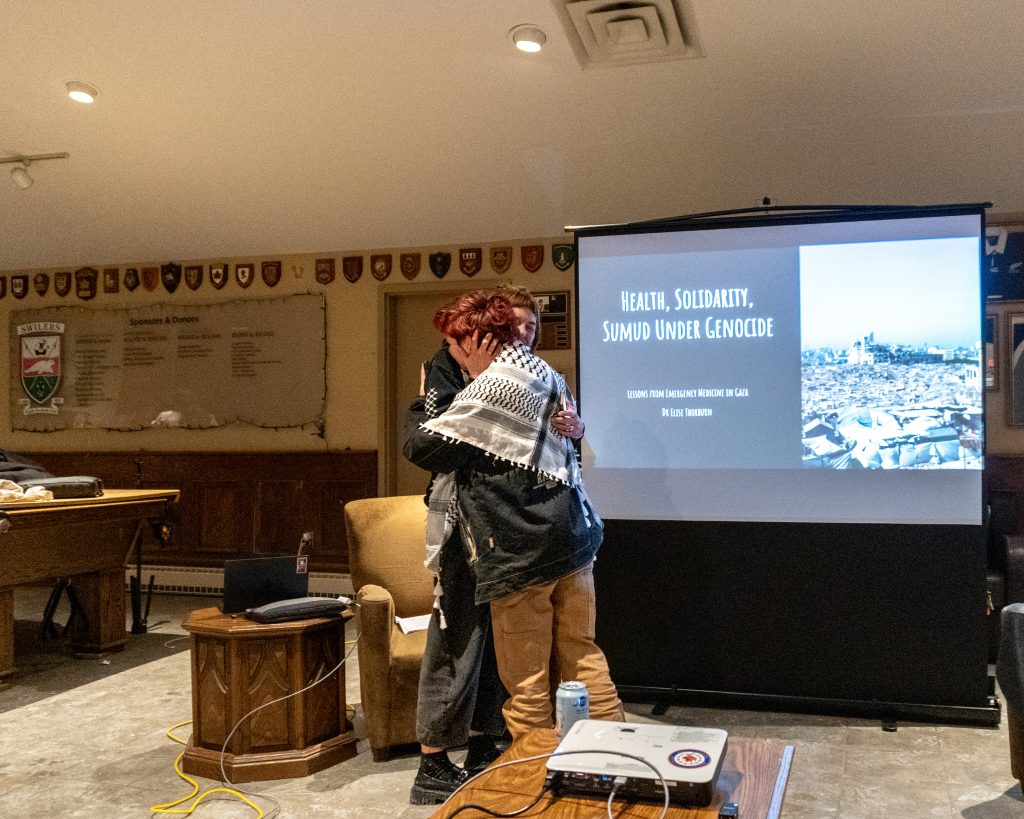
On November 11th, 2025, community members gathered for a Townhall in support of Palestine, calling for a two-way Arms Embargo with Israel. The event included songs of protest, a message from Dr. Elise Thorburn from Gaza, and a conversation with Sadie Mees about her voyage on the Conscience Flotilla.
Dr. Elise Thorburn, who traveled to Gaza in October to provide emergency medical aid, acknowledged the amount of destruction she had witnessed incurred on Palestine since she arrived. She also discussed the incredibly high grocery prices in Gaza that make it extremely difficult for people to be able to eat – especially those who have lost employment.
Sadie Mees discussed her experience on the Conscience Flotilla, as well as her time being held in several Israeli prisons.
“The intent of our mission was to break Israel’s illegal siege on Gaza; it’s a fully legal, humanitarian mission” says Mees. “Our boat was hijacked by the IOF… During the interception, they descended with helicopters onto our boat.”
Community members leading group in songs of protest (Catherine Payne/The Muse)
Mees stated that the experience of those sailing on the Conscience was not comparable to the citizens of Gaza being imprisoned and held hostage: “We were physically abused, verbally abused, sexually harassed, but even within our group, others experienced much worse due to racism and islamaphobia… I’m here because I’m a White Canadian citizen and the eyes of the world were on our mission, and that is not the case for Palestinian prisoners who are there indefinitely – without charge, sometimes.”
Group discussion led by Daniel Smith (Catherine Payne/The Muse)
The event concluded with a group discussion on what further steps could be taken in order to support the people of Palestine, with mentions of non-violent protest marches, and contacting government officials to express deep concern for the genocide occuring in Palestine.
“The importance of our conversation here today is so that we can find ways of collective action moving forward so we can change that reality, because it’s not acceptable, and we need to do something,” says Mees.
Despite the weather, hundreds gathered for the Remembrance Day ceremony at the National War Memorial in St. John’s this past Tuesday to commemorate those who have served.
November 11th marks the end of the First World War, and a national day of remembrance for veterans across all conflicts throughout Canadian history.
Remembrance Day ceremony in St. John’s (Kate McKnight/The Muse)
“It’s a good day because … it’s that one day of the year where people take their time to remember what people like myself, or my dad, or my uncles, or friends of mine did.” said veteran Michael Pretty.
In attendance at the ceremony was federal Fisheries and Oceans Minister Joanne Thompson, who laid a wreath on behalf of the federal government, Lisa Brown, Vice-President (Advancement and External Relations) on behalf of Memorial University, and Premier Tony Wakeham on behalf of the provincial government.
“When it comes to our whole education system and the opportunities that we have here in this country because of that, and so many people sacrificed their lives … it’s their efforts that keep us here, keep us safe and I think it’s just an opportunity to remember the past,” said Wakeham.
Residents and veterans alike crowded around the War Memorial, where on the eleventh hour they observed the two minutes of silence, followed by the laying of the wreaths.