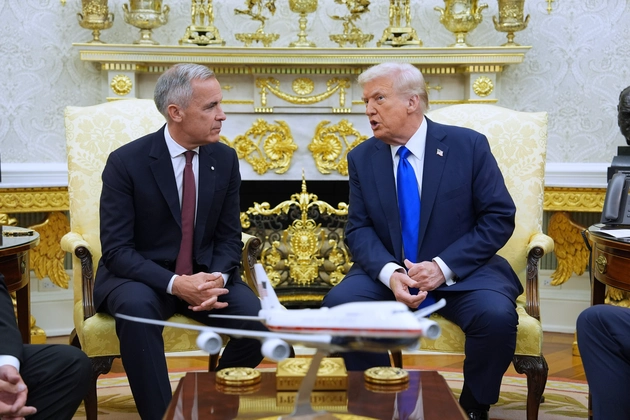
Mark Carney’s response to the recent attack on Venezuela by the American military and the kidnapping of the Venezuelan president Nicolas Maduro by the Trump regime is alarmingly pathetic.
Carney’s impotent statement, which itself claims that “Canada calls on all parties to respect international law,” actually does a great deal to undermine any claim that Canada may have had to being a country that strongly supports an international rules based system.
By focusing his statement on Maduro’s “brutally oppressive and criminal regime” and “grave breaches of international peace and security,” while offering zero criticism for the brazen transgression of international law by the Trump administration, Mark Carney is justifying the degradation of the rules based international order that he claims to uphold and venerate.
In fact, he goes further than justifying it. He downright supports it. In perhaps the most sinister part of his statement, Carney asserts that “Canada has not recognised the illegitimate regime of Maduro since it stole the 2018 election. The Canadian government therefore welcomes the opportunity for freedom, democracy, peace, and prosperity for the Venezuelan people.”
By saying he “welcomes the opportunity,” he is explicitly saying that he supports the actions that the United States took, somehow believing that those actions will lead to some kind of “freedom, democracy [and] peace.”
The Trump administration ratcheted up tensions in an unprecedented manner with their deadly targeting of Venezuelan boats in the Caribbean Sea and their naval buildup off of Venezuela’s coast.
While elements of the Trump administration, including Trump himself, initially tried to frame these actions as part of the “war on drugs” – specifically the fight against the fentanyl epidemic – declaring Nicolas Maduro and the Venezuelan citizens killed in the boat strikes to be “narco-terrorists,” they eventually admitted their primary objectives were regime change and resource extraction.
Venezuela is an oil and mineral rich nation, and Trump has not been shy about his intention to leverage this conflict to allow American companies to pillage Venezuela for its resources. This is a notable shift from past US administrations, who used more careful rhetoric and spin to justify conflicts such as the invasion of Iraq.
Critics have long held that such conflicts were primarily driven by resource extraction, but there was at least an attempt to mask this by the ruling coalitions at the time. With the Trump administration, everything is out in the open and they’re not even trying to hide their true intentions – in fact, they’re proud to announce them.
The initial line about fighting “narco-terrorists” is still used as well, but is hardly believable when Venezuela is responsible for a whooping 0% of fentanyl that is trafficked into the United States. Instead, it’s clear that this military action was meant to oust Nicolas Maduro, a longtime enemy of American political and economic elites, and to set the stage for resource extraction by American companies.
In its attack on Venezuelan soil, the American military killed at least 40 people including multiple civilians, and its kidnapping of Maduro harkens back to the 70s and 80s when the United States ruthlessly pursued the defeat of governments in Latin America, including the infamous coup against Salvador Allende in Chile or the deposing and capture of Manuel Noriega in Panama.
The actions taken against Venezuela, and the the boat bombings that preceded them, are wildly illegal by any standard of international law, and you would be hard pressed to find a significant coalition of scholars or experts in the field who would tell you otherwise. Beyond the illegality, the precedent these actions set should terrify everybody. If China attacked Taiwan and kidnapped their president, or if Russia did the same to Poland, Mark Carney would have no trouble expressing how horrific of a violation of international law those actions would be.
But with the Trump regime actually engaging in these actions towards Venezuela, he did not manage to utter a single word of condemnation. Instead, he spent his time bemoaning the “brutally oppressive and criminal regime” of Nicolas Maduro and its “breaches of international peace and security, gross and systematic human rights violations, and corruption.”
To anyone who is familiar with the recent history of American foreign policy, this sounds awfully familiar to the justifications made by many Western leaders when it came to the United States’ involvement in countries like Iraq or Libya. Seemingly everyone looks back now and agrees that those interventions were atrocious mistakes which made bad situations worse and further destabilized the countries which America claimed needed to be “freed” from the dictators which ruled them at the time.
The last 80 years is rife with examples of American intervention destabilizing entire countries and regions, while shattering America’s reputation with much of the global population. And yet, the American ruling class engages in these invasions over and over again, with the military industrial complex and resource extraction justifying the capitalist desire to do so.
On the contrary, the Trump regime’s offensive has not only undermined the freedom and peace of Venezuela, but of the entire globe. It shreds the veneer of international law and drags us closer to an unapologetic ‘might-makes-right’ world where large and powerful countries act with impunity and where small weaker nations live in constant fear of having their sovereignty annihilated.
By decimating any legitimacy international law had left, after it has already been so thoroughly challenged in recent years by states such as Russia and Israel, the United States has just made the world a more volatile and dangerous place for everyone in it. Our Prime Minister not only rationalizes this, but supports it. And that is entirely unacceptable.