
Home Blog Page 5

Series Recap: Regiment move on to next round

0

Newfoundland Regiment fans got a great gift on Easter Sunday, as their beloved hockey team advanced to the second round of the Gilles-Courteau Playoffs, and defeated the Cape Breton Eagles in six games.

Split first two games

DSC3992
Newfoundland Regiment’s Pilgrim-Edwards (No. 7) skates towards the puck on opposite side of the rink after a heated play. (Anuoluwapo Abosede/The Muse)

As mentioned in a previous article, the Newfoundland Regiment split the opening two games of this series.

It entered game one with high expectations, but it was an uncharacteristically underwhelming performance for the team, falling 3-2.

Justin Larose scored the first playoff goal in franchise history, but the team was outmatched, especially in the third period, where Cape Breton’s Caden Kelly netted the game winner, giving the Eagles a 1-0 series lead.

Newfoundland was looking to exact revenge the day after and ensure they weren’t going to Cape Breton down 2-0.

They came out swinging with a goal in the first five minutes of the game from Blake Pilgrim-Edwards. They would continue to add in the second period, as Dawson Sharkey and Justin Larose extended their lead to 3-0.

Momentum seemingly shifted to Cape Breton midway through the period when Dawson Sharkey got a game misconduct for a blindside hit (also leading to a two game suspension), giving the Eagles a five minute powerplay, where Reece Peitzsche would capitalize, before Raoul Boilard got the Eagles within one before the period’s end.

Newfoundland would ultimately run away with this one, dominating the third period with three goals, and winning game two 6-2, tying the series 1-1.

Won two-of-three road games

SnapInsta.to 660794662 17914756149344200 8214815719459885811 n
Alexis Michaud scoring late in the first, tying game 3 for Newfoundland (nlregiment/Instagram).

With that, the series shifted to Cape Breton, where Newfoundland played three games in a row in enemy territory.

It was a perfect start for Cape Breton, which scored 25 seconds into the game, and led for most of the third period, before Alexis Michaud scored his first of the playoffs in the final 15 seconds of the period.

Newfoundland added two more in the second period, thanks to Benjamin Veitch and Tyson Goguen. Cape Breton would score later in the period, but were ultimately shut down after Marek Danicek got a late third period insurance goal, suring up the 4-2 win for the Regiment.

Entering game four up 2-1, Newfoundland was looking to extend their series lead to 3-1, and that they did.

After a 1-1 first period, Ryan Dwyer scored his first career playoff goal early in the second to give Newfoundland a 2-1 lead, before Louis-François Bélanger added insurance late in the period. Newfoundland would score twice more in the third, giving them a blowout 5-1 win.

Newfoundland had the chance to win the series on the road in game five.

It scored three goals in the first period, including a goal from Benjamin Veitch, assisted by Quinn Norman, both of whom are rookies and the only NLers on the team.

Cape Breton nabbed a goal late in the first period, before Newfoundland scored another in the second, meaning Newfoundland entered the third in complete control and 20 minutes away from advancing to the second round.

But in a shocking turn of events, all within the last 12 minutes of the period, Newfoundland gave up three unanswered goals, as Cape Breton tied the game 4-4 and force overtime, where Maxime Sauthier would score the game winner for the Eagles 22 seconds into the frame, sending the series back to St. John’s.

First ever NL-based QMJHL team to win a playoff series

DSC3348
Regiment goalie Louis-Antoine Denault had a 2.66GAA and a .909sv% in this series (Anuoluwapo Abosede/The Muse).

After the frustration of blowing their late third period lead and squandering their chances of ending the series, Newfoundland entered game six determined to finish the job.

Dawson Sharkey gave Newfoundland a ton of momentum early, as he scored in the opening minute of the game. Reece Peitzsche would tie the game for Cape Breton midway through the period, before Tyson Goguen scored a late first period goal to give Newfoundland a 2-1 lead.

The game got out of control in the second. Newfoundland score four unanswered goals, extending their lead to 6-1 after 40 minutes.

While the Eagles scored twice more in the third, this time, their deficit was too large to overcome, as Newfoundland would go on to score an empty netter and win the game 7-3, giving them a 4-2 series win.

After the series, head coach and general manager Gordie Dwyer said “I like the way our team responded after the last game, coming home and a big Easter Sunday crowd here at the Mary Brown’s Centre, so great to see the building alive and electric, and I really like how our team came out [to play].”

Newfoundland’s round two match-up will be determined on tonight.
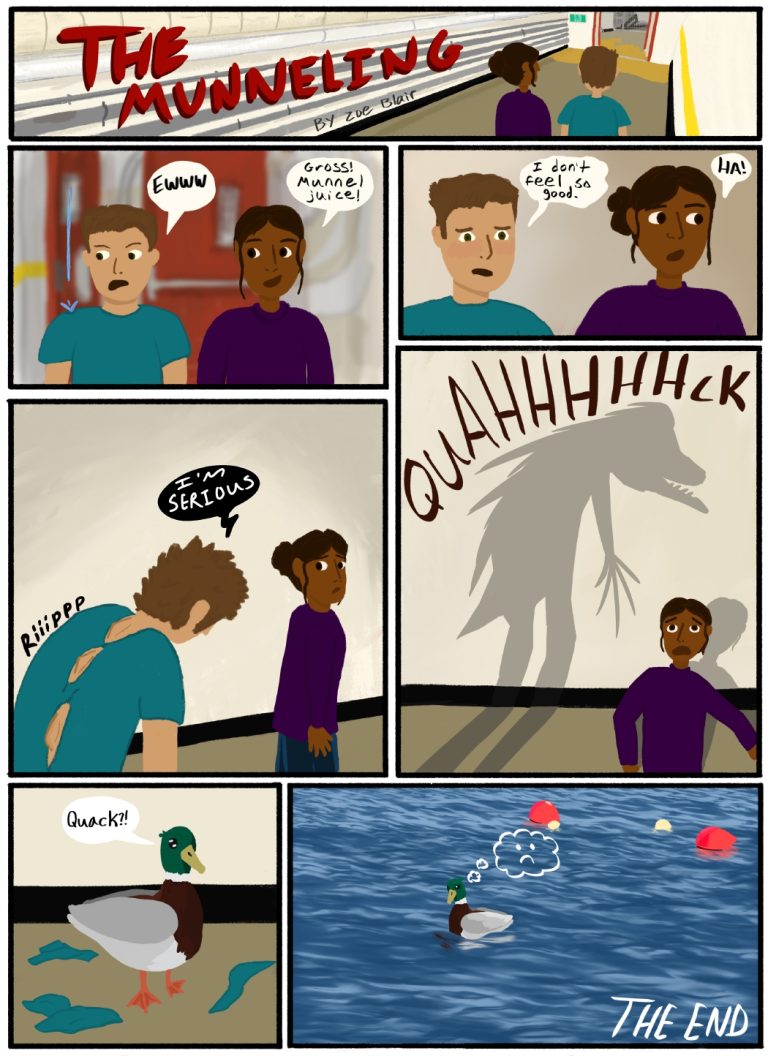
COMIC: The Munneling

0

Are you a comic artist? Submit or pitch your comics to editor@themuse.ca!

LETTER: Fund the Freedom to Learn

0

A plaque in the atrium of the Arts and Administration building on MUN’s St. John’s campus reminds us that our university was created as a living tribute to the enormous sacrifices made by the people of Newfoundland and Labrador on the battlefields of Europe: “In the freedom of learning their cause and sacrifice might not be forgotten.”

This legacy is a moving testament to the desire of the people of this province to build something of beauty and meaning that helps us all live better together now and in the future of this place.

Freedom to learn is something unfettered and unrestricted. It is a freedom codified into sections 3(3)(a) and 3(3)(c) of the legislation covering Memorial University: the university shall, “give instructions and training in all branches of knowledge and learning” and “provide facilities for the prosecution of original research in every branch of knowledge and learning and to conduct and carry on that research work.”

But, the freedom to learn that defines Memorial University has been subject to salvo after salvo in a decade of funding cuts.

Since 2014, every provincial government has reduced transfers to Memorial while professing continued support for the University.

As of 2025, MUN’s operating grant was down 47 percent in inflation adjusted dollars from its level of funding in 2014. No institution, no matter how ‘nimble’, can be what it was before almost half of its budget was removed.

Cuts to the university’s operating budget continue despite two separate studies showing the institution’s economic contribution to be between $1-2 billion.

That contribution means that for every dollar of public money put into the university $2-4 dollars come out into the broader economy. There is not an investor in the world who wouldn’t jump at a chance to double or quadruple their money.

Muse colour
Comparing university budget 2014-2024 versus the economic contribution of Memorial University. Circles are proportional to the numbers they represent.

Yet, when it comes to the public university of this province governments typically treat it only as a cost. Members of our provincial government repeatedly describe Memorial University students as “the most heavily subsidized” in the country while insisting the university get its “fiscal house in order.”

But what do statements like these even mean?

Memorial University is a public university. Public infrastructure and services are, by definition, supported by public money.

Shall we build a public drinking water system and then complain that the water coming out of the tap is too wet?

Transfers of public money to private industry—that’s a subsidy. Meanwhile, it’s academic staff members and students who bear the fallout of unrelenting budget cuts in the form of deteriorating working and learning conditions.

Those cuts—even in the face of clear evidence of the economic benefits of the university—dismantle the very infrastructure necessary to fulfill the core mission of the university.

Budgets are choices.

The decade of cuts to MUN is a shameful choice to abdicate the responsibility to honour the memory of sacrifice and the freedom to learn that our university is founded on.

Previous governments have made that choice, but this one doesn’t have to. Today’s government can chart its own course and help restore the foundations on which Memorial University is built.

Josh Lepawsky, Professor, Department of Geography, Memorial University

AI, and You: MUN Libraries AI Strategic Project Team

0

In the Summer of 2024, Memorial University Libraries put together an AI Strategic Project Team. The Muse sat down with Chelsea Humphries, the Chair of the Team, to discuss AI and its impact on the libraries and students.

The team was developed “to support learning and information sharing both within the university as a whole around AI” says Humphries. It helps library staff and students “to learn more about AI, how it functions, and how we can make more informed decisions.”

Humphries says that MUN Libraries itself doesn’t “necessarily [use] AI, but [they] do a lot of work around AI literacy. [They] provide resources and instruction to both faculty and students.” 

However, there are some specific tools that have new AI features. There are currently “a number of databases that the library subscribes to that have brand new generative AI features in them.

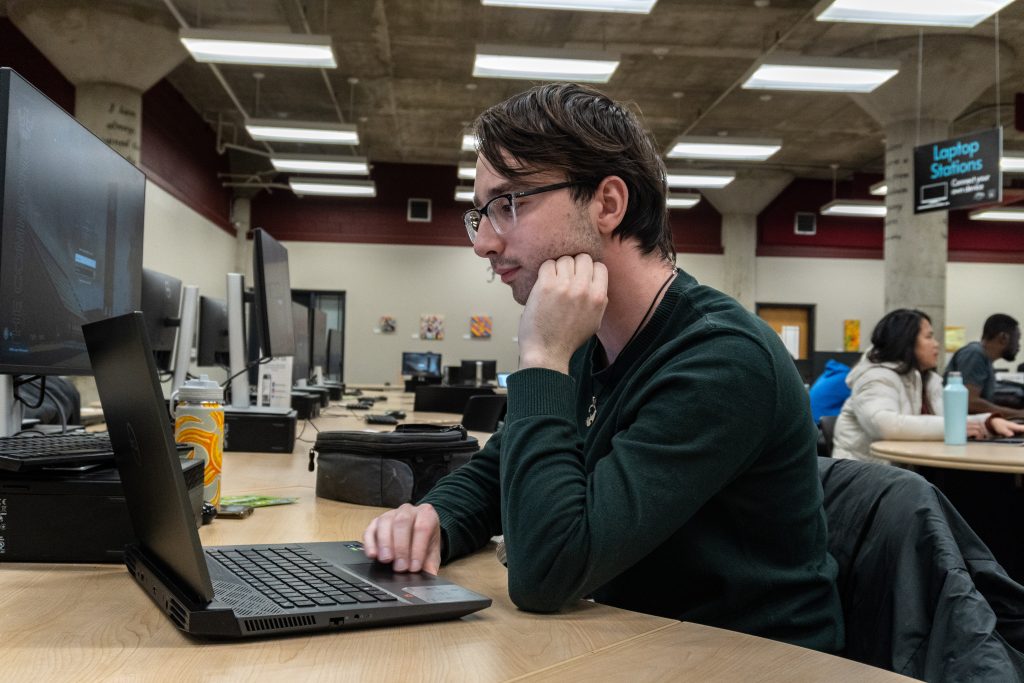
DSC01163
A student at work in the The Commons at QEII Library (The Muse/Anuoluwapo Abosede)

Some examples include Scopus and Web of Science. These are database subscriptions which use generative AI as a research tool that acts as a sort of “super-powered version of predictive text,” but the AI is an “add-on” rather than a requirement to use the database.

These AI add-ons are large language models (LLMs). Scopus and Web of Science are LLMs that are trained on private data, whereas LLMs like ChatGPT are trained on public data. There are some important differences between the two that students should know about. 

Firstly, Scopus and Web of Science are “drawing from the scholarly material actually in [their] databases, instead of ChatGPT drawing from the entire scraped internet,” says Humphries.

This makes for a better research tool because of what Humphries calls “retrieval augmented generation (RAG).” 

What RAG does is make sure that the output of the AI is rooted in the private database it was trained on. This roots it in the scholarly material and makes the AI less likely to “hallucinate.” These LLMs are also better at providing citations. 

Secondly, LLMs like ChatGPT collect users’ data, whereas Scopus and Web of Science do not. “The default setting if you’re using ChatGPT is that it will retain anything you type into it, and anything it spits out. It will use that to continue training the tool for other people.”

“We in the libraries encourage anyone using these tools to refrain from sharing anything super personal. If you’re doing research, consider [it] your own intellectual property. You don’t necessarily want [your work] to be saved in a big generative model.”

Humphries also states that users of these tools should be cautious in giving copyrighted materials to generative AI. Amid ongoing legal battles, “we don’t have any definitive rulings on whether copyrighted content [is] legally allowed to be used… or if that’s copyright infringement.”

This is to say that there could be copyright implications for sharing such material with AI.     

DSC01136
Between the bookshelves at QEII Library (The Muse/Anuoluwapo Abosede)

Humphries argues that while AI can be used as a useful research tool, it doesn’t replace having actual human input on a topic.

If students were to instead “ask a librarian, there’s a good chance you’ll get a really robust answer that won’t have the same risk of leaving information out.”

“We are all still the experts and the authorities on the topics that we are doing our work on and the things that we are investigating.”

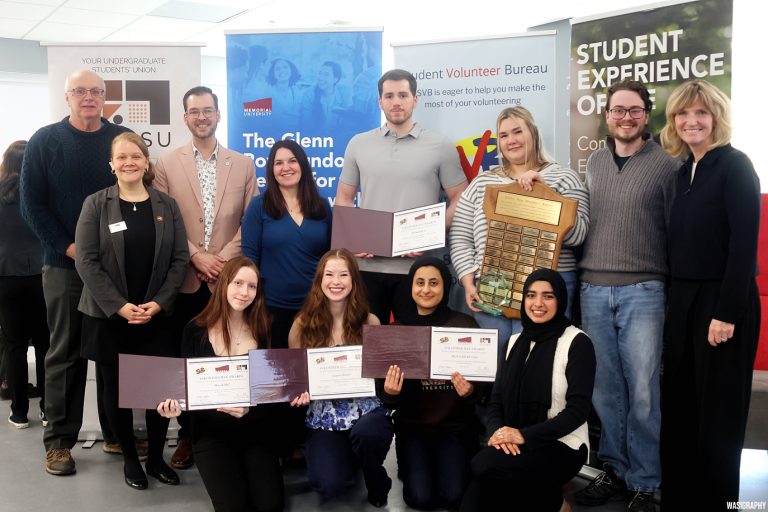
The Student Volunteer Bureau host 2026 Volunteer Day Awards

0

The Student Volunteer Bureau kicked off the Volunteer Day Awards on March 25th in the Landing, with guest speakers including President Janet Morrison, Associate Vice-President (Academic) and Dean of Students Christine Arnold, Director of Student Life Dr. Jennifer Brown.

The Awards commemorate student volunteers and groups at Memorial. Here is a list of the awards and their recipients.

Volunteer Student Group of the Year

0326 (3)(31)
MUN UNICEF Club receiving the Volunteer Student Group of the Year Award (Wasif Hossain/SVB)

There were four nominees for Volunteer Student Group of the Year, with MUN UNICEF Club winning the award.

This award is presented to a Club or Society that has contributed to their university community through their volunteer work this past year.

David Kirkland Student Leadership Award

0326 (3)(33)
Norman Burry receiving the David Kirkland Award (Wasif Hossain/SVB)

Amid twenty nominees for the David Kirkland Award (Student Leadership Award), Men’s Basketball Seahawk Norman Burry took home the achievement. 

This award is presented to a student who has contributed to the university community and demonstrated leadership in their volunteer work.

Student Volunteer of the Year

0326 (3)(35)
Lauren Ringer receiving the Student Volunteer of the Year Award (Wasif Hossain/SVB)

The Student Volunteer of the Year was awarded to Lauren Ringer, who rose above ten other nominees.

The award is presented to a Memorial student who have made contributions to the university community, local community, or the global community. Nominees must have a long-standing commitment to volunteerism.  

Volunteer Residence of the Year

0326 (3)(36)
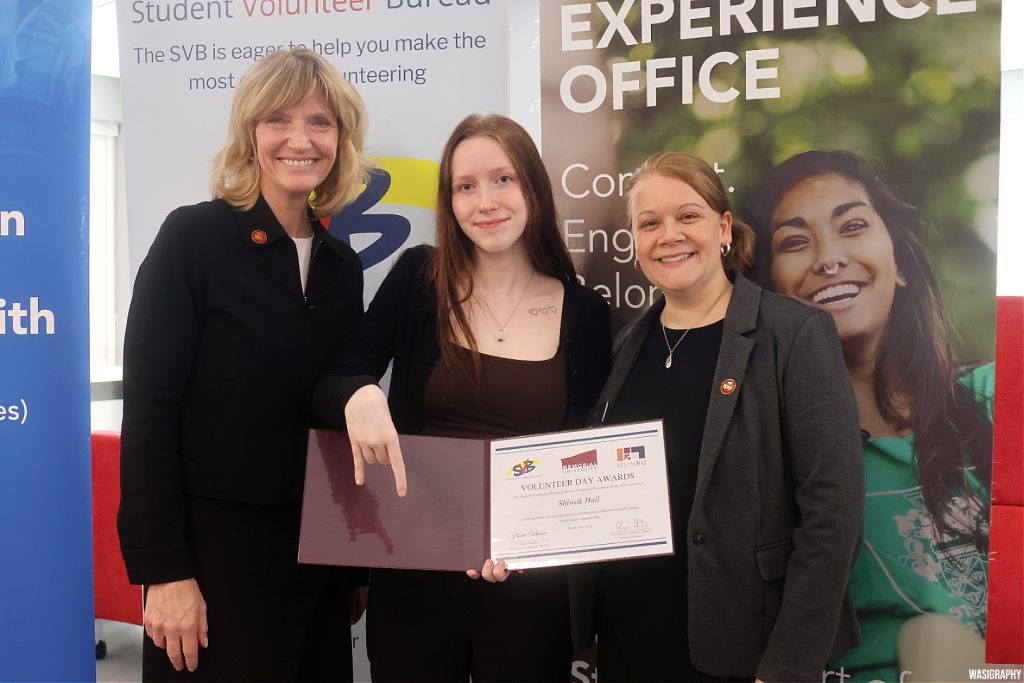
Shiwak Hall receiving the Volunteer Residence of the Year Award (Wasif Hossain/SVB)

The Volunteer Residence of the Year was awarded to Shiwak Hall.

This award is presented to a residence at Memorial that has made considerable contributions to the community through their collective volunteer work.

Glenn Roy Blundon Award

0326 (3)(42)
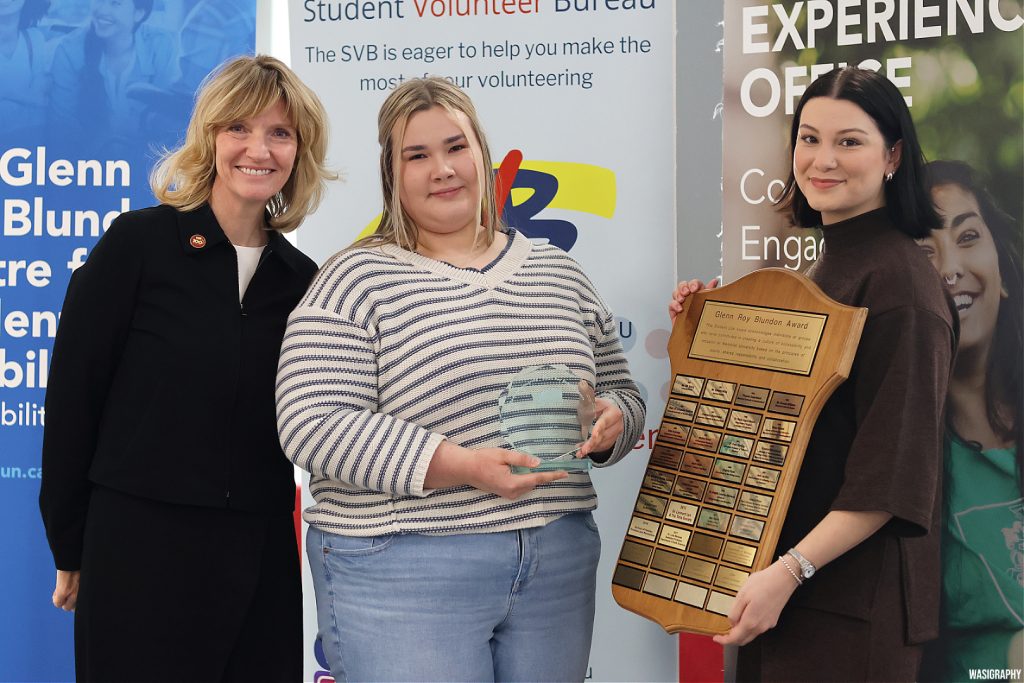
Halie Hindy receiving the Glenn Roy Blundon Award (Wasif Hossain/SVB)

Finally, the Glenn Roy Blundon Award was granted to Halie Hindy, amid five other dedicated nominees.

Named after former Memorial student Glenn Roy Blundon, the award is presented to a student who has surpassed their normal volunteer duties to advocate for students with disabilities.

Why MUNSU representatives say CHMR should be cut

0

After close to an hour of listening to the public plea to keep CHMR open, multiple MUNSU executives presented their own reasons as to why they believed the station needed to be cut.

HSS Representatives

Juairya Abdullah, an HSS rep for MUNSU, and a CUPE 4554 MUNSU employee addressed concerns from the community that taking away CHMR silences marginalized voices, saying “I hear a lot about black and brown and marginalized communities and how much this impacts them, and it almost comes off as little bit of, like, tokenization, as a brown, Muslim, international student.”

She also responded to some community criticisms of the 84 person survey.

She said “someone talked about going to the math society or the statistics department about doing a full survey with their cases… one of the biggest things about statistics, because I have a minor in statistics, is when you’re doing a survey, sometimes it’s not possible to get a whole sample of the population…”

“If your whole population is 11,000, you do a randomized sample to make sure you understand what it represents… because sometimes it’s not possible to do 11,000 members.”

Abdullah said a focus needs to go towards ensuring students needs are met “we’re in a recession right now. I care if someone gives me a $10 voucher to Sobeys, because that’s what’s gonna help me, because the first thing that I’m worried about is being able to make rent, if I’m able to make my tuition, if I’m able to eat properly.

“I feel like a lot of the times when the community speaks about like, well, ‘this is so important,’ of course it’s important, but you need to make sure students have the ability to live and get their actual needs met, and we’re not even able to meet their needs.”

Finally, one other point made by Abdullah was ensuring MUNSU was being smart with its money.

“I’m a student, and I care about where my $51 that I give every semester goes, and, when I know that I’m giving this $51 to the university, that I worked blood sweat and tears for… I know when it goes to help [students].”

“I would love for us to be able to fund everything… I’ve seen over the last to years that I’ve been working here, some people talk about free meal [plans]… that’s what students need.”

Another HSS rep, Hasan Habib, responded to claims that CHMR creates job opportunities for art students.

“I think it’s rather unfair to talk about student employment while not having students as full-time employees in CHMR. To the best of my knowledge, the employment option that CHMR offers to undergrads are, if I’m not mistaken, mostly MUCEPs and ISWEPs, and for those who don’t know, MUCEPs and ISWEPs pay at most around $1,500 a semester. It would perhaps be better to talk about equity and employment for arts students after such concerns within the CHMR structure is addressed.”

He also gave a response to CHMR’s station manager Rhea Rollman, who called out MUNSU for its $1 million loan to renovate the Breezeway.

He said “the Breezeway offers an amazing service, if you simply ask a student they’ll tell you that… they offer an amazing service as a venue for socialization, events, and a place to get drunk after 5pm classes, which I think it quite important for students, especially if they want to maintain a regular type of life… I think it would be quite unwise, in my opinion, to dunk on services that the student body uses regularly in order to get by their day-to-day lives.”

Business Representative

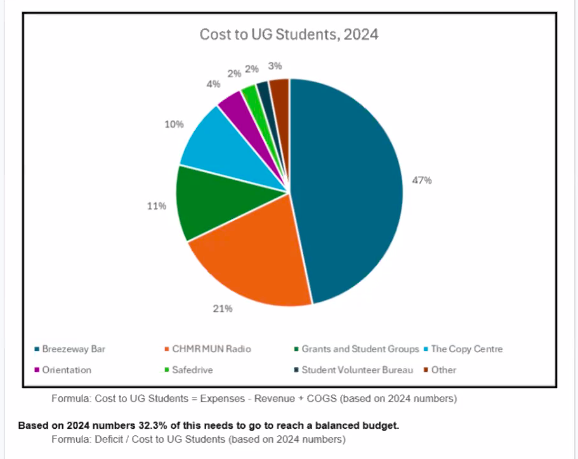
One of MUNSU’s business representatives, Jordan Dean, created the following visual:

a7296ef42d3a8d1a5b630cb5354d07ac
(Jordan Dean/MUNSU).

Dean said “MUN provides different services. These are the seven main services, and the other category was too small to really mention. There’s a deficit… it is a big deficit. This is our pie, and 32% of it needs to go based on 2024 numbers, and that’s just to balance the budget.”

He continued “if you’ve got to cut 32.3% of this pie out, you can’t do that do that without reducing funding to the radio station.”

“I have spoken to many business students and other students over the past week and a half and unfortunately many are unaware of the service [CHMR], and I have to explain the whole situation because they’re just completely unaware. So that’s my stance, at least for the business faculty and business students, it’s not a service we use.”

Executive Director of Finance

MUNSU’s finance executive spoke about the Union’s current financial situation.

He said “thank you for the overwhelming support for CHMR. It means so much to me to see so much outpouring of love and support for CHMR. When I was elected into this role, MUNSU was in free fall. It still is. Right now we are at a juncture where, like, over next year, actually, if we don’t find a way to break even, then we will have to take out a loan, and then we all know how that path goes. We have another union on campus and we are all seeing what they are going through.”

“So, I have two choices, which is: do something now, or let this organization, the MUN Students Union, face bankruptcy in the next 2-3 years. This decision is not light at all, as the Executive Director of Finance and Services, I was elected to look over the finances of our services, but also the long term financial stability of the Union… and we don’t have anywhere else to go for our funding… our only source of revenue is student funds and our businesses. That’s it.”

Executive Director of External Affairs

MUNSU’s Director of External Affairs said “I fully understand the sentiment of someone on the board of CHMR who may have felt blindsided by this. But I mean, I think it’s really important to emphasize at the same time, because we have unionized staff members, that our consultation obligations would be an inappropriate space to talk about future jobs within that space.”

Many referred to a five-year plan CHMR originally proposed to MUNSU (Rollman also proposed a one-year plan on multiple occasions at the meeting). Gillingham’s response was “it does appear that we don’t really have time, and I think that’s what’s heaviest about this conversation. Our accountant had flagged just a couple of months ago that our bank account was getting so low that we might not even had enough money to pay our staff. That’s a dire condition. It causes a lot of stress amongst many of the current staff here as well.”

Student Life

MUNSU’s Director of Student Life didn’t actually speak during the public forum, but took to an Instagram comment section a day later, where he posted “I am seeing a lot of comments but not many from current students actually paying for this service. CHMR ran a community fundraiser and received a little over $300… If all the media and alumni in these comments who said they support CHMR put their money where their mouth is the union might not have had to make this decision.

Responding to another comment, Colbran said “I don’t think it’s anyone’s “fault”. The cost has grown and the money from enrollment is down. The funds must come from somewhere. I am not expecting the community to fund CHMR but students shouldn’t either (as I see being suggested).”

The comments, emails and responses I am seeing are clearly placing blame on the students who voted for the station’s closure as a MUNSU service. If they choose to place blame it also has to lie with the people who use the service without contributing. The fact of the matter is most students do not use the radio station – out of 11,000 students don’t you think more than 60 (not all of those were in support of the CHMR either btw) would have responded?”

“The students I have talked to all said they don’t use it and don’t understand why we are spending $300,000 on it. I do believe the motion passed on what the vast majority of students would have wanted. I would absolutely support a referendum to increase funding, let the students decide.”

Farhan Probandho, MUNSU’s director of finances, called out his colleague on the same Instagram post, and the two had a back and forth in the comments.

MUNSU announces results of 2026 General Election

0

The results of the MUNSU general election were announced this evening, April 2nd amid more than 10 vacant positions and 12 uncontested. These vacancies were:

  • Indigenous Rep
  • Music Rep
  • Burton’s Pond
  • MacPherson College
  • Trans Rep
  • Queer Rep
  • Medicine Rep
  • HKR Rep
  • HSS Reps
  • Eng Rep A
  • Pharmacy Rep

The results of the filled positions are as follows:

Students with Disabilities Representative

Julia Crocker: 276

Jane Meadus: 220

Women Students’ Representative

Hailey Cooke: 480 Yes , 45 No

Education Students’ Representative

Rachel Snow: 27 Yes , 0 No

Nursing Students’ Representative

Winner Nwachukwu: 63 Yes , 7 No

Social Work Students’ Representative

Halie Hindy: 51 Yes , 4 No

Engineering Students’ Representative B

Aayushman Srivastavah: 51 Yes , 4 No

Center for Nursing Studies Representative

Chioma Ehigie: 386 Yes , 57 No

Business Students’ Representative

Shadman Kabir: 92 Yes , 22 No

Science Representative’s (3)

Md Abdullah Al Saikat: 162 Yes , 28 No

Blessing Agu: 155 Yes , 37 No

Sheikh Mahdi Mansib Zion: 158 Yes , 27 No

Black Students’ Representative

Joy Olabode-Daniels: 478 Yes , 49 No

International Student Representative

Swacha Mallik: 481 Yes , 64 No

Executive Director of Campaigns

Rana Abuidris: 450 Yes , 120 No

Executive Director of Finance

Nathan Gillingham: 312

Isfak Ahmed Nehal: 169

Shokry Ahmed (Ziad): 120

Executive Director of Advocacy

Sanaa Mrad: 502 Yes , 72 No

Executive Director of Student Life

Blake Colbran: 480 Yes , 85 No

Executive Director of External Affairs, Communications & Research

Kazi Taqi Yeasir: 344

Stephen Ehigie: 266

MUNSU board votes to cease funding CHMR

0

In an in-camera session, MUNSU Board of Directors voted to cease funding to CHMR. By June 1st MUNSU employees assigned to CHMR “shall no longer spend their paid working time on broadcasting” according to the motion passed at the April 1st meeting.

A previous version of the motion was ruled out of order by Board of Directors Chair Mackenzie Broders because it included MUNSU taking over the $2 per semester student-levy that partly funds CHMR.

The motion that passed says that the “levy will continue to be collected and remitted in accordance with existing referenda and bylaws.”

At the meeting, MUNSU Executive Director of External Affairs Nathan Gillingham said that they need to make cuts to address their deficit of nearly $300,000, and that if the financial situation does not improve at the student union, it will face bankruptcy.

Station Manager Rhea Rollman says she’s seen MUNSU in debt before, and has come back from it by making a longterm plan. “As someone who’s worked here for 20 years, I can guarantee without a shadow of a doubt MUNSU is not going bankrupt anytime soon.”

She says that when she was on the board of MUNSU it was in a worse financial position, and got through it by limiting spending and making a multi-year plan.

Rollmann says that back in December, she had approached the MUNSU board with a five year plan for independence from funding from the Student Union. She says this was rejected by the executive.

At the meeting, Rollmann instead asked for a one-year continuation of funding as the station prepares for independence. This was not granted.

Community support

In the past week, a massive wave of support at local, provincial, and national levels came in favour of keeping CHMR funded. People such as former Open Line host Paddy Daly, CBC’s Tom Power, OZ FM’s Hugh Campbell, musicians and more called for MUNSU to keep the station operational.

Before the in-camera session, community members were invited to the MUNSU meeting and were given the opportunity to publicly discuss their thoughts on MUNSU’s decision to potentially shut down CHMR, including a number of current undergraduate students.

About 140 members of the community and students attended the meeting virtually.

‘Taking away marginalized voices’

One of the biggest concerns mentioned at the meeting was the fact that taking away the campus radio station would be taking a voice away from marginalized people.

Sarojini Ramnarine-Lang says she has been hosting a show at CHMR for nine years.

She said “I have given my time to CHMR and see CHMR shut down, you’re gonna have something else coming to you… I have hosted consistently black history month, women’s history month, the Islamic functions, the Hindu functions, the Buddhist functions and more.

If you shut down CHMR I want you to write to me and tell me who is gonna be the voice of black, Indigenous and people of colour community on campus.”

Greg O’Grady, Chair of the Newfoundland and Labrador stuttering association said that hosting his own show at CHMR helped both him and the rest of the stuttering community in St. John’s find their voices.

This was arguably the biggest concern brought up at the meeting. Almost everyone who spoke was worried about the potential of taking voices away from marginalized communities, including undergraduate student Drake Rose, who said “you have several voices within students that are not often represented. I know for sure there are some people who come from Ukraine, Malaysia, Bangladesh that currently have shows at the station.”

‘MUNSU only surveyed 84 people’

Many people were critical of the survey handed out by MUNSU that saw only 84 people respond.

Jeff Rose-Martland was said “you’ve conducted a straw pole of 84 people, and you’re basing this decision on such a low sample, for such a large population… If you’re going to shut down the station, you need to consult the students, and if your justification is nobody’s listening, you need to be able to show that, and 84 people doesn’t do it.”

Kody Gardner, the stations technical director said “I think it’s such an injustice to pull 84 people and make a decision on closing or, you know, removing the funding from CHMR. I can’t imagine making a decision this big with 84 people.”

‘Importance in arts community’

Many in the arts community stressed the importance of CHMR in promoting stuff within the arts.

Cullam Lockhart, a member of the arts community and MUN alum, said “I understand that in a modern era, a lot of things like radio are less relevant because there’s Facebook now.”

“But the fact is, as someone who is very involved in theatre and trying to get these things out, things like Facebook, Instagram and social media are not working very well for these community outreach programs anymore. It’s being replaced with a lot more algorithmic content.”

Brad Mercer said “I want the MUNSU executive to consider that, you know, this is not a decision you want to have associated with your reputation. If you ever want to have a future claiming you support the arts, that you support the growth of artists, that you support the growth of a local or artistic community. This is not a decision you want to have associated with you. I really want you to think about it and consider it.

‘Importance for future journalists’

A lot of people highlighted the importance CHMR has for honing the skills of future journalists and giving them job opportunities.

VOCM’s Russell Bowers was in attendance, and he says he got a job at VOCM less than a year after starting at CHMR, crediting the campus station for giving him that opportunity.

MUN undergraduate student Gracie Gallant, who hopes to get into radio in the future said “I was genuinely so confident CHMR was going to be the reason that I could have a career in radio after graduating MUN… I think to get rid of such a vital community and training ground for prospective journalists at MUN and other creative minds would be just such a deeply felt mistake for years to come.”

The future of CHMR is still uncertain, as the motion passed does not preclude the station to continue independently.

CORRECTION: A previous version of this article said it was a unanimous vote. This is incorrect. We have since been informed that there was one vote opposed.

MUNSU executive responds to motion of reprimand

0

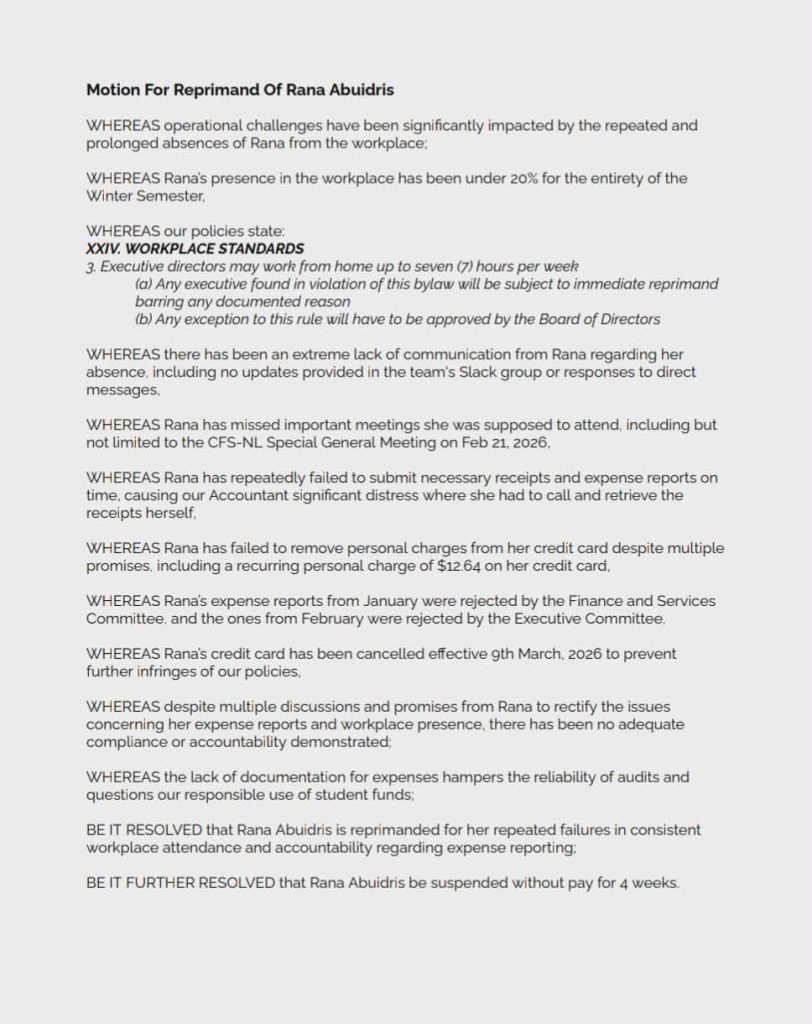
MUNSU’s Director of Campaigns, Rana Abuidris faces a motion of reprimand that alleges shortcomings in her role this past semester. Notice was given at the last MUNSU meeting, and is on the agenda for the April 1st meeting.

The motion, moved by Farhan Probandho, alleges that Abuidris has been present in-person for less than 20% of the semester. MUNSU allows Executives to work, at maximum, seven hours from home per week. For reference, the executive positions are full-time positions, for a total of 35 hours per week.

It also alleges she has been absences at meetings, and has had a lack of communications with other members of MUNSU.

It alleges that Abuidris has used her MUNSU credit card for personal expenses, that her expense reports in both January and February were rejected, and that her card was deactivated on March 9th.

Motion

The motion calls for Abuidris to be suspended for four weeks without pay.

Abuidris responds

We reached out to Abuidris for comment, and this is what she had to say.

“I want to begin by acknowledging the importance of accountability within the Students’ Union, and I appreciate that this process reflects a commitment to transparency and responsibility to students.”

“However, I do not believe this motion reflects the full context of my role or the work I have delivered throughout my term.”

Abuidris said that the Director of Campaigns position is “largely external, independent, and structurally unsupported.”

She said that she spent significant time on events over the past year, such as the Day of Action and Black History Month, while also engaging with university admin on issues such as unpaid work terms and tuition costs, as well as communicating with government officials.

She said she “formally raised concerns regarding communication, process, and lack of structural support within the environment, including the need for additional staff such as an HR or harassment-related process.”

She told us about the feeling of isolation that comes with being the only woman on the MUNSU Executive.

“Those concerns were not addressed in a meaningful way,” said Abuidris.

“I recognize that my in-office presence has not always been consistent,” said Abuidris. “However, reducing the work of this role to physical presence alone does not accurately reflect how campaigns are built, relationships are maintained, or outcomes are achieved.”

“This motion focuses on operational gaps without fully accounting for the conditions that created them.”

Abuidris told us that she “remains committed to improving [her] administrative processes.”

Abuidris is seeking re-election as Director of Campaigns for the 2026-27 university year.

MUNSU to hold ‘in-camera’ meeting on CHMR following community statements

0

MUNSU Executive Director of External Affairs Nathan Gillingham says that the executive will motion to go in-camera at its April 1st board meeting, closing the decision-making process on CHMR to the public.

The first section of the meeting will be open to the public to give statements on CHMR. There has been a massive wave of support from the community in favour of keeping CHMR open in the past week.

According to MUNSU’s Instagram post the meeting has been moved online because due to “inclement weather.”

Gillingham says that because meeting will focus on the distribution of documents to Board members relating to employee-employer confidentiality, including CUPE 4554 (Canadian Union of Public Employees local that represents MUNSU staff) correspondence, and collective bargaining matters.

“Our Collective Agreement outlines the Board of Directors as the employer of our unionized staff. Any matter the Board considers relating to this jurisdiction would be best practice as a closed session in order to be in full compliance with labour laws and our expectations as the employer,” says Gillingham.

According to Gillingham, CUPE members will be allowed to attend the closed portion of the meeting. Rhea Rollmann, Station Manager of CHMR tooked to the Instagram comments to express her disapproval of the intention to close the meeting to the public.

“Why is there a closed session with CUPE 4554 members? As a CUPE 4554 member I think it’s really important the debate/discussion be public for all students to watch. CUPE has nothing to hide, why does MUNSU want this session to be secret? “There’s nothing confidential here and students deserve transparency. As a CUPE member I seriously object to the secrecy and really don’t feel comfortable with a secretive closed session, important discussions like this deserve to be made publicly and transparently. Students deserve to see and hear how their elected reps represent them.”

Gillingham says that any decisions made during the meeting will be further communicated in a press conference on April 2nd.