After a weather delay, Fridays For Future St. John’s is holding a global climate strike this Friday, April 26th. At 12 pm, protesters will meet at the MUN clock tower and march collectively to the Confederation Building.
Entitled Voices of Resilience, all are encouraged to attend to include their voices, amplify impact, and exert pressure on their elected officials. Chants will be chanted, songs will be sung, and protest signs are encouraged!
Fridays For Future St. John’s has highlighted 4 main goals for the Voices of Resilience protest:
The Government of Newfoundland and Labrador to declare a climate emergency
Substantial investments in province-wide public transport infrastructure
Ceasing of subsidies for Oil and Gas companies
Provincial legislation that bans advertising for Oil and Gas companies
Fridays For Future
Fridays For Future St. John’s is a St. John’s-specific branch of the global, youth-led, collective grassroots Fridays For Future movement.
Fridays For Future St. John’s is a youth organization advocating for climate action from municipal, provincial, and federal government. Join us in protecting our planet for now and for future generations.
The Memorial University Students’ Union is holding a town hall meeting on Monday, May 22nd, at 7pm in the Breezeway. The purpose of the meeting is to spark a dialogue surrounding the future of post-secondary education in the province.
The student union invited Premier Andrew Furey, Opposition Leader Tony Wakeham, Third Party Leader Jim Dinn, University President Neil Bose, and Board of Regents Chair Glenn Barnes to participate as part of the panel and answer students’ questions.
Of the invited guests, those confirmed are: Minister of Education Krista Lynn Howell, PC MHA Craig Pardy, NDP Leader Jim Dinn, MUN President Neil Bose, and MUN Board of Regents Chair Glenn Barnes.
Following the town hall meeting will be an after-party open to students, faculty, staff, parents, and community members, from 9-11pm.
Last April, the student union held another town hall with attendees including MHA’s representing all three provincial political parties, as well as the President and Provost of MUN. We then saw in July a commitment from the provincial government to invest up to $10 million towards the removal of the campus renewal fee.
This is to say that we have seen changes and decisions made following added pressure placed by students on leaders in our community to prioritize post-secondary education in our province. With MUNSU emphasizing that, “What happens at MUN, our province’s only public university impacts our community’s overall economic and cultural health.”
If you have further questions or require a Zoom link to join the meeting virtually, reach out to campaigns@munsu.ca.
The government touted investments in healthcare, support for seniors, housing initiatives, and efforts to reduce poverty. However, students have been wondering what’s in it for post-secondary studies in the province?
With this, The MUSE had the opportunity to forward some questions to the Minister of Education, Krista Lynn Howell.
Can you explain the government’s decision to continue with the decrease in funding for the tuition offset grant, as the student body has stated that it has been left confused due to last year’s promised re-evaluation of the tuition freeze funding?
The Government of Newfoundland and Labrador remains committed to supporting affordable and accessible post-secondary education in the province. When Memorial University announced in 2021 that it was increasing tuition for new students, the Provincial Government responded by phasing out the tuition offset over the next five years, redirected those funds toward the tuition relief grant, and enhanced one of the most generous student aid programs in Canada.
Why was there a 35% reduction from $10 million to $6.5 million for funding given to offset the campus renewal fee?
Funding for Memorial University is evaluated each year, with over $298 allocated to Memorial University’s core operating grant through Budget 2024, an additional $70 million for the Faculty of Medicine, and the continuation of three satellite sites for the Faculty of Nursing.
The campus renewal fee offset has been continued into this year, with $6.5 million allocated through Budget 2024. This is the same amount that was provided to Memorial University in 2023-24.
When funding for the campus renewal fee offset was originally budgeted, Memorial advised they projected needing up to $10 million, and the Provincial Government budgeted up to that amount. At the end of the year, the actual amount that Memorial would collect for this fee was actually $6.5 million. As a result, we have budgeted $6.5 million to continue the offset of this fee in its entirety into the current fiscal year.
With this decrease in funding to offset the campus renewal fee, should students expect to pay the fee in 2024-25?
No student will be required to pay the campus renewal fee this year.
Are the non-repayable and forgivable grants available through student assistance programs open to out-of-province/international students?
To access student financial assistance, an individual must be a Canadian citizen, permanent resident or a protected person, or a person registered as an Indian.
To access student financial assistance through the Government of Newfoundland and Labrador, the student must meet the residency requirements.
Are there plans to help support post-secondary students outside of tuition relief programs, given students’ current struggles with the housing crisis and cost of living?
The student aid calculation includes consideration for tuition, fees, books and supplies, transportation to and from classes, NL Hydro monthly power rates, and childcare costs if applicable. Students receiving financial aid are able to access a living allowance based on living arrangements (i.e. living away from home, living at home) using Canadian Mortgage and Housing Corporation monthly rental rates.
The end of the semester is coming up. Summer officially starts on June 20 and there’s a lot to look forward to…
The end of the semester approaching can mean a variety of things. Firstly, it means that all your assignments and exams are piling up. Towards the end of the semester, students often find themselves extra stressed out over deadlines and studying. Finals season is upon us, whether we like it or not.
Here are some tips on how to effectively wrap up the semester:
Create to-do lists
Creating to-do lists can be useful. Simply writing down a list of tasks you need to accomplish in a day, whether that’s studying for an exam or concluding an assignment, a to-do list can motivate you to achieve these goals. Checking off that task in your planner is an effective way to accomplish tasks.
Manage your time well
Spending all your time studying for one subject isn’t studying effectively. Make sure you allocate enough time to all your subjects- some may require more time than others. But make sure that you don’t spend all your time studying for one course. If you find yourself getting easily distracted when studying, try out the Pomodoro Technique. This method includes setting 25 minutes to study and then taking a 5-minute break. Then after four pomodoros, take a 30-minute break.
Organize a study schedule
This is similar to creating a to-do list. It can be helpful to highlight which parts of the day you would like to accomplish what. Are mornings more productive for you? And if so, which courses would you like to study then? Thinking about these sorts of questions can allow you to create an effective study schedule that you can stick to. Make sure that your schedule has room for flexibility- some tasks may take longer than others, so it’s important to not be so rigid with your schedule.
Ask for help
If you’re stuck trying to figure out how to solve problems, ask your professor for help. This may be the quicker route than trying to solve the issue yourself. You could also ask your classmates for help on assignments and even study together. Studying with a classmate who’s taking the same course as you can allow you to help each other out while learning from each other.
Hide your phone
Procrastinating is inevitable. Constantly checking your phone, whether you’re scrolling on Instagram or texting your friend, can interrupt your productivity. Everything will be fine if you put your phone down for thirty minutes, try to avoid unlocking it as a habit. I know that it’s a task you’ve familiarized yourself with, but every time you’re about to reach for your phone, ask yourself- what am I hoping to gain from this? When you’re on a study break, you can check your phone, but if you’re supposed to be studying, put your phone away! It can be practical to hide your phone- for example, you could put it in your kitchen drawer, or under the sofa, just anywhere that’s not in view.
Take a break!
I can’t stress this enough. The end of the semester may come with a burnout. I get it. It’s the end of the semester and you don’t want to study anymore or finish off that assignment. To avoid burnout, take breaks. Whether this is going on a quick walk (weather permitting, of course), having coffee with a friend, or catching up on your chores, a break is necessary. If you spend too much time sitting and looking at your computer screen, you’ll never relieve any stress. Prioritizing self-care activities can allow you to reduce your stress levels.
Think about summer
Sometimes in order for us to accomplish tasks, we need to think about the end goal. If you’re overstressed, think about summer. Think about all the fun you’re going to have. Summer is always a time to look forward to. The sun will be out, you’ll spend time with your friends and maybe even go on holiday. Summer has endless possibilities!
Overall, to navigate the end of the semester, make sure you manage your time well- you can’t spend all your time studying. Maintaining a healthy balance between rest and productivity can help reduce stress.
Summer is approaching. Have a positive and proactive mindset to the end of the semester.
General campus discourse leads me to believe that most students found this semester to be super quick, a feeling I can attest to. Regardless, here we are, with final exams just around the corner and students making haste to prepare for those end-of-term evaluations.
A good study session requires music. Not an opinion, just a fact.
It may be difficult to find the perfect song or playlist when you are trying to simultaneously grind and jam out. And if your study session requires focused reading, it can be hard to do both at once.
Not to worry! The following selection of ambient tunes is exactly what you need for focused study and good vibes. Before we begin, let’s gain some context.
Ambient music can be traced back to one artist, Brian Eno. Its description is literally in the name, consisting of ambient and atmospheric sounds, ranging from soothing and relaxing, to dark and disturbing. John Dale explains,
Ambient music “caresses the sensorium and moves toward pleasure, offering calm and refuge from the 21st century storm.”
This is exactly why I listen to ambient music, as a relief from the overstimulating nature of everyday life, and as a tool for productivity and relaxation (at the same time!)
Curated selections for the reader
Fans of Mac Demarco will recognize this ambient tune from Demarco’s song “Chamber of Reflection.” Shigeo Sekito’s “ザ・ワードⅡ” was originally released in 1975, from which Demarco sampled his popular hit, and it is majorly groovy.
Likewise, Buddy Ross’s “Running Around” will be instantly recognizable for Frank Ocean fans, which Ocean sampled in “Be Yourself.” If you were a Frank Ocean fan during the Blonde era, this ambient tune will really resonate with you.
Takeshi Abo’s “Lease” will leave you feeling like you are in the waiting room of a DS/Wii game, in the absolute best and most nostalgic way possible for 2000s kids.
Vegyn’s “Big Fun Never Ending Nightmare” presents an interesting mix of upbeat chords with a tinge of melancholia.
If you want to listen to your favorite artist while remaining study-focused, check out if they have any pre-existing instrumental/ambient tunes in their collection, which they most likely do.
You cannot compile an ambient music list without including a tune from the uniquely eccentric and oftentimes desolate Aphex Twin catalog. Sometimes you just want to feel a little sad.
An ominous ambient tune from Radiohead, from one of their best albums might I add, that will bring instant relaxation and focus.
Boards of Canada has a major discography filled with the best ambient tunes to add a distinctly cinematic quality to your study session.
When you have exhausted all of your options, check out the soundtrack to your favorite movie(s). This is a great way to get into the zone while also reminiscing on a good film.
The following entry is another atmospheric soundtrack example, perfect to flick on for ambient background noise and focus.
Finally, you cannot go wrong with classical music. Erik Satie’s “Gymnopédie No. 1” is one of my all-time favorites, in part due to its whimsical quality that, once again, is just a little bit sad. There seems to be a theme here.
Another nostalgic example for anyone possessing grade-school recorder/piano experience. Or, if you remember the “Clair de lune” scene from Twilight… this one will really take you back.
This final classical selection will get you so zoned in you might accidentally pull an all-nighter.
Proven benefits
It is common to feel inundated with the never-ending modern-day cycle of media consumption. At first, I was worried that my dependence on music while studying was just another added layer to this cycle.
Fear not, listening to music while studying has actually been proven beneficial for academic performance, cognitive and intellectual development, and for improving general mental wellbeing.
As well, it can be a lot of fun to just zone out a little bit, really getting into the grind with some good background tunes.
With the House of Assembly currently meeting to go over the legislature in the province of Newfoundland and Labrador, I set out to investigate what “contributing to climate change” means from a global perspective. The information can then be transferred back home to look at Canada’s involvement in the changing atmosphere.
Only when we are realistic in our national responsibilities can we look to be a leader of change on a global scale. If, as a country, we were able to consume 100% renewable energy, would the climate change conversation stop? Is our inability to become completely green inseparable from our humanistic traits to disagree?
Renewable energy: Consumption vs generation in Canada
Since 2018, six Canadian provinces and territories have been 93% renewable energy or higher when looking at electricity generation. One thing to keep in mind with these numbers is that the percentages reflect what the province uses for its electricity but do not include what each province produces to export.
Provinces such as Saskatchewan, Newfoundland and Labrador, and Alberta contribute over 96% of the oil from the country. More than half of what we produce gets sent to the United States and Europe for profit. That being said, when there is more demand for petroleum than supply, Canada also purchases oil back from the same places when needed. These numbers continue to shift each quarter as more countries transition their infrastructure to produce renewable energy.
A “Just Transition”
Just transition: what is it? The Minister of Environment and Climate Change, Bernard Davis, uses the phrase sparingly as he says it has been “weaponized” to imply anti-oil agendas; something that scares the oil-producing companies in the country.
Instead, a just transition seeks to work towards the United Nations Climate Change Conference goals while fulfilling the employment and quality of life needs of a society. This includes finding new employment for those who work in the oil industry rather than cutting them out entirely. Oil is profitable; however, the current climate change agendas and pledges set by such committees of the United Nations say there will be an end to the fossil fuel era if we want to continue living on a healthy planet.
Therefore, as well as cutting down on carbon emissions, we can benefit from anticipating the new landscape in the present. The goal for a just transition in the province of Newfoundland and Labrador is to prepare infrastructure with training programs and employment that will prepare for this shift in priorities. However, with so many jobs currently in the oil and gas industry and so many countries relying on the resource, it will take years.
Electricity isn’t the only thing that needs renewables
The International Energy Agency (IEA) predicts growth in oil demand will plateau by 2030. This prediction is calculated through the current oil demand trends over the last few decades, paired with the hope of transitioning to a Net Zero Emission future by 2050; a very optimistic standard on a global scale, but a necessary one.
It is also important to note most statistics deal with renewable energy in terms of Electricity Generation. “Net zero carbon emissions” will also take into account how we heat our homes and our transportation. This means the conversation cannot stop at electricity alone; the automotive industry is the main consumer of oil and gas. Further advancement of electric cars and green transportation options are needed for a transition away from non-renewables.
Whether or not there is still a debate as to how we got here, there are a few things we can be sure of…
For one, the burning of fossil fuels adds greenhouse gases to our atmosphere. Those greenhouse gases cannot easily be taken away except through ecological processes, something we are also ridding the earth of through deforestation, among other things. The more greenhouse gasses we add to the atmosphere, the more of the sun’s heat gets trapped underneath, and it will continue to warm the globe. However, we are continuing to learn and converse. We need to keep learning and discussing policy changes that can better the environment and ourselves together, not separately.
A Look Around
Damir Babacic Via Unsplash
It’s hard to convince ourselves that we are at the edge of irreversible damage to our global ecosystems in a place such as Canada, where the geography feels endless.
Right now in Canada, in 2024, it is very easy to walk outside and see trees, agriculture, and animals, but that doesn’t mean there isn’t a problem. The scale of the problem happens over multiple human lifetimes, so it is hard to perceive destruction in the life we are given, but we must do our part.
As an individual, it is hard to force change on a global scale. We should not feel guilty about the entirety of climate change if we are forced to use one plastic fork, but we are responsible for understanding our place in the problem.
We don’t all have to become ecologists, but even through cooperation, we can look to bring policymakers to our neighbourhoods to empathize with the necessary transitions. We can keep learning with governing bodies to form policies. Most importantly, we must continue to ask ourselves what’s most important in this world.
Community Involvement
Friday’s For Future St. John’s is a youth organization fighting for climate action. The organization pressures governments to listen to the current best science opinion to set standards for reducing the effect human activity has on the climate. The next planned strike is set for April 19th, 2024. For more information, check out their socials.
The deadline to submit your taxes is fast approaching. April 30th, 2024 is the last day to file your taxes for earnings in 2023, but what does the deadline mean? Let’s take a look at this important distinction along with other questions to help get you through your tax season with ease.
What does the deadline mean?
Submitting your taxes before the deadline isn’t just good practice, but can save you money as well. If you need to pay taxes owed, after the deadline, there can be late filing fees and you will start to accumulate interest on the amount owed. However, if you do not need to pay taxes or are getting a refund, not filing on time will, of course, delay any money you can claim, but also remove any credits you may be entitled to, such as GST, Climate Action Tax Credit and so on. Most people start receiving these credits after their first time filing their taxes but do not know they can be put on hold if they do not file by the next deadline.
Now let’s get started by figuring out what you need to file taxes with peace of mind.
How much tax do students pay in Canada?
The answer to each following question will be preceded by the phrase, “It depends”. No one answer covers every single person and their situation when it comes to calculating tax. That being said, some patterns and tips can help you understand what to prepare for in the current tax season.
Canada has what’s called a “progressive income tax system”, meaning individuals earning more are subjected to paying a higher tax percentage. Taxes are bound to change each time you file based on whether you worked, how much income you made, and what tax credits you are eligible for. All of these factors will give you a rough idea of the tax bracket or “individual tax rates”. Most students will be below the first bracket in the federal taxable income threshold on average, which means around 15% is what to expect to pay in taxes.
However, there is also a federal basic personal amount, which is the amount of money you can earn up to before having to pay tax. This number increases every year and is currently sitting at around $15,000. This does not mean you don’t have to pay taxes on your income, but instead, if there are no outstanding debts, you should expect most of what you paid into taxes as a return during tax season.
What materials do you need?
One of the most important pieces of advice that tax brokers can give is to keep all documents about taxes in one place for ease of access. Tax season doesn’t have to be hard or take up a lot of time; if all of your documents are accessible, doing taxes yourself or going to a tax consultant can be a smooth process. But what documents are we talking about?
Around the end of February/beginning of March, any workplace you were employed at in the previous year will deliver to you a T4 (Statement of Remuneration Paid) slip. **Make sure your address is up to date even from previous employers so they know where to send the slips if the company chooses to mail instead of electronically file.
Along with a T4, students should expect to receive a T2202a (Education income tax receipt) from their educational institution. This displays the amount of eligible tuition per semester paid for the current tax year. Find out how to find your T2202a from Memorial University.
Lastly, keep all receipts from moving expenses, childcare costs, work-related expenses, and student loans paid in, if interest is being paid in. After all documents are gathered, check your eligibility for claims, or prepare the forms to bring to a tax consultant to help you assess claims.
General student claims
Now that we are almost ready to file, what kind of claims should students be looking out for? As mentioned, this can vary drastically depending on your lifestyle. However, common claims include moving expenses, Canada child benefit (CCB), and non-refundable reductions for T2202a receipts. Each claim has different requirements to claim.
For example, to claim moving expenses, the requirements include:
You’re a full-time post-secondary student.
Your new place of residence is the place you usually reside throughout the year.
The new place of residence is at least 40 kilometres closer to the educational institution.
T2202a receipts can be carried over for future tax filing. This means you can delay claiming credits earned from filing a tuition receipt until you need to pay taxes. If done this way, you may be able to claim a T2202a as a “non-refundable” credit. This means it will go against the amount you owe in taxes, but cannot be used to get a tax refund. Instead, the amount owed could decrease to $0, but it cannot surpass that to earn any credits.
For further information regarding claims, please see HERE.
International student tax information and foreign income
If you work in Canada and earn income during your time as an international student, the first time you file you will be considered a “newcomer to Canada”. Each following year, for tax-related purposes, you will file as a temporary resident of Canada. Your residency status for income tax purposes is different from your immigration status. If you have questions, please check determining your residency status on the Government of Canada website.
It is very important to also keep track of any foreign income earned outside of Canada if filing taxes in Canada. This can apply to Canadian residents who work in a different country with a work visa. Taxes are done differently in each country, so make sure to keep track of any income slips or amount of taxes paid elsewhere, as you can file it when you do taxes in Canada. As well, make sure to assess how taxes work in other countries to double-check where and how to do your taxes.
Final notes and places to file
This is in no way a comprehensive list of all the possibilities when filing your taxes. If you find yourself with materials not covered in this guide or have general questions, find a tax broker to help you file, or use online resources such as TurboTax Canada or canada.ca/taxes-help.
Make sure to check in to MUN’s Tax-Help Super Clinic for information sessions and free tax advice dates. You can also find a list of available tax clinics around St. John’s HERE.
Fashion. Don’t we love it all? The endless scrolling on Pinterest, TikTok or Instagram to see what other people are wearing. Saving pins to boards as inspiration and TikTok reels on ‘fashion inspo’- it can be entertaining to dive into the rabbit hole of the current fashion trends. The truth is, trends in the fashion industry die out very quickly, instantly replaced by the next big thing.
Current trends
Fashion trends are constantly popping up. Today, it’s all about the bows. Referred to as the “coquette aesthetic”, bows have made their way into the world of online fads. The coquette aesthetic focuses on the more girly side of fashion. It’s all about bows, ribbons, lots of pink, lace, frills, heart prints and flower patterns.
According to Pinterest, the word “coquette” began to receive attention on the platform in November 2021. But the aesthetic has received particular attention over the last few months.
While the coquette aesthetic is a pretty picture to look at, it also begs the question- well, what’s the next trend?
At some point, people will begin to get sick and tired of looking at bows. The bows are everywhere- in girls’ hair, on the backs of phone cases, on a packet of chocolate… you get the point. But what exactly is the next trend?
Remember the Cottage Core aesthetic? This aesthetic is about residing in the countryside while baking, gardening and living in the present.
This aesthetic has a sense of ‘living off the grid’ to it. Cottage Core includes clothing like floral prints, corset tops, and clothing inspired by the Victorian era.
Bucket hats, tie-dye clothing, jumpsuits, mom jeans, Barbie core- these are all micro trends. Micro trends are categorized as those fads that quickly enter the trend cycle and are swiftly replaced in a matter of weeks, maybe days. These trends have worryingly short life spans- this is largely due to the influence of social media.
By constantly consuming content on the internet, we’re exposed to the never-ending scrolling that exists on these platforms. Posts and reels about trends, whether bows or puff sleeve blouses, flared jeans or cargo pants- the point is that seeing someone else style these trends only encourages us to purchase the item for ourselves.
Bearing the costs
We rarely consider the negative effects that these micro trends can have. Firstly, micro trends encourage the fast fashion industry. There’s an immediate need to produce clothing at a rate that can keep up with the cyclical nature of trends- the demand is high at peak points of a trend or the optimum point of popularity of the clothing. During this time, fashion brands are rapidly producing that particular clothing item and customers are willing to hop onto the trend and make the purchase.
Eventually, the hype surrounding the trend slows down a little and it isn’t loved by as many as it once was. Companies then produce less of the item. Suddenly, social media popularizes some other clothing trend and fast fashion brands quickly follow suit in manufacturing the garment; and so the cycle begins all over again.
The environment is bearing the costs. Think of Shein, we’ve all heard of this fast fashion brand that sells relatively cheap, trendy clothing.
In 2022, Shein received a net income of $800 million, so it’s safe to say that Shein is significantly profiting off of micro trends. Shein Hauls have become the latest popular content to watch, whether on TikTok or YouTube, these videos play a substantial role in encouraging the short life cycle of these fashion trends. It’s not just Shein though, it’s also brands like Urban Planet, Forever 21 and H&M.
Fast fashion isn’t only impacting our environment. There are garment factory workers in underdeveloped countries who are suffering. These workers who come from countries such as China, India and Bangladesh are experiencing inhumane working conditions so that businesses can heavily profit off cheap labour.
Even if you are not personally bearing the costs of fast fashion, the person who produced your clothing is most likely suffering.
Image credit: Katie Rodriguez (via Unsplash)
Moreover, the fashion industry is one of the most polluting industries. It’s estimated that around 2000 gallons of water are used to produce one single pair of jeans.
The production of clothes uses enormous volumes of water in the dyeing process and in cotton production. In addition, clothing is often left behind in landfills, burned or thrown into the ocean.
According to Earth.Org, 92 million tonnes of textile waste end up in landfills every year, out of the 100 billion garments produced annually.
To vividly picture this: imagine that approximately a rubbish truck full of clothes ends up in landfill sites every second.
Additionally, the quality of these fast fashion clothing brands is questionable. The clothing is designed to be worn once or twice- it’s not designed to be a long-term item in your closet. We’ve all been there- we excitedly buy a $5 crop top reminiscent of the early 2000s to add to our collection. We end up finding out that the quality isn’t up to a high enough standard.
But at the same time, what did you expect? It was $5 and it was from a fast fashion brand. Needless to say, not all of us can afford to buy high-quality clothing at premium prices, some of us just have to stick to fast fashion brands to support ourselves.
However, you can still be environmentally conscious when buying fast fashion items- it’s all about increasing the life cycle of your clothing.
The future of it all
Image credit: Cherie Birkner (via Unsplash)
When you go shopping, ask yourself- am I buying this because I like it or because it’s a trend? The two could be interlinked, for example, someone could like low-rise jeans because it’s all the rave on TikTok.
But can they see themselves wearing the item? Is the clothing item something that you genuinely like and can see yourself wearing for the next few months at least and hopefully the next few years?
Asking yourself these questions and being more environmentally conscious and mindful of your shopping habits can greatly guide you toward breaking toxic shopping habits.
Additionally, buying second-hand clothing or upcycling your current clothes are also ways to switch up your wardrobe. Going thrifting is becoming increasingly popular today and it may be worth investing in.
The next time you go shopping and you are ready to buy an item, ask yourself:
Am I buying this because I like it or because it’s a trend?
This question can work great wonders on not only our bank accounts but also the environment and our attitude towards fashion trends.
Buy an item because you see yourself wearing it in the future. Remember that just because an item is trendy today doesn’t mean that this will be the case in the foreseeable future. Our actions greatly impact the environment. A little bit today goes a long way.
The MUSE attempted to attend the media lock-in for today’s coverage of the 2024 – 2025 Provincial budget and was told by three RNC Officers that media were not being granted access to the building.
This comes after a release from the government stipulating that all media should arrive prior to the 9:30 Lock-In time.
The MUSE was promptly contacted by a government official stating that this was a ‘Communications Error’.
Even so, The Muse has decided not to attend today's coverage of the provincial budget.
Likewise, this event occurred prior to the decision of media outlets NTV, CBC, St. John’s Telegram and Saltwire not to enter the Confederation Building amidst protestors treating access to the building as a picket line.
Correction from my previous tweet: Major NL news outlets have decided to not attend the 2024 Budget lock in at the Confederation Building citing safety concerns. #nlpoli
Budget day was scheduled to proceed today as the provincial government was set to unveil their plan for the upcoming 2024-2025 fiscal year. The media advisory sent out last week indicated the lock-in for the press would begin at 9:00pm and the budget unveiled at 2:00pm. However, hundreds of protestors representing various workers in the fishery have blocked entry into the Confederation Building…
The provincial government has postponed the budget citing safety concerns stating that there exists a threat of violence, as “fish harvesters are preventing public service employees from entering the Confederation Building Complex.”
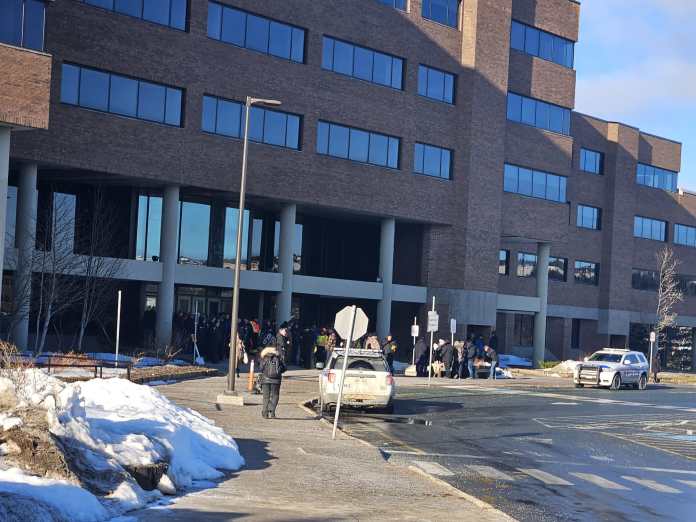
Protestors blocking entrance to Confederation Building
The scene is tense as protestors have clashed with police, with at least one injury resulting from the RNC on horseback attempting to remove protestors. Likewise, some staff at the confederation building attempting to go to work confronted the protestors in frustration. VOCM reported that the confrontation grew intense at times, sharing a video taken of a civil servant attempting to enter the building and being pushed back by protesters.
Warning: explicit language.
Workers are blocked from entering Confederation Building as they protest ahead of today’s scheduled budget. pic.twitter.com/WhpLkvhjKc
Protestors have largely expressed the need to limit existing restrictions, increase competition and remove some of the industry’s limitations. Among some of their demands were: Allowing buyers from outside the province to purchase products, increases in processing licenses, and a reduction of limitations on scheduling harvests.
Indeed on the eve of the protest, the Honourable Elvis Loveless, Minister of Fisheries, Forestry and Agriculture, provided a media release indicating that the Government is open to addressing the issues raised by the protestors, including the processing cap and restrictions on outside buyers.
The release states, “The Government of Newfoundland and Labrador has made significant commitments in response to requests from fish harvesters and their Union. Some of these requests have been longstanding, and our Government has moved on each of them. We will continue to engage with the FFAW, ASP and all stakeholders as we move forward with a comprehensive review of the fishery.”
However, protestors have said that the commitment from the government is not enough.
Muse reporter, Bruce March, speaking with local fisherman, John Short
Danny Hearn, a fisherman from Petty Harbour, states the media release is “just trying to pull the wool over your eyes,” adding that “[Minister Loveless] never said he’s going to allow, he said he’s willing to entertain.”
A common sentiment from protesters is the desire for less government control in the fisheries.
“We’re all fishermen here, from all around Newfoundland and we’re in the position where we’re being dictated who we’re selling to,” says Hearn. “We need more processing so that we can make a living, but right at this moment, this is a pure dictatorship. I own an enterprise, my own business, where I’m told when to fish, how to fish and if they don’t want to buy.”
Sign from previous protest in Central Newfoundland
Voicing support for the protestors, labour leaders including President of the Federation of Labour, Jessica McCormick has said that had the budget gone ahead they would not attend in solidarity with workers from the fishery.
As hundreds of fish harvesters and processing workers protest outside Confederation Building today, labour leaders have made the decision to stand in solidarity with workers and not participate in today’s budget proceedings. #NLPoli
With Budget Day now delayed, protesters have not relinquished their stance outside the Confederation Building and are continuing to increase in numbers. The delay is being considered a victory in getting their voices heard and concerns taken seriously.