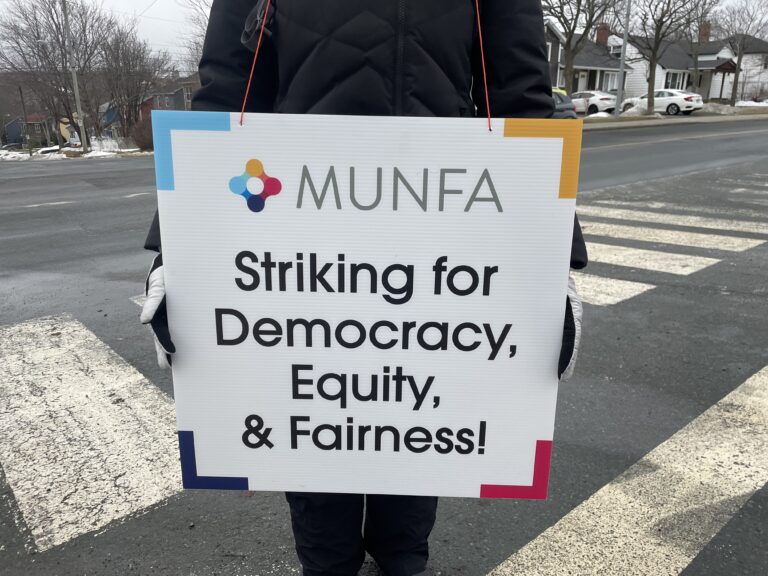
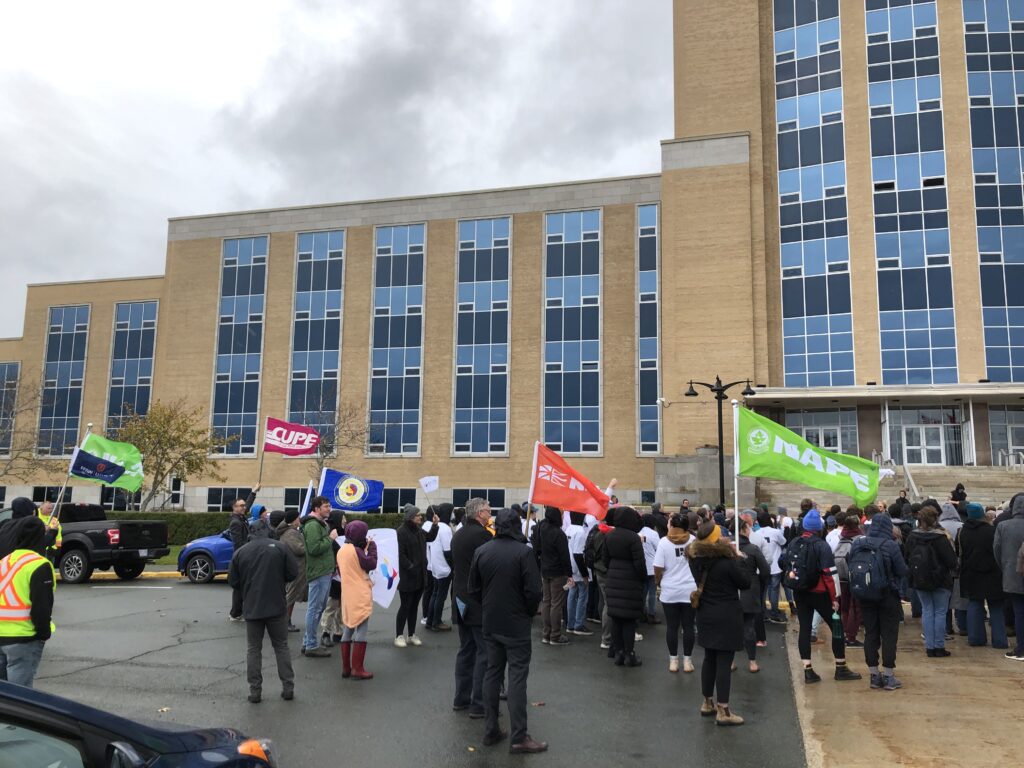
A MUNFA supporter holds their sign during a late January picketing.
Since the end of the MUNFA strike in mid-February, spring break, and a discombobulating return to class, many students have wondered- what exactly came of it? With students spending many hours at the picket line and showing solidarity with striking professors, we are left with the question, what was in the final collective agreement?
The strike was premised on four contested issues of negotiation between the MUNL administration and MUNFA, that being: Remuneration (Pay), Collegial Governance, Benefits, and changes to Contractual Professors’ work arrangements. Prior to job action, and after the initial strike vote, the university conceded on pay offering a 6% increase in compensation (up from 2%). However, refusing to budge on the other three. With this, the strike ensued.
After the strike, both parties reached a tentative agreement, with finalized details and its contents were revealed shortly after.
On the issue of pay MUNFA’s website states gains were made such as:
A 12% salary increase over the life of the collective agreement, including 6% retroactive to September 1, 2022
Professional development funds increase for all ASMs, including term appointments, to $1800 per year, up to $5400 maximum in three years.
Stipend for overload teaching has increased to $6500, with salary increases applied accordingly (i.e. the stipend will be $6890 as of September 1, 2022, $7028 as of September 1, 2023, etc.)
For term appointments, two additional steps added to the top of the Lecturer scale.
$2000 signing bonus for all term appointments employed in the Academic Years 2021-22 and 2022-23.
On the issue of Improvements to Contractual Academic Staff, gains were made such as:
Length of Teaching Term Appointment contracts increased by one month, with normal start dates defined as August 1, December 1, and April 1 to ensure recognition and compensation for teaching preparation.
Conversion language expanded to all term appointments, with the option to convert to either a Regular Term appointment or tenure-track appointment.
A Letter of Understanding to strike a Joint Committee to investigate a permanent teaching stream and to make recommendations to the Parties for future consideration.
On the issue of benefits, MUNFA rejected initial requests for modifications to post-tenure review, a residency requirement for Newfoundland and Labrador, and changes to post-retirement benefits that would have resulted in a system with different entitlements for new and current ASMs, requiring the former to pay more and work longer.
Finally, the matter of collegial governance- an issue of great concern to students:
A Letter of Understanding to form a committee consisting of representatives from the Board of Regents, Senate, ASMs, and students to carry out a review of collegial governance at the University. This review shall include broad consultation and will result in a public report within 24 months of signing the collective agreement.
In spite of MUNFA’s ask, no language in the collective agreement or commitment was made for a change in university governance. What was agreed upon was the creation of a committee of which faculty and students hold a majority to look into collegial governance and provide a report within two years.
This makes up the bulk of the contents of the collective agreement. So, what is the feeling and response to the gains made? We spoke to Dr. Lucian Ashworth, a Professor in the Department of Political Science to get his opinion.
“The strike was a victim of its own success, as we can see from the strike vote and support from students, support from other unions and even those outside the bargaining units not unionized showing support on the picket lines there was a very strong sense of solidarity across the board here.
It felt less like a picket line and more like a colour revolution – there was a real sense we could change the world. So, there was an immediate sense of unfulfilled promise. This was a labour dispute and a lot of the problems that we were facing weren’t going to be solved with this round of negotiation, they were merely a step in the right direction.”
Dr. Lucian Ashworth, Professor of Political Science, MUNL
When asked about the planned committees to study collegial governance, contract academic staff, and what their influence might be, Dr. Ashworth had the following to say:
“Those committees will be as good as we want them to be. Particularly when we look at the CA one, the majority is going to be made up of students and faculty. So, if that majority want to use that committee to really get some hard questions answered, it can happen, it’s a question of will. Now it’s linked as a timescale of 2 years – there is a report at the end. I think if it’s carried out in the open, it will actually shift the conversation.”
Additionally, Dr. Ashworth believes there is a broader undertone to the strike implicit in many similar issues being faced around the world.
“We’ve got a strike in Sydney, we’ve got strikes all over Canada, In the US, we’ve got major strikes taking in all institutions in the UK. Now some of the issues on these are about pay, some of the issues – I know in the UK one of the big issues is pensions.
But it’s also in all of these you are seeing a running thread of the two issues that were kind of central to the strike here: one is collegial governance, there is a real strong feeling amongst students and faculty is that we’re not having a say in universities and that’s right across the western world.”
As the dust settles from the strike, it remains to be seen precisely what work will lie ahead for Memorial and faculty going forward.
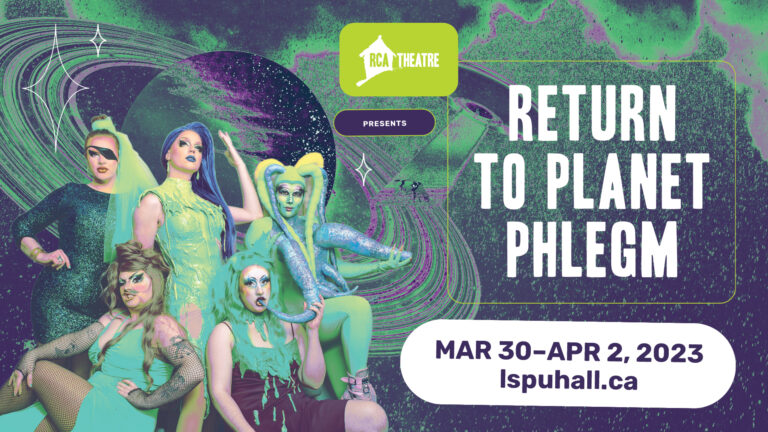
The Phlegm Fatales’ latest performance took place this past weekend at the LSPU hall. A stunning, tasteful affair and definitely another reason to support local arts and culture.
The Phlegms
The Phlegm Fatales (Phlegms for short) is a local St. John’s based drag collective, putting on some impressive shows and featuring some awe-inspiring local talent, such as Irma Gerd, who was also on Season 3 of Canada’s Drag Race.
The Return To Planet Phlegm was their first show on the mainstage at the LSPU Hall, and to call it impressive would be an understatement.
A Captivating Story
Perhaps even more impressive than the performance was the story they followed. An intergalactic tale that was extravagant but also relatable. The use of humour while still conveying an emotional tale is also noteworthy. While we don’t want to spoil it for you, it runs along the lines of fighting back against authority, even if it’s your own family, while standing up for each other in the hardest of times. It is a relatable tale, told using drag as a medium.
The story also embraces music to tell a story. There’s extensive use of music peppered throughout the play, but it was never overwhelming. The music never deviated from the main narrative and certainly added to the glamour of the performance.
Overall performance
This performance was well prepared for, and it shows. There were no noticeable hiccups, and even when things didn’t go to plan, there was always a 2nd option already planned. Everything seemed planned to the millisecond.
Elaborate Costumes & Makeup
Drag brings with it the expectation of very elaborate costumes and makeup; the Phlegms did not disappoint. The costumes were picture-perfect, and every design element served a purpose. Remembering the significance of sticking to the time period is also important. Every aspect of the costume design played a role in communicating the story’s timeline. From a 60s-themed flight attendant to a modern software assistant, everything matched the time they were from and served a purpose.
Audio Masterpiece
The sound design was also top-notch. Well-thought-out sound effects that didn’t take away from the performance were key. Much like costume design, the audio design also remained relevant to the period. Effects that changed with the times and locations along the storyline were beneficial for the story. The audio was so detailed and descriptive that one could watch the performance with their eyes closed and still understand the story; it really was that good.
Final thoughts,
The Return to Planet Phlegm was an all-around success. A captivating story featuring excellent costume design and thrilling sounds with the ability to keep the audience at the edge of their seats for the entire 2 hour show. The Phlegm’s put on an exquisite performance, leaving me with absolutely no regrets. This is an excellent representation of how important it is to support our local arts and culture community. Stay tuned for their next performance, which will be an absolute hit if it’s anything like the last.
“Student’s First Boutique” will be open on March 31st from 3:30 pm to 9 pm at the Landing (UC 3015).
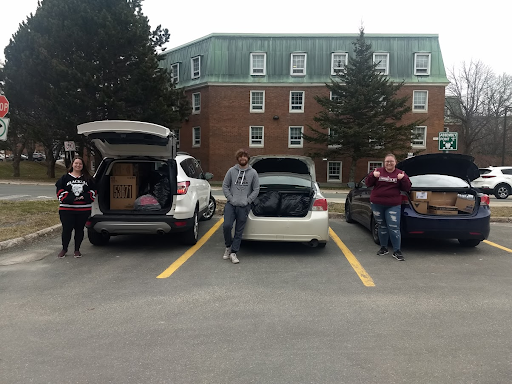
This on-campus thrift store is an initiative that three education students at Memorial originally developed as their Take Action project for their education program with Dr. Vaandering. Margarita A. Conway, Ryan Wall, and Kaitlyn Menchions created the project with the intention “to take action in our community and to make a difference in the environment around us, no matter how small that action may feel.”
Where the idea came from,
The concept for the project arose as a solution for the garbage bins around the residence buildings that are overflowing at the end of every term. At the end of every academic year or even semester, when students leave campus, they have accumulated so many things throughout the year that they have to leave most of their excess belongings behind… in the garbage bins.
When this issue was brought up, “their solution was to do more garbage runs,” explained Conway.
As a student who had previously lived in residence, Conway understands the difficulty of hastily packing up and not knowing what to do with everything you’re leaving behind.
“You have one suitcase, maybe two,” she said, “What are you going to do with all that stuff? You’re definitely not going to take your bedding- there’s a lot of clothing you’re not going to take with you either, and who’s going to take a full bottle of shampoo?”
One or two items per person doesn’t seem like that much, but when you consider a whole residence, it’s a lot.
Plus, “[Students] have to move out 24 hours after their last exam,” explained Conway, “So it’s a lot of pressure.”
With their entire focus on exams and pulling all-nighters in preparation for the end of term, having only 24 hours to pack up their whole life and move out is the last thing on any student’s mind. This is where “Student’s First Boutique” can lend a hand.
How and what to donate,
Donations are ongoing, and students are encouraged to donate any items they no longer need that are in relatively good condition. These items can range from clothes to books and household goods. Most of the items donated will be free for all students, whether from CNA, MUNL, etc.; Those with a price will only cost $1-$5.
“We’re even taking things that are half full, like a box of menstruation products,” said Conway. If the box is open, but all the remaining products are still in their individual packaging, unlike most second-hand shops, “Student’s First Boutique” will take them.
They also have a coupon system. Coupons were given out to certain locations, such as the food bank. Students can use a coupon, pay, or even bring in their donation and swap it for something in the store.
Conway explained the coupon system, saying, “So, say if something [in the store] has a five dollar cost, if you bring in something that is very gently used and good quality, that would be worth five dollars- and then you can get five coupons and go in and shop around.”
“We got funding for MUCEP and ISWEP as well,” she continued, “that’s how we were able to have employees and create a store vibe.”
Rahil Jiwani, Samuin Reza, Rifa Khawaja, Anushka Kalia, Nabiha Nawshin Shukheemoni, and Khushi Patel are the current Mucep employees helping bring the project to life.
Donations are also collected at the end of each semester and carried through till the fall. If you’re interested in donating or have any further questions, you can reach out through their email or social media profiles linked below,
ChatGPT, a product of OpenAI, is a language model meant to provide users with a human-like conversation on any topic. ChatGPT can give answers to test questions, solve complex coding assignments, and write entire essays on niche topics. It has become a concern in schools worldwide, particularly in universities where the stakes of plagiarism are higher.
ChatGPT has a plethora of uses in academia. It could cut research time by providing users with articles about a specific topic or instantly answering students’ questions about assignments. However, given its ability to write detailed papers and complete entire assignments, it may pose a threat to academic integrity.
How is MUN responding?
MUN has yet to release an official statement concerning ChatGPT. However, their plagiarism policies stand against the direct copy and pasting of online resources to pass as one’s work. Furthermore, AI is developed to detect when an essay or assignment was written by an AI, partially or in whole. Professors are entitled to use this when grading assignments. It would be considered plagiarism per MUN’s policies if traces of AI assistance were found in the document’s writing.
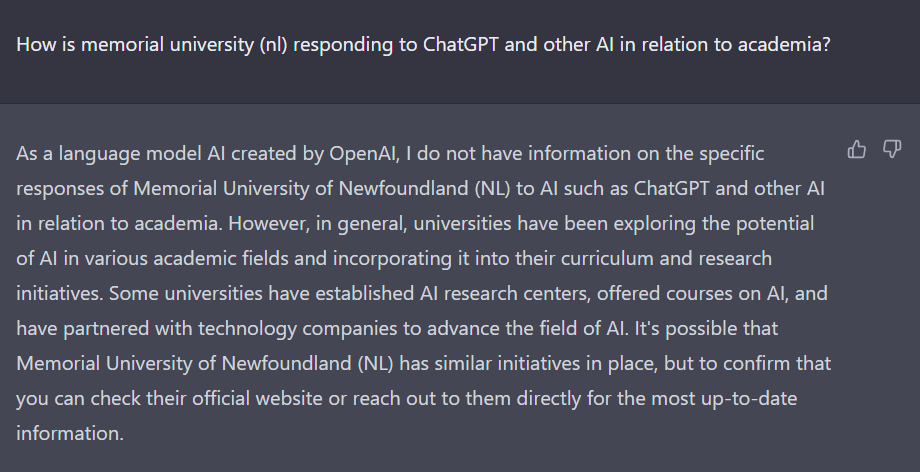
If you ask ChatGPT, it will give you a neat response:
ChatGPT Fig. 1
General Consensus of Canadian Universities
While several public schools have banned ChatGPT here in Canada, statements released by professors of Canadian Universities appear to be pro-AI for the use of research. AI as a tool for research is not new, and now that there is a more streamlined, accessible version for both professors and students alike. However, it may be necessary to outline clear plagiarism policies on AI assistance.
In response to the chatGPT craze, Dr. Nancy Pedri, head of the English Department at MUN, commented, “banning students from AI use is not a good route since some require AI for their research. In addition, the university has several courses of action in place for plagiarism, which can help curve uses that breach academic integrity.”
ChatGPT and Research Optimization
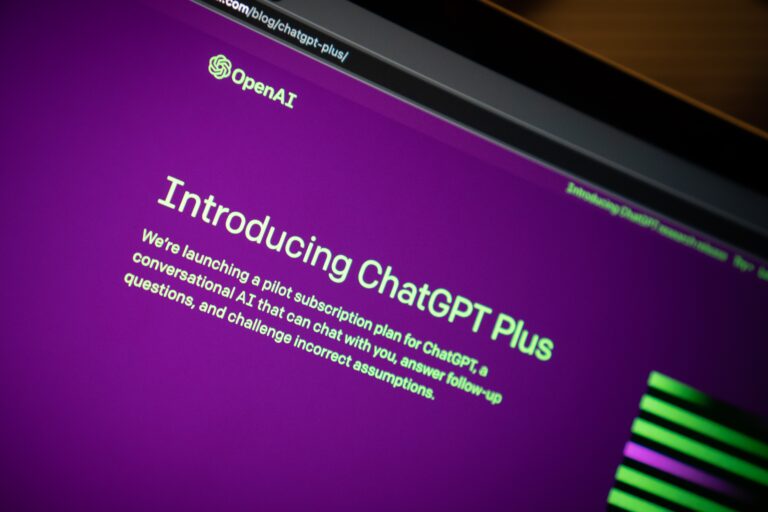
ChatGPT has recently announced it will offer a premium package for $20 USD a month, promising faster response times, constant access to the AI even during peak hours, and priority access to new features and updates. With the new premium plan in place, it may be reasonable to wonder if future research packages for Universities will be released. At this point, students would utilize the program through their respective institutions, where the university could monitor all of their research activity. This may be how AI plagiarism is mitigated in the future.
It’s everyone’s favourite time of year again, tax season! The 2022 tax season is upon us, meaning students at Memorial must dive into their finances. Tax time can be stressful for many. Hunting down various documents, the confusion of what credits to claim, and the fear of doing it all wrong lead many to worry.
Fortunately, the MUNL Tax Clinic has got your back. Students at Memorial can file their taxes for free using their services right here on campus!
For March and April, MUNL’s Tax Clinic operates every Tuesday from 6 pm – 10 pm at the Landing (UC3015) with no appointment necessary.
Attending University entitles you to a tax credit, allowing you to reduce the amount of taxable income (the amount of taxes paid). Additionally, depending on your income, you may be entitled to various payments, such as the GST, for those with low and middle incomes.
For most, the CRA’s filing deadline is April 30, 2023. So be sure to file before the deadline!
Editor’s note: The Muse’s interview with Premier Andrew Furey occurred prior to Memorial University’s faculty strike.
In January, The Muse had the opportunity to interview Newfoundland and Labrador’s Premier, Andrew Furey.
Furey took office in 2020 and described his first three years as challenging due to unprecedented pressures resulting from the COVID-19 pandemic, the province’s demographic and fiscal crisis.
“When I put my hand up, there was significant challenges ahead of the province but I see them also as opportunities and I think we are starting to capitalize on them, and I think that’s very rewarding, not just for me but rewarding to see on the faces and psyche of Newfoundlanders and Labradorians as they see a vision and a path forward towards a sustainable future,” said Furey.
Youth Retention
In 2008, the Government of Newfoundland and Labrador recognized youth as the life force of the province’s future prosperity and development by launching a youth retention and attraction strategy to determine which young adults want to work at home.
Former Premier Danny Williams told CBC, “We need to retain our young people, attract back those who have left the province, and ensure that Newfoundland and Labrador is their province of choice for now and into the future,” Williams said.
Fifteen years later– combined with the failed Muskrat Falls project, the rising cost of living, the provincial healthcare crisis, tuition hikes, and the COVID-19 pandemic- Newfoundland and Labrador is still trying to retain its youth in which Memorial University plays a significant role.
Premier Furey is a Memorial University alumni. He earned both his undergraduate and Master’s degree in clinical epidemiology and became an educator in the School of Medicine before taking office.
The Muse asked if he thinks current students deserve better, based on his experience at Memorial and the university’s financial situation.
Furey said, “I know there are challenges there now, of course we are not involved in those challenges currently but I think MUN has unlimited opportunity to unlock value for students and the province alike.”
“MUN is an important institution for the people of the province, it helps shape the province, it’s a part of who we are, it’s a foundational instrument of the province and will be for generations to come,” said Furey.
Addressing Tuition Hikes
Memorial was built on the principle that accessible higher education would benefit the whole country, and its economic benefits would move NL forward.
Following tuition hikes and provincial cuts to Memorial’s operating budget, The Muse asked if the government plans to give Memorial more money.
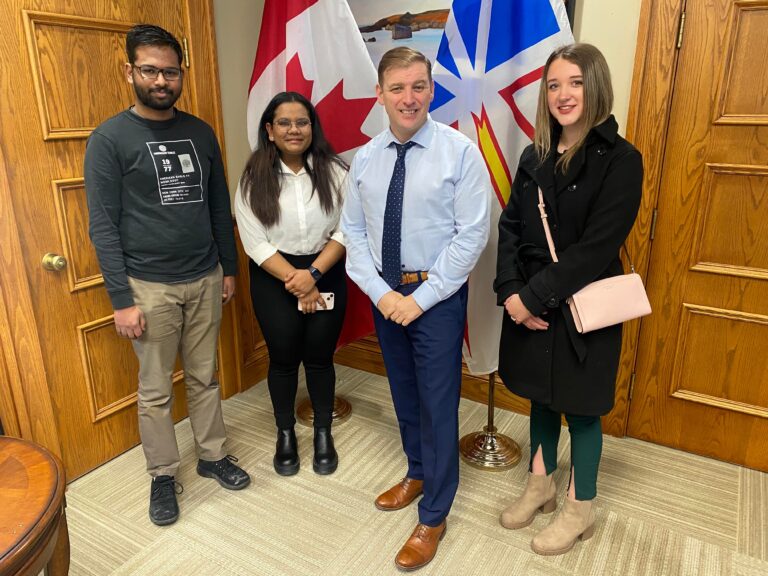
Photo Credit: The Muse
Furey clarified that the government and Memorial University are separate institutions. However, when MUN approached the government regarding tuition hikes, Furey explained the situation.
“When they (MUN) came and asked about raising the tuition, we said, well, that’s interesting- it hasn’t been raised since before I was an undergraduate student. If you’re (MUN) going to go that route, we will take the money that is displaced and make sure we are looking after through student loan programs and forgivable student loans using the same quantum Newfoundlanders and Labradorians that go to Memorial,” said Furey.
In the 2022 provincial budget, The Government advanced a Tuition Relief Grant program to support provincial students impacted by Memorial University’s tuition increases.
The program provides eligible students with non-repayable grants of up to $3450 per academic year for any Canadian institution if one is a permanent resident of Newfoundland.
“The goal is that there should not be a Newfoundland and Labradorian who wants to go to Memorial, who can’t due to financial reasons and I think that we’ve put together a pretty good package to accomplish that,” Furey says.
According to Furey, the government is open to supporting students in other ways.
“Nothing is ever perfect, so if there are ways to enhance that support for students differently, we’d certainly be open to looking at that through existing or non-existing avenues, because there’s often tools or programs that we’re not aware of, programs for students who are struggling,” said Furey.
Nursing Students and NL Healthcare
In the fall, Premier Furey returned to MUN to deliver letters of intention and job offers for nursing students at the Centre of Nursing Studies and Memorial’s Faculty of Nursing, as the government of Newfoundland and Labrador is indirectly the employer for nurses and other healthcare professionals.
Furey described the letters as a “letter of intent with a promise to job offers” because “when you’re dealing with that many people, in order to be generic but legitimate and honest, we gave them letters of intent and then made sure the path was there with the RHA’- Regional Health Authorities- who then have to sign the contract,” said Furey.
Furey described his visits to Memorial’s nursing schools as very positive.
“There was some good feedback about what their needs were, coming out of nursing school, what their desires were, and I think we took that back as feedback, and we’ll act on it,” said Furey
“Most encouraging for me was within the classes, there was a real spirit and desire of wanting to stay in Newfoundland and Labrador,” he said.
Student experience & advice
Three years of Memorial University students had their degrees affected by the COVID-19 pandemic through disruptions, lockdowns, and online classes.
As a result, the student experience across campus has been far from traditional.
With this in mind, Premier Furey suggested that students felt the burden of the pandemic socially more than any other cohort in society– except for senior citizens.
Furey praised students for their resilience and advised them to “find your passion, and your passion will lead you to success in life.”
“I changed a bit in my undergrad path; don’t be afraid to change, don’t be afraid to fail, if you try something and you don’t like it, don’t stick with it just because you think others want you to,” Furey says.
Submissions are now open for the 8th annual Short Play Festival!
St. John’s Shorts is a non-profit arts organization that prides itself on being inclusive, respectful and demonstrative in its goal to empower all voices and stories reflected in our community’s culture, ethnicity, orientation and abilities. The first festival was presented in 2016 at the LSPU Hall and has continued annually ever since.
Anyone with a script or an idea for a piece of theatre is encouraged to fill out the submission form for a chance to join the festival. All participants are to be chosen through a lottery system.
Submissions close on April 28, 2023.
St. John’s Shorts Inc. has decided to curate a portion of the shows featured in this year’s festival to ensure true diversity of ethnicity, gender identity, sexuality, ability, medium and experience level.
There will be three different lottery pools:
Indigenous artists pool
Equity pool
General pool
Shows in the Indigenous pool not selected will be placed in the equity pool, and those not chosen in the equity pool will be entered into the general pool.
In addition to the fifteen mainstage shows this year, St. John’s is excited to announce an additional five original shows will be chosen for a special public reading, designed to give artists the opportunity to workshop scripts in a creative environment. The readings will be chosen following the lottery from those that indicate their interest on their submission form.
The festival will include:
Five curated shows
Two indigenous pool shows
Three equity pool shows
Five general pool shows
Five public readings
St. John’s Shorts also has a number of exciting partnerships with other arts organizations in the works for the upcoming festival, with details to be released over the next few weeks. The festival runs September 6-16, 2023 in St. John’s at the LSPU Hall and is the home for one-act plays and other unique pieces of theatre produced by Newfoundland and Labrador-based artists.
If you have any further questions, please email outreach.sjshorts@gmail.com
St. John’s has a reputation for being fairly treacherous in the Winter time. People here are no stranger to snow, ice, storms and cold weather. However, a by-product of this occupies many concerns in the city amongst students and residents alike. That being winter-time accessibility.
If you stayed or attempted to get around the city between the months of November and March, then you are certainly familiar with the real and dangerous conditions that exist for pedestrians.
Unshovelled sidewalks, inaccessible bus-stops, mountains of snowbanks, and people forced to walk on the street are just a few horror stories residents have shared. Indeed, the prevailing wisdom amongst many is that if you do not own a car in St John’s then it certainly feels almost impossible to get around. Some students have come forward and shared with The Muse their experiences:
“I don’t drive so I rely on walking to get to campus. It’s always a nightmare trying to get around after a storm because the sidewalks around campus are almost never cleared for days or they’re full of ice and not bothered to be cleaned,” said Sarah Boudreau
Maureen Malone shared a photo of three people who attempted to walk over to the sidewalks, but amidst the unshovelled snow, decided to walk in the middle of Freshwater Road instead.
These 3 people had been trying to walk over where the sidewalks are supposed to be and I guess decided to take their chances walking up the middle of Freshwater. @CityofStJohnspic.twitter.com/xaqxN7bVLp
Tweet containing photo of pedestrians walking in middle of road amidst unshoveled sidewalks
Accessibility during the winter months is crucial for pedestrians to get places, especially students, many of whom don’t drive. Disabled pedestrians, especially those on wheelchairs, may find it near impossible to navigate city streets without a car. This sets a dangerous precedent that, in order to get around the city, one must own a vehicle.
“A lot of places around the residence were not cleared until today (Feb 16), and spots end up with black ice that isn’t well salted. Getting around campus as a disabled student can be challenging on its own, let alone icy and snowed in sidewalks,” said Alex.
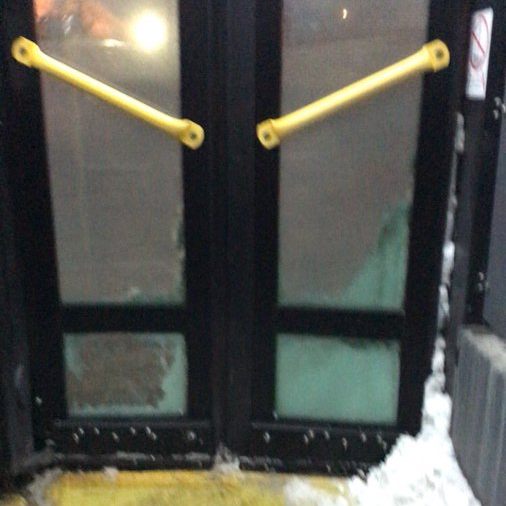
“The Metrobus door was stuck because of snow and we had to wait for half an hour in the middle of the nowhere,” said Moe Afkani.
Frozen Metrobus Door
Deputy City Manager of Public Works for the City of St. John’s, Lynnann Winsor, says the timeline following a storm for sidewalk clearing is four to seven days. She says that it is due to the equipment they use. Meanwhile, most, if not all streets are plowed and ready for automobile use usually within 24-48 hours.
This stark contrast between the amount of time taken to clear streets for automobiles versus pedestrians points to where the city’s priorities lie, and nowhere is it more apparent than in their budget.
In the 2023 budget, the City of St. Johns invested $20,312,897 for snow clearing, a 7 percent increase from 2022 ($18,983,149). As well as $306,000 for ‘enhanced snow clearing’ for pedestrian street crossings.
Additionally, the City uses a priority system for clearing, stating on it’s website: “We salt and plow streets in a priority order that is primarily based on traffic volumes. This ensures emergency vehicle access is always maintained to the greatest number of residents.”
However, many have pointed out the often subpar clearing completed on ‘priority one’ streets. Sonja Boon shared photos of sidewalks cleared, but still full of ice, slush, and some snow drifts.
Elizabeth Avenue SidewalkMacdonald Drive SidewalkPortugal Cove Road Sidewalk
It quickly comes to mind, how would a person on a wheelchair, or a blind individual navigate these streets? Not only does this put disabled individuals at a disadvantage, it is also dangerous.
There is hope however, the city has increased its budget for pedestrian snow clearing, and it has seen constant improvements in recent years. Streets that were once covered in ice and slush, are now cleared albeit days after snowfall. While small, these changes are meaningful, and do make navigating the city at least a slight bit easier.
President Timmons is off on a voluntary six-week leave of absence following public discourse after CBC led an investigation into her Indigenous status and ancestry.
During Timmons’s leave, Memorial’s Board of Regents will be led in a Roundtable Engagement with Indigenous Peoples to consider the president’s claims of Mi’kmaw heritage and guide the board on this matter.
Dr. Neil Bose, interim provost and vice-president (academic) and pro-vice-chancellor, will assume presidential responsibilities on an interim basis. This decision came into effect yesterday, Sunday, March 12, 2023.
In the meantime, Memorial’s Board of Regents reiterated the critical importance of Indigenization and the fundamental role universities play in truth and reconciliation.
“Our vision is, and remains, to create a Memorial University where every aspect of the academy is integrated with Indigenous ways of doing, being and knowing.”
Memorial’s Board of Regents also said their initial understanding was that President Timmons did not claim an Indigenous identity but has since received a lot of feedback from the community.
“As a Board, we have been reflecting on how to proceed in a way that is respectful of Indigenous people, our president, and the Memorial community. While our initial understanding was that President Timmons did not claim Indigenous identity, we have received a lot of feedback from the community. We have received important questions about the president’s actions, and we believe we have a responsibility to Indigenous Peoples and a fiduciary duty as a Board to explore these questions further.”
A statement from President Timmons shortly followed in response to the Board of Regent’s release in The Gazette.
“I have been reflecting on this feedback from the Indigenous community, and I sincerely regret any hurt or confusion sharing my story may have caused. That was never my intention and I deeply apologize to those I have impacted,” said Timmons.
More of President Timmons’s statement can be read in The Gazette, and the Muse will continue to cover and monitor updates to follow.