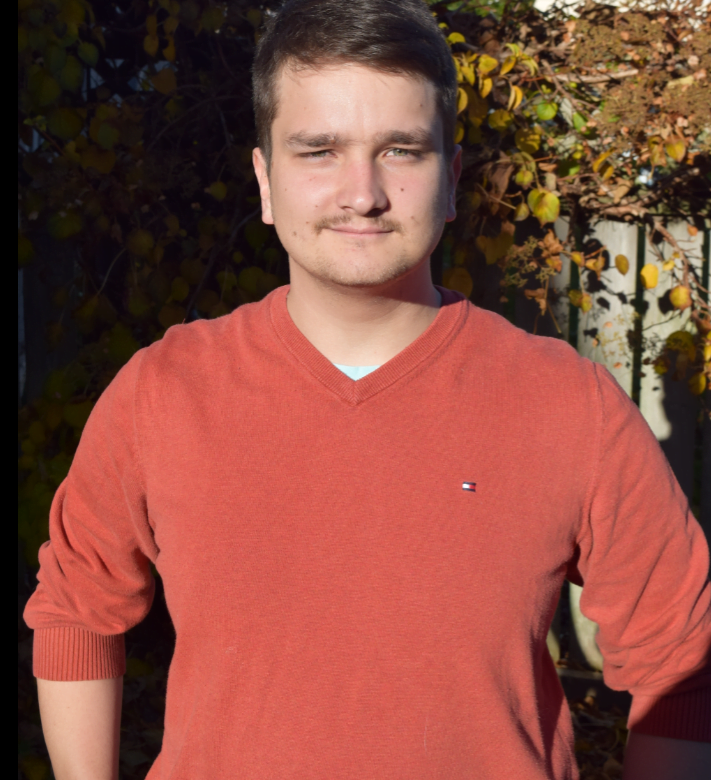
Derek is someone who’s been involved and volunteering with various on and off-campus organizations for quite a while. You may know him if you’ve spent time with the German Society, or with MUN SAGA (Derek was an elected union leader and manager of the SAGA resource centre). He has occupied several roles at that organization over the years, from Administration to External Affairs and beyond. Aside from MUN SAGA, Derek is a member of the Student Volunteer Bureau and has completed its volunteer incentive program (VIP). With MUNSU, he’s been Queer Rep since 2017 in addition to everything else listed previously. To add to his pile of awe-striking accomplishments, he has also served as the Co-Chair (internal) of St. John’s Pride since late 2017 as well!
His platform has three main principles: better care for resource centres and student societies, better communication between MUNSU and the student body, and increased awareness of MUNSU programs and support for students. Derek had this to say about increased communication between MUNSU and students:
“What we need to do is meet the students where they are when we all have time, and not simply follow old trends. As an individual, I won’t have the man power to reach out to each of our respective 13,000 students. As a board member, I will be able to facilitate an organizational culture that does more to make itself accessible. As a 6th floor UC veteran, I know how, where, and when to reach some of my constituents; as someone going into the exec position, I’d have the organizational backing to reach more of them”.
On increasing awareness of MUNSU programs and opportunities for students, he noted: “…we need to make people aware of extant student programs in the UC and the supports they offer; not only Safe Drive, but the work of MUN Minds, the Gender Gear Initiative, and Trans Support, and more”.
Make sure to get out and vote during this upcoming MUNSU election, being held on the 19th and 20th of March!
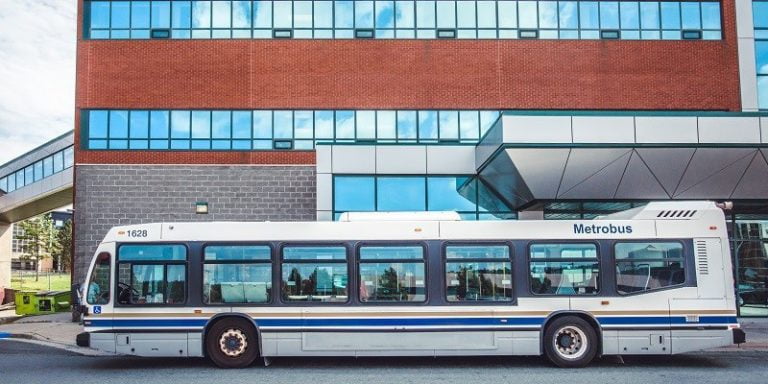
After the recent U-Pass vote, The Muse journalist Timothy Parsons spoke with Jordan Wright, a member of Memorial University’s Parking and Transportation Solutions Committee to discuss the results.
How did the idea of the U-Pass come about?
The Parking and Transportation Solutions Committee explored U-Pass as an option to improve parking and transportation solutions on and around campus, following concerns expressed by students in 2015. Parking demand exceeds supply on campus and there is little to no remaining space for parking stalls and further, no intent to re-purpose existing green spaces on campus.
Memorial participated in the commissioning of a Commuting and Parking Strategies Study and a Memorial Area Traffic Study. Both studies recognized a U-Pass as an effective transportation demand management tool and the most readily available solution to alleviate student parking and commuting challenges.
What would some of the pros and cons be if the U-Pass was implemented? U-Pass programs are designed to offer a discounted bus pass to students. A U-Pass and included service enhancements allow for expanded search areas when looking for work and affordable housing in addition to getting to campus and around the region.
Implementation of U-Pass programs across the country has increased ridership and reduced bus fares, traffic congestion, and carbon emissions in addition to significantly improving public transit networks to accommodate the needs of students.
The program could have addressed commuting challenges of students, first and foremost starting with full-time students, and could be expanded to include part-time students, faculty and staff interested in opting in.
Not every student views the program as having equal personal benefit. The administration worked closely with Metrobus to develop specific opt-out criteria to address the needs of students, consistent with other U-Pass programs across the country.
Why do you think the results were overwhelmingly negative? After three years of discussions, research and planning, in early fall of 2018, a concerted effort was made to engage and consult with students to shape the final proposed U-Pass program. Despite a student-defined program, the result of the vote was a resounding “no”. The vote had a 56 per cent response rate of eligible voters, which points to the success of the consultation and engagement efforts. Not all students saw themselves using the U-Pass and through the vote, indicated they were not interested in an additional mandatory fee for this service.
If some changes were made to make it more appealing to students, do you think there could be another vote in the future?
Administration has concluded its work on this project. The best efforts were made to present a program to meet students’ needs. Students decisively voted not in favour of the program and as such, the university will not pursue this endeavour further. The feedback received will inform future public transit review on the needs of the student population and assist as the university continues to explore solutions to parking and transportation challenges.
Female-led production bedazzles crowd with its bold play! Written by Jenna Turk, “Remnants” is based on The Triangle garment factory fire in 1911 which killed more than 100 people.
The wailing woes, screams, yells, and shrieks manifest themselves in the form of helpless young maidens who perished in The Triangle garment factory fire in a dramatic play, “Remnants” by Jenna Turk at the LSPU Hall. The intricately woven storyline sheds light over labor rights issues – much of which is still prevalent today.
Themes of child slavery, abuse, and subjugation were central to the play. Set in a time where labor unions were finding their ground, the play sheds light on the challenges and hurdles they had to overcome and how such unions relieved a lot of workers from their worse-off conditions in hopes for a better future.
“Remnants” rekindles the agony set alight in 1911 and depicts that the tragedy, contrary to popular opinion, is still ongoing. One hundred forty-six workers lost their lives in The Triangle garment factory fire, marking it as the deadliest event in the US before the 9/11 attacks. One would assume that drastic measures would have been put in place to prevent such incidents, but is that the reality? In 2012, a garment factory fire killed 260 people in Pakistan and a similar tragedy in 2013 cost more than 1000 people their lives in Bangladesh, most of which were again, impoverished women. The pains and sufferings of the workers back then, unbeknownst to many people, are still experienced by thousands of workers today.
Jenna Turk’s “Remnants” aims to give voice to the lost women!
The play begins with blood-curdling cries filling the hall as the ablaze young women strive to escape the blazing scorches of the fire. This act sets the dark tone for the rest of the play, hinting to the audience that the worst is yet to come. At the centre of the play are four figures: Danijela (Vanessa Cardoso Whelan), the keyholder and the matron of the workspace; Esther (Nabila Qureshi), the suffragette struggling to support her family; Anne (Nora Barker), the hopeless romantic trying to find her place; and Lena (Karen Monie), the boss’ young rebellious daughter. Anguish, sorrow, and resent plague the workers as they fight desperately, each in their capacity, trying to find their voice.
Danijela is the archetypal matron: strict, harsh, and stone-cold. Her job is to keep all the workers in line. A glint of childish curiosity is squashed with the monotonous chant of “sew, sew, sew…” Esther, though an advocate for labor rights, is unable to take charge when the opportunity arises, showing that she is someone who abides by the rules, no matter how wrong that may be, and is guilt-ridden over it. Anne is exploited by Lena’s dad who took advantage of her hopeless romantics. Lena is the decorated child who wants to find a place of her own, far away from the shadows of her father. Throughout the play, the child-workers proceed with their childish antics, poking their nose here and there and playing around whilst the matron struggles to maintain order in the factory.
The play culminates in the stage bursting into flames with the smoke choking the women, and the heart-stopping thump of the charred bodies dropping to the ground. Shrieks, screams, squeals, everything merely comes to an abrupt halt! The once-lively stage begins to resemble a morgue as the projector reels in footage of falling bodies.
Ruth Lawrence did a marvelous job in realising Jenna Turk’s vision and portraying it in the best artistic flair without impeding the seriousness of the play’s message. She set the right tone from the beginning as well as designed the stage to deliver the actual impact of the play in the end.
Vanessa Cardoso Whelan, Nabila Qureshi, Karen Monie, and Nora Barker, all delivered a phenomenal performance and did an excellent job in bringing their characters to life. The synergy amongst the quartet echoed volumes of countless rehearsals and a deep understanding of their roles.
Throughout the play, each character delivers a monologue revealing to the audience a bit of their history, their motives and what their personality entails. Vivid video footage projected onto the silk screens turns those moments into reality and provide an immersive theatrical experience.
Paradoxically, the silent moment at the end of the play provides the resounding voice to all the silenced women. They may be gone, but their echoes will go on!
I was working at CHMR last week when I heard something happening outside of the studio. I was busy putting a show together, so I didn’t have time to go check out what the fuss was about. After I had wrapped up, my boss told me that someone had come by, requesting that student media cover the U-Pass vote that was in its final stages at the time.
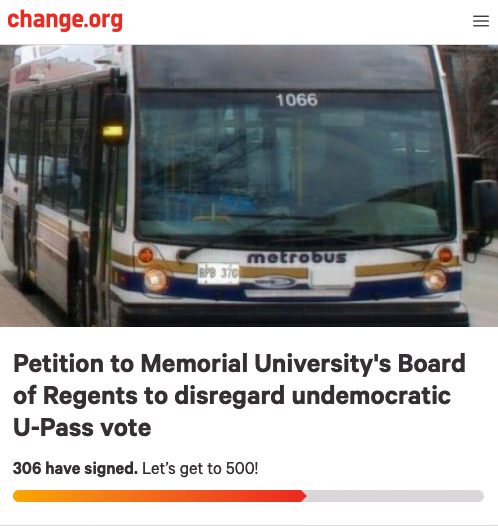
The individual, Matt Barter, had started a change.org petition to “have the board of regents disregard the undemocratic U-Pass vote” – citing what he believed to be problems with the way the vote was being held.
I asked around and found his email, and he immediately agreed to be interviewed that same day. When he paid a visit to our offices, he spoke at length about what he perceived to be major and systemic issues with the vote. Hours later, the results would come in; students did not want a U-Pass.
Matt’s petition, hours before the results of the vote were made public.
You’ve probably seen Matt around campus; during his time with MUNSU, he was heavily involved in student life, and even now (as a part-time student unable to occupy that role) he seems to be dedicating his time to representing student interests. The vote was, in his mind, a major issue.
“The purpose of [my petition] is for there to be a fair vote to take place” he said. His issues with the vote held last week are numerous:
“There’s pretty much a whole campaign in support of the U-Pass, and that’s most of the information that students have consumed”, he noted in reference to the posters, photoshoots, and videos that the school has released in regards to the U-Pass (total costs of this marketing campaign add up to 1336.78 dollars, the bulk of which was spent on Facebook ad boosting and an information session held by the school). He sees this marketing as enforcing a bias, especially considering that the entity releasing these materials is the same one facilitating the vote.
He worried that the U-Pass would benefit the province and Metro-bus on the backs of the students. “For them, they get to improve transit for all of the citizens without having to pay anything”. In addition to this, only full-time students were eligible to vote – despite the fact that statements had been released by the school claiming that they would like to open the U-Pass up to more than just full time students in the future. “If the goal is to open it up to more people, why are part-time students not allowed to vote on this now, if it’s going to effect part-time students for generations?”
“Why is everybody in the university community [including faculty and staff] not obliged to pay to be part of this?”
His petition sees more fundamental issues with the vote as well. “It’s not a vote, it’s merely a poll. The university has said that it’s just to gauge student opinion. Why should students take this seriously if it’s not even a legitimate democratic vote? The board of regents has the power to implement any fee that they want.”
As a former student senator, Matt has seen the issue of the U-Pass discussed for years. In 2016, he described a meeting with the president of the school who he claims said to him that “a referendum is a student union policy, not ours. We have the right to implement any fees we want. The U-Pass is something that we want to move ahead with. This is not just to improve things for students; this is to improve things for everybody”.
Although this statement can’t be confirmed, if his story is accurate, then it confirms the notion of the U-Pass being a way to secure funding for the province and MetroBus at the expense of the students (as opposed to being secured through the raising of taxes or more conventional methods).
He believes that to avoid conflicts of interest and bias, a third party should hold the vote (not the school itself). He cited Elections Canada’s role in the conduction of federal elections as an example of this being commonplace in other fields. “The way the school is doing it – that would be like the Liberal party of Canada conducting a referendum, them counting the ballot, determining if it’s valid, and then deciding what to do. It’s really problematic the way that it’s being done.”
“It’s almost like fascism”.
He sees issues with the vote that illustrate problems with the provincial government. “Is it fair that the provincial government is not investing any money in public transit?” The funds that would be secured if students were made to pay for the U-Pass program would probably improve many of the issues with transit in the city, which clearly benefits the province. “There really needs to be a regional approach to public transit, with investment from the regional government and from the municipality”.
“I felt personally the need to speak up. There hasn’t been much discourse on this issue. It’s been pretty much one-sided… people tend not to question authority, which is why they’ve been able to get away with what they’re doing”.
Although some students don’t seem to mind the extra fee that the U-Pass would entail, for many students, having to pay for a mandatory bus pass that they won’t use could be a problem. Many students at Memorial drive to school and can transport themselves without metro. “This is a car centric society,” Matt said as we held the conversation with a view of Price Philip Dr. just outside of the window, bustling with people coming and going.
That makes this U-Pass unique to other universities where campuses are located at the heart of a city (Dalhousie and Saint Mary’s are Atlantic Canadian examples of this). Living in a city where everything is built longitudinally, most people drive. “Now those people will have to work more shifts to pay for this fee”, Matt remarked.
The allocation of funds gathered from tuition can be factored into this issue as well, Matt argued. At Memorial, over 200,000 dollars were spent on searches for faculty deans in 2018 and administrative figures spend hundreds on dinner meetings.
Matt asked why funds can’t be reallocated to implement a U-Pass, as opposed to having students pay more money for a service they may not make use of.
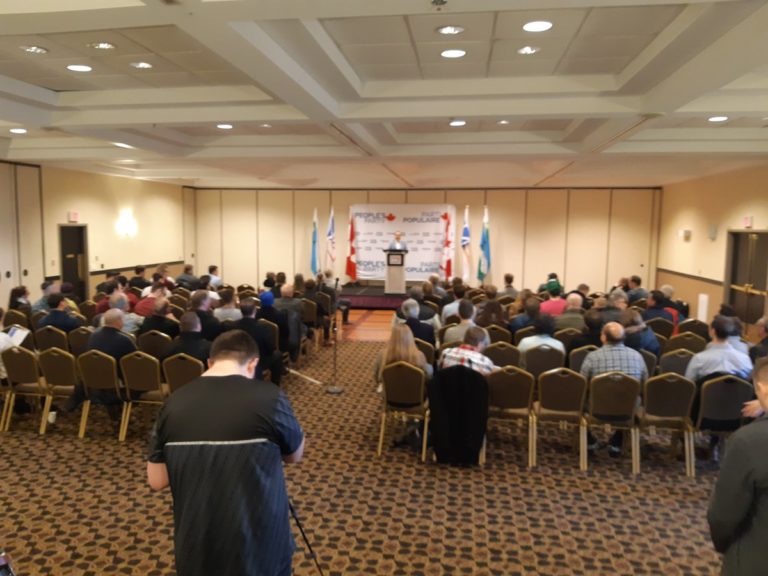
Amongst the weekend’s hectic tidal winds, the Peoples Party of Canada wafted into St. John’s this Saturday afternoon. One can only explain their zeitgeist as a sort of populist wave surfing. In part, the atmosphere was caused by a ripple from the bizarre 2016 election compounded with toxic elements that the Western hemisphere begrudgingly entertained with debate, creating a by-product of looming storm clouds, giving us what is only describable as ‘an uncertain political climate’. Appearing at the Capital Hotel, Mad Max (a nickname for the party leader which has its own potency for dissection) presented a ‘town hall’ style rally.
While the attendees were described as mostly young and male, Memorial campus reception of the Mad Max Tao seems to be negative. In some cases, MUSE found evidence of posters on campus which had been covered up or ripped up and disposed of, days prior to the rally.
Rally posters ripped off the walls, days prior to the event.
Despite some cold treatment, the rally itself, however, had a warm reception from attendees as Max Bernier boasted various feats of the party thus far. Thirty-six thousand members (which Max noted is more than the Green’s nineteen thousand) in support of some of the party’s platform against “special interest groups”, crony capitalism, and “big corporations”. Policies such as these might make a reader double take in confusion for the ascribed conservative orientation. These excerpts, densely blanketed in Max’s Quebec accent, underlie a philosophy which also stated he “will do nothing” for Jewish, Muslim, and Christian religious communities out of tire for “identity politics”.
To further distinguish himself from progressive partisans and strategically soak the party in a strange syncretism, Max endorsed capitalism, ending corporate welfare, and fixing a 25% flat tax for 100k salaries. Max also proposed ending foreign aid and stated his opposition to the UN as an actor seeking world government in thirty years. Afterwards, he combatted obstructive cheers and applause during an exploration of immigration policy “we need to take control of our immigration system… we don’t want the problems Europe has with immigrants, we don’t want that problem in thirty years… diversity is not our strength… it’s not part of the government to celebrate it: that is extreme multiculturalism.”
Despite this approach to the celebration of some cultural identities, Max stated directly afterwards “if we’re not there to defend free market-western civilization values, no one will.” Subsequently, the question for voters becomes whether Max has priorities for certain values over others, and if so, is it tiered in a hierarchy? If it is, would this outlook possibly lead some to view the status quo as superior? If not, what would the People’s Party do to prevent this conclusion if the party does not agree with the celebration of diversity as strength? Furthermore, to what extent, and in what ways would the PPC ‘defend western values’?
With this interpretation of ‘individualism’, one might think personal values ought to be kept to oneself but that fails to explain why a defence of vaguely defined ‘western values’ need be legislated. Particularly this seems counterproductive when the core approach of the party is small-government. In incongruence with previous comments, and perhaps misspeaking, Max finished his opening remarks by stating “We will challenge free market values. They are the foundation of Western civilization.” This is another instance of Maxime’s lack of clarity given his love of a diverse Canada, but opposition to expanding the parameters of diversity. Once more this syncretism is evident in Max’s boasting of a BC riding president being a former NDP member. While this extra-party intermingling isn’t the first occurrence (previously the Libertarian Party has been coveted), this may concern New Democrats considering this is the success of a pursuit mentioned months prior in September.
A call some might suggest has a fundamental language barrier, clearly has former opponents picking up the phone. What remains to be seen is whether Canadian voters will do the same come October, given that the PPC garnered 10.6% of Burnaby South’s ballot last month.
For an accurate account of the rally, a Twitter thread by Drew Brown of The Independent (which produced the heading image of this article) is available here: https://twitter.com/drewfoundland/status/1101859279433334784
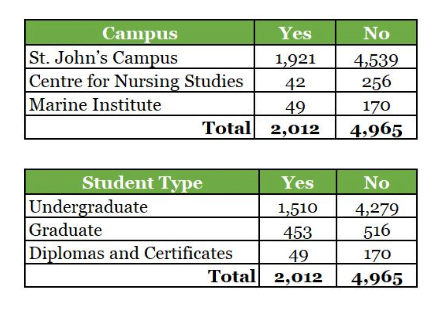
The results of the online U-Pass votes have been tabulated, revealing that 71% of students are not in favour of mandatory increased tuition in exchange for a bus pass.
Image courtesy of https://www.mun.ca/u-pass/vote.php
The official statement from Memorial reads as follows:
“University administration will recommend that the Board of Regents not proceed with a U-Pass program for Memorial University and will bring this forward for conclusion at the March Board of Regents’ meeting”.
A statement provided on Memorial’s official website.
With such an overwhelming response from the student body, it is highly unlikely that the Board of Regents will approve of the idea.
February 15th, 2019 saw a change in the executive leadership positions at Nalcor Energy. After eight long years of service, John MacIsaac, Executive Vice President of Power Supply, left the company recently. He has been replaced by Jim Haynes, former President of Newfoundland and Labrador Hydro. In another pleasant twist, Mr. Haynes’ place as the President of Newfoundland and Labrador Hydro has been taken over by Jennifer Williams, making her the first female to be holding that position.
“I thank John MacIsaac for his eight years of service and for his many contributions to Nalcor and Hydro and I wish him all the best in his future endeavours. Thanks to Jim Haynes as well for taking on this newest assignment and his steadfast commitment to Hydro over the years. I am also pleased to announce that Jennifer Williams has been appointed as President, Newfoundland Labrador Hydro, the first female president of Newfoundland and Labrador Hydro. Jennifer’s passion and dedication to serve the people of the province will continue to drive Hydro’s commitment to safely and reliability delivering power to homes and business.” -Stan Marshall, President and CEO, Nalcor Energy
Jim Haynes graduated Memorial University with a Bachelors in Electrical Engineering. Throughout his long career with Hydro, beginning from 1977, Jim has held multiple positions including manager of Transmission Planning and General Manager, Churchill Falls, Vice President, Regulated Operations and Vice President, Production. In June 2016, Mr. Haynes was named the President of Newfoundland and Labrador Hydro, where his primary responsibility centered around ensuring safe, reliable and cost-effective practices in delivering electricity throughout the province.
In his newest role as the Executive Vice President of Power Supply, Jim will be responsible for the completion of transmission portion of the Muskrat Fall Project and the continued integration of the assets to the newly inter-connected electricity grid, a supremely complex technical task.
Jim is a member of the Professional Engineers and Geoscientists of Newfoundland and Labrador, and the Institute of Electrical and Electronic Engineers and his years of experience allow him to bring an expansive knowledge of the technical side of operations.
Meanwhile, Jennifer Williams, a Memorial University graduate with a degree in Bachelor of Civil Engineering, began her career with Hydro in 2014. She served as a Manager, Regulatory Engineering and moved on to being General Manager, Hydro Production in February 2016. In August 2016, Ms. Williams was appointed Vice President, Production with Newfoundland and Labrador Hydro.. Prior to joining Hydro, Jennifer had worked with both Newfoundland Power and the St. John’s international Airport Authority. She is a member of the Professional Engineers and Geoscientists of Newfoundland and Labrador, where she has been an active volunteer in many different capacities, including as a previous member of the Board of Directors of PEGNL. Jennifer was awarded the Fellow of Engineers Canada in 2016.
“The changes being made today will allow us to continue to focus on the successful completion of the Muskrat Falls Project; to prepare the provincial electricity system for integration of Muskrat Falls power; and to have clear focus on our regulated business (Newfoundland and Labrador Hydro) while continuing our commitment to providing safe, reliable electricity to our customers.” -Stan Marshall, President and CEO, Nalcor Energy
The International Student Resource Centre is a student-run resource centre dedicated to helping international students get on their feet and get to know each other here at Memorial. The primary purpose of this group is to hold events where international students can do those aforementioned things.
Their biggest event by far is the Multicultural Show, an annual talent show held to bring in hundreds of audience members and a ton of performers from all across the world. This year, the show is set to be held at the Holy Heart Theatre on the 5th of March.
We sat down with the president of the ISC, Nethmini Hapuarachchige, to talk about the resource centre and how it goes about creating these huge events.
MUSE: So, what does the ISC do?
NETHMINI: In the fall semester, we usually have a welcome event. So this past Fall, we had a movie night and a hike and bonfire up to Mt. Scio. We also have the International Student Recognition Awards (ISRA), which are scholarship awards given in eleven categories. And then there is the Multicultural Show.
MUSE: How many people usually attend the show?
NETHMINI: 350, 400, 450, roughly that manyt. But last year we had 350 to 400. That’s excluding all the performers, committee members, and volunteers.
MUSE: So how do you prepare for the show?
NETHMINI: The show is usually focused mostly on MUN students and bringing them together. Basically providing a platform for international students to share their talents and their culture. We encourage the use of different languages and different traditional outfits but this year we kind of extended out more to the public. In past years, we’ve had non-students perform as well but this year we kind of opened it up even more. We have young kids performing too. There are 18 performances, excluding a fashion show, lined up for the event. We held two rounds of auditions at MUN, one in January and one in February.
MUSE: What kind of performances are presented?
NETHMINI: There’s a mixture between singing, dancing and instruments.
MUSE: What’s your favourite part about volunteering with the ISC?
NETHMINI: I guess finding ways to get international students involved and creating opportunities for them. There’s less opportunities for us as International students to share either our talents or our cultures and be inclusive and whatnot, and we just want to bring everyone together, so we find ways as best as we can. The multicultural show is my favourite I’d say, but it’s the most stressful as well. It takes up all of our time but no complaints.
The multicultural show is on March 5th from 7:15 to 10:15 with twelve dollar ticket prices, available through holyhearttheatre.com or the box office. For more details on the event, please visit the event page on Facebook: https://www.facebook.com/events/506387729884660/
Last Friday, the local chapter of the Newfoundland & Labrador New Democratic Party (NDP) held a mixer in The Breezeway, offering free pizza and Pepsi to all attendees. The group seemed to have easily garnered an impressive attendance. All of the pool tables were full and multiple sections of the bar had occupied tables with cheery faces that showcased a great amount of camaraderie. This turnout is not surprising, given the historical performance of the party in the area, holding both St John’s East and St. John’s South prior to 2015. Notably, the group seems to have an energy which seeks to compete and overtake youth engagement in Memorial campus in comparison to other political groups.
Speaking with the Chair of the NDP Youth Caucus, Kerri Claire Neil, students and youth have the opportunity to get involved with the party by attending weekly meetings on Monday afternoon at the University Centre in room UC 6011. Additionally, the bulk of engagement is through social media, mainly Twitter and Facebook. Currently, the group’s main goal is to conduct social events such as movie and trivia nights as part of a larger move to arrange more frequent activities. One of the notable approaches at this is the Campaign School starting June 1st aiming to train individuals on how to run campaigns prior to the election. The next event for the group is a movie screening of Salt of the Earth on March 15th, and a trivia night booked on April 3rd.
This no doubt marks the beginning of the party’s mobilization prior to the upcoming election. Given that Memorial University occupies the St. John’s East riding which featured the infamous upset of long-time MP Jack Harris against Liberal Nick Whalen, (dubbed one of the most baffling outcomes of the turbulent 2015 election) the NDP may be looking to reclaim lost territory. As the political climate on campus remains mildly active, events like the NDP’s may indicate that parties are beginning to heat things up by increasing their presence. With the widening Overton Window, seen in the upcoming populist People’s Party rally on March 2nd, one can only wonder what the political discourse in Newfoundland and Labrador will look like in the near future.
In keeping with the theme of bringing music to public spaces, renowned non-profit organisation ‘Business and Arts NL,’ in collaboration with St. John’s based radio station ‘Coast FM 101.1’ and Memorial University unveiled a new public piano at the University Centre food court on February 14th, 2019. It is a part of the #ComePlayWithMeNL public piano project. The #ComePlayWithMeNL public piano project was launched in December 2014 with the Jag Hotel Piano placed at the St. John’s International Airport. Over the past five years, Business and Arts NL has placed pianos in multiple public places including the Memorial University’s Signal Hill campus, the Comfort Inn of the Health Science Centre in St. John’s and at the Deer Lake Airport. The new piano at the Memorial Centre food court brings the total of public pianos across the province to six.
An important feature of the public pianos is the unique artistic designs, hand-painted by different creative artists. Speaking with Mark Benson, the creative artist who designed the piano about how the creative process went, he said “we went through three to four designs before finally settling on this one here on the piano”.
“I am glad Pete Soucy of Business and Arts NL, my handler on this project pushed me to take the creative attempt on this project. The designs ended up coming out better than I would have expected” he added.
More of Mark Benson’s work can be seen on his website www.swassesois.comand his Instagram handle @instanthalffgram.
Mr. Peter Scousy, the director of collaboration at Business and arts NL who organised this event spoke about the fate of the already existing public piano stationed at the Memorial centre food court. “The old piano will be put back into storage and will be refurbished and painted by a new artist. This will then be placed somewhere else within the province,” he said. Speaking on future plans for the #ComePlayWithMeNL public piano project, Mr. Peter Scousy added that
“We are growing the number of public pianos across the province to eleven within the next three months and hopefully to fifteen by the end of the year.”
On the significance of the date of the launch, we spoke with Jane Furneaux, program coordinator for Business and arts NL. “I am actually not sure why we did it on Valentine’s day, maybe because it’s just a special day and so we could kind of get everyone to play love songs. I guess not that it’s about love, but about bring people and different communities together. And even if you don’t celebrate Valentine’s day, it’s a nice way to celebrate connection.”
“We hope to get more pianos so there are more province wide. We are trying to bring more to Labrador, to the West coast, to the Northern peninsula, so that there is music all over not Newfoundland, not just here.”
“A lot of programs are Avalon specific so we want to broaden the horizon so that there is more connections made all over.”