

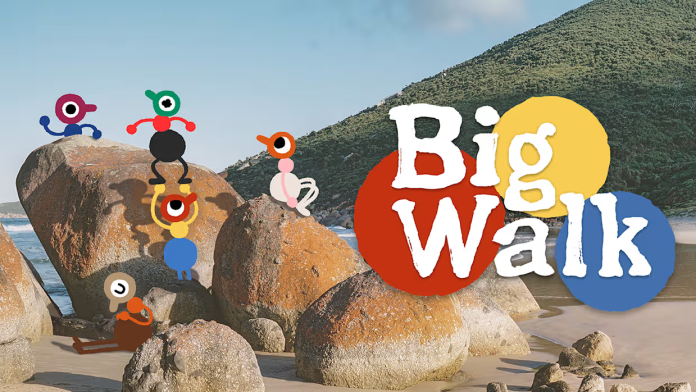
As an avid fan of co-operative video games, Big Walk by House House was on my radar since its original announcement in 2023, and now, having played it for hours with a good friend of mine, I can confidently say that it’s far from “friendslop”.
“Friendslop” as a term describes low-budget and low-cost co-operative indie games, typically used with the negative connotation (with “-slop” typically referring to “low-quality”). Paling in comparison to the polish of AAA games, the low-cost of these games and their short game length make these games oftentimes disposable media, and it’s this disposability and comparative “low-quality” that makes these indie co-op games “friendslop”. Friendslop is not a term I like using to describe these games, though it’s becoming more prevalent across media and online discourse regarding new and upcoming co-operative indie video games.
Unlike other wildly popular co-op games to come out in recent years that have fallen under the friendslop category—Semiwork’s R.E.P.O, Aggro Crab’s PEAK, and Innersloth’s Among Us, just to name a few—House House’s Big Walk stands out for having a uniquely hands-off approach, allowing you and your friends to play at your own pace.
With no way to “fail”, Big Walk doesn’t place pressure upon its players in the same way other traditional co-op games do, putting more emphasis on exploration, problem-solving, and discovery—put simply, the game wants you to embark on a “big walk” with your friends.
On the surface level, this premise can sound a little flat: what drives players to engage with a game that has no stakes, pressure, or definite goal? What is the point of Big Walk? And, more importantly, how does Big Walk differentiate itself from friendslop?
I personally think that the magic of Big Walk lies within its rich environments. With exciting discoveries and game moments that you get to share with a few close friends, the fond memories you make transform the digital landscapes of Big Walk into a type of cultural landscape; an emotional landscape.
These emotional landscapes are the reason that “slop” as a description of Big Walk is misinformed and inaccurate, as they are clearly made methodically, not thoughtlessly as the word “slop” would suggest; this is how House House’s Big Walk stands out among an ocean of co-operative friendslop video games.
One way Big Walk creates memorable game moments is through the use of different forms of communication, creating engaging, playful, and unforgettable moments with friends.
In Big Walk, you’ll often get lost and need to shoot a flare into the sky to find your friends again. You’ll have to point and gesture to communicate in moments where you can’t hear one another through the games proximity chat system. You’ll also talk with your friends across long-distance walkie talkies (and you’ll find yourself ending every sentence with “over”, too).
Discovering these different forms of communication creates moments that are unforgettable, and every time you find a new way to communicate across the island, you realize how many opportunities you’ve just opened up for puzzle-solving and uncovering more of the game’s vast open world.
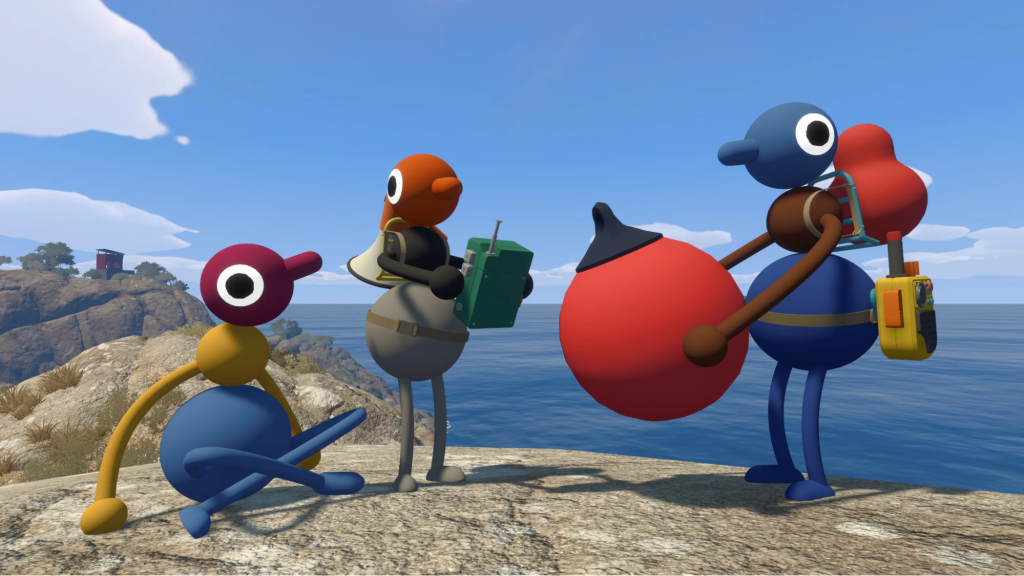
The way you communicate across Big Walk’s digital landscapes isn’t all, as physical features of the landscapes themselves create time capsules of the time you first discovered them with your friends.
You’ll discover a place that plays some fun music, and you’ll jam with your friends while cracking jokes and looking out beyond the shoreline. Then, you’ll find a watch tower with a view over everywhere you’ve been for the last hour.
Big Walk is constantly encouraging the player to uncover unique perspectives of the main island, only for the player to see an interesting feature in the distant landscape and declare, “Let’s go there!”
After completing a series of engaging puzzles, you’ll discover maps, tramways, and all sorts of fun spectacles sprinkled generously around the world of Big Walk, and believe me when I say that discovering all of them feels uniquely special and memorable in their own way. “Slop” is the last term I’d use to describe these gratifying game moments.
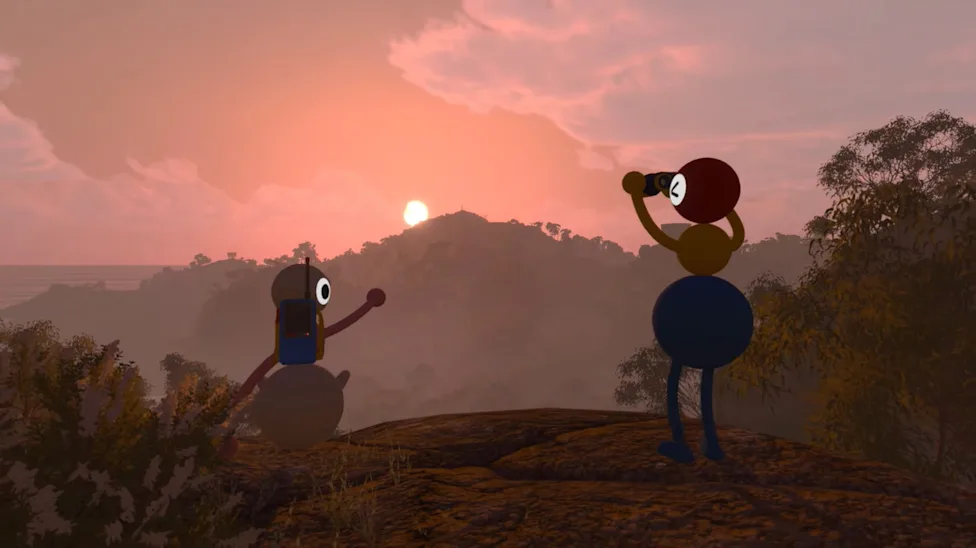
The longer I play Big Walk, the more I fall in love with its world and the more I feel emotionally attached to the places I’ve travelled to in-game. It’s as though you and your friends are uncovering more and more of the world’s largest playground.
I do fear that—when I’ve fully discovered all of the game’s content—Big Walk will lose its replayability in the future, though I can say for certain that my first playthrough is quite a fond and memorable one nonetheless, and is far from a low-effort friendslop experience.
Overall, if you’re looking for a co-op video game with dynamic communication, exciting puzzles, emotional landscapes, and an exceedingly more mature and polished experience than your typical friendslop game, Big Walk is waiting for you to open the Pandora’s box of its world.
Now if you’ll excuse me, I’m gonna find out where this ski-lift is gonna take me.