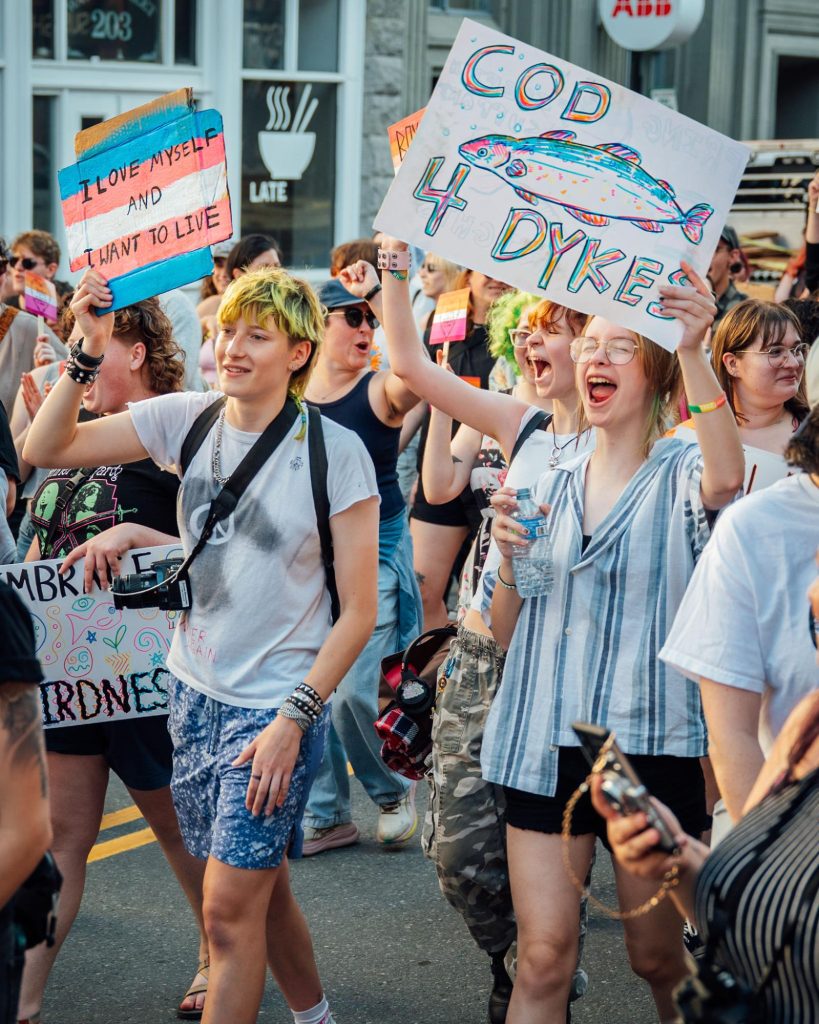

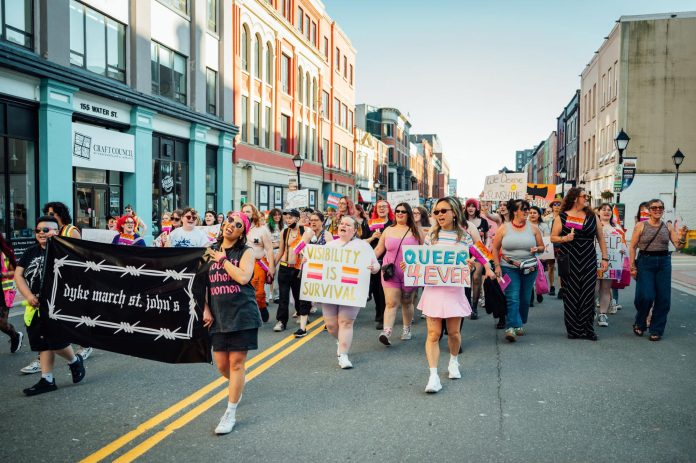
On Thursday July 16th at 5:30 pm, a crowd of lesbians took over Water Street in a beautiful display of queer power, joy, and whimsy; St. John’s first-ever ‘Dyke March’ was a success.
The reclaimed term dyke encompasses a vast spectrum of gender expression and intersectionality. All were welcomed to the event with open arms. The group fanned one another with small themed signs as the heat beat down upon them. Organizers made sure everyone had water and understood the short route. Activists young and old came together to emphasize the power of grassroots movements and that safety is a human right.
Dyke marches occur around the world as a counterweight to the sanitization and White-male domination of Pride. The first documented march was in Vancouver, BC, in 1981, where 200 lesbians gathered downtown after the fifth Bi-National Lesbian Conference. The movement further evolved to counter the corporatization of Pride, and is typically grassroots with no business sponsors. Where Pride marches may have bank-branded floats, dyke marches have only community members walking together (and maybe a local dykes on bikes chapter).
Dyke marches are unapologetically political; they fight for an intersectional perspective on justice, housing as a human right, and harm reduction. They represent queerness and the people left invisible in typical Pride line-ups. Corporate Pride places queer-ness in-line with straightness. People against White nuclear-family norms in the 2SLGBTQIA+ community are cast out so they don’t make Pride “look bad.” Political strength and non-conformity are overshadowed by a Pride looking to be brand friendly, in the eyes of dyke march supporters. Dyke marches are inclusive in a way that is radical and/or controversial. It is foundational to the movement.
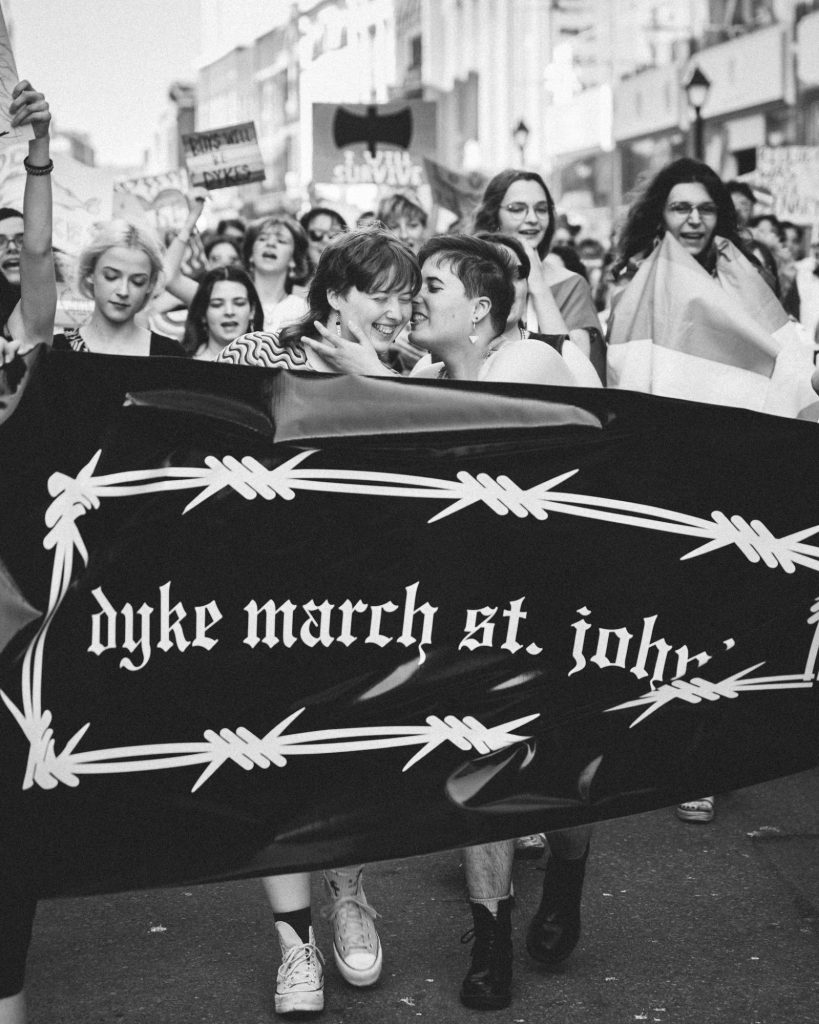
The march on Water Street was well received by the surrounding community. Onlookers in the pedestrian mall cheered and laughed as the crowd chanted: “Look over here, look over there, lesbians are everywhere!” Patrons on restaurant patios clinked their glasses to the marchers while another onlooker shouted: “Yay, lesbians!”
There was an outcry of support for the community taking over the street at last… and it was felt. The demonstrators smiled and cheered, with many queer couples (including myself, seen above) taking the moment to embrace. The spirit of queer love, joy and resistance flooded the street. It was clear that the community had been waiting for a march like this and was revelling in it finally happening.
“I’m surprised this is the first [dyke march]; I thought it would have been years before this,” one participant said, “To actually be a part of this and make history is an insane feeling.”
Overdose Awareness and Response (OARS) marshalled the event, stopping traffic to allow the group to pass through downtown safely. The march may not have had the most elaborate route (a silly, practiced, 180-degree turn), but based on the love shown, the legacy of the Dyke March was done justice.