

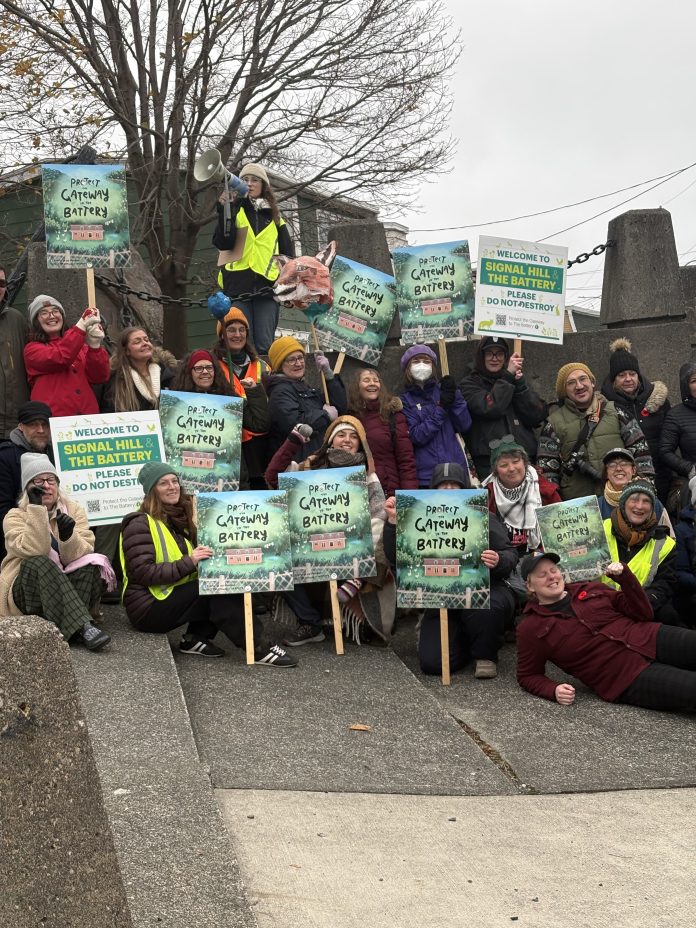
The wrecking balls that would demolish Penny Alderdice’s home in the Battery are not self-propelled. They require momentum. So, too, does the logic used to justify this development.
The language of the St. John’s housing crisis has acquired a momentum of its own, and we should be careful about where it takes us.
Those who want to develop the Battery Gateway into housing units invoke familiar refrains of ‘housing crisis’ and ‘housing affordability.’ They say that the Trifecta Group’s Battery development would build 25 new townhouses, as well as 3 executive ones, which could critically ease housing cost pressures.
Additionally, these proponents argue, this housing development would help stimulate business in the area, allow more people to stay in the province, and, most importantly, tame housing affordability pressures by increasing supply and pushing down housing prices in Newfoundland and Labrador’s time of dire ‘housing crisis.’
But while affordable housing is a worthwhile goal, it is an oversimplification to think that housing affordability is achieved by targeted increases to housing supply alone.
The housing crisis is a holistic issue: it is not a function of supply alone, but of household incomes, employment opportunities, population trends, access to credit, and the broader non-housing cost of living. Adding housing does not automatically make housing more affordable.
This is especially true when the housing units in question are constructed in high-value locations and priced beyond the reach of those experiencing the greatest housing insecurity.
The more important question, then, is not how many affordable homes this development promises to make, but what kind of affordability this development promises, and for whom?
As high-value properties, these new townhouses could easily follow in the footsteps of other types of high-value properties that pepper the ins and outs of downtown areas: they would be owned by (likely absentee) landlords, who have mortgaged their units either before or during the construction phase as speculative investment decisions, in hopes of lucrative future returns on their real estate. Those absentee landlords would rent or lease their units to permanent tourists and upwardly mobile workers, to short-term and medium-term travelling high-income executives, or to very-short-term tourists through platforms like Airbnb. In other words, this development would not be for living, but for earning.
In this light, the logic behind calls to develop the ‘Gateway to the Battery’ because of the housing crisis becomes a lot murkier. While the slogan of ‘housing crisis’ was originally intended as a term to name a problem of the people, it can be co-opted to work against them when real estate developments are touted as more places to live but become more places to earn: as speculative investments, as quasi-bank accounts, or as diversified portfolio holdings. We must beware the fog of ‘affordability.’
While those protecting the Battery Gateway are criticized for basing their rationale on an overly sentimental, baseless, or illogical emotional attachment to heritage, the platform’s long-term goals are much more serious.
In the coming years, Newfoundland and Labrador’s stock of very-affordable housing relative to other Canadian provinces will draw many Canadians who possess the geographic and financial foresight to expand their conception of Canada’s east beyond just Toronto and Montreal.
If we, misguided as we are by tropes of ‘housing crisis’ propagated elsewhere, are to bow down to the dogma of real estate speculation and medium-rise development that is threatening us now, then we risk selling our urbanity before it can reach the value it deserves, and before it can be reached by people who deserve it.
Are we so concerned about attracting transient high-income tourists and executives that we are prepared to deplete the very urban charisma that makes St. John’s worth visiting, living in, and investing in to begin with? Might this be both a paradoxical and an unproductive development strategy?
But the biggest danger is not simply that the Battery Gateway is sacrificed to speculative investment, but the precedent that such a decision establishes.
If a property of this significance can be demolished based on familiar refrains to revitalization, business activity, and housing supply, then what prevents the same rationale from being applied to its neighbours? What happens when Breakwater Books, or another irreplaceable downtown property, becomes the next obstacle to a supposedly necessary development opportunity?
If there is one thing we shouldn’t do, it is to concede our urban policy out of an ill-defined weakness, by a housing crisis that might not work as we think, and by blind ascription tomarket-oriented logics with no rationale outside of microeconomics. If the Cities Act allows for
further municipal decisions to be made here or elsewhere, let them be made out of concern for our strengths and strategy — in tourism, for example — and not for some lack of conformity to a decontextualized market logic.
The Gateway property is a gateway decision. Are we ready to sacrifice our established urban assets for new developments whose primary beneficiaries already possess the means to profit from them?
Graham King, MUN Graduate