

After hearing the definition of “straight edge” when I pitched this article, a friend of mine asked, quite sincerely, “why the fuck would you do that?”
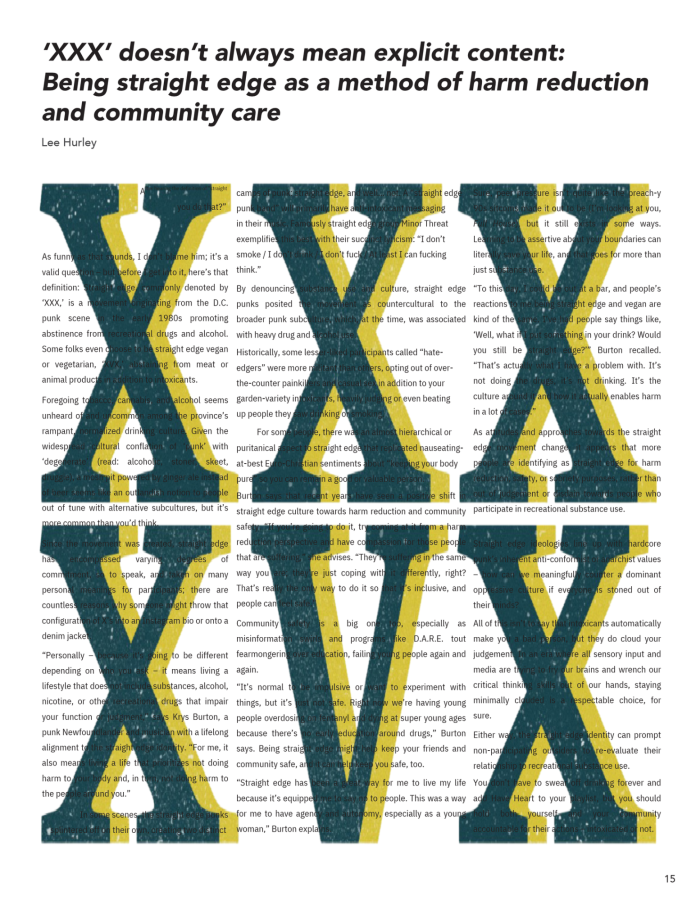
As funny as that sounds, I don’t blame him; it’s a valid question – but before I get into it, here’s that definition: Straight edge, commonly denoted by ‘XXX,’ is a movement originating from the D.C. punk scene in the early 1980s promoting abstinence from recreational drugs and alcohol. Some folks even choose to be straight edge vegan or vegetarian, ‘XVX,’ abstaining from meat or animal products in addition to intoxicants.
Foregoing tobacco, cannabis, and alcohol seems unheard of and uncommon among the province’s rampant, normalized drinking culture. Given the widespread cultural conflation of ‘punk’ with ‘degenerate’ (read: alcoholic, stoner, skeet, druggie), a mosh pit powered by ginger ale instead of beer seems like an outlandish notion to people out of tune with alternative subcultures, but it’s more common than you’d think.
Since the movement was created, straight edge has encompassed varying degrees of commitment, so to speak, and taken on many personal meanings for participants; there are countless reasons why someone might throw that configuration of X’s into an Instagram bio or onto a denim jacket.
“Personally – because it’s going to be different depending on who you ask – it means living a lifestyle that does not include substances, alcohol, nicotine, or other recreational drugs that impair your function or judgment,” says Krys Burton, a punk Newfoundlander and musician with a lifelong alignment to the straight edge identity. “For me, it also means living a life that prioritizes not doing harm to your body and, in turn, not doing harm to the people around you.”
In some scenes, the straight edge punks splintered off on their own, creating two distinct camps of punk: straight edge, and well… not. A “straight edge punk band” will primarily have anti-intoxicant messaging in their music. Famously straight edge group Minor Threat exemplifies this best with their succinct lyricism: “I don’t smoke / I don’t drink / I don’t fuck / At least I can fucking think.”
By denouncing substance use and culture, straight edge punks posited the movement as counter-cultural to the broader punk subculture, which, at the time, was associated with heavy drug and alcohol use.
Historically, some lesser-liked participants called “hate-edgers” were more militant than others, opting out of over-the-counter painkillers and casual sex in addition to your garden-variety intoxicants, heavily judging or even beating up people they saw drinking or smoking.
For some people, there was an almost hierarchical or puritanical aspect to straight edge that replicated nauseating-at-best Euro-Christian sentiments about “keeping your body pure” so you can remain a good or valuable person.
Burton says that recent years have seen a positive shift in straight edge culture towards harm reduction and community safety. “If you’re going to do it, try coming at it from a harm reduction perspective and have compassion for those people that are suffering,” she advises. “They’re suffering in the same way you are; they’re just coping with it differently, right? That’s really the only way to do it so that it’s inclusive, and people can feel safe.”
Community safety is a big one too, especially as misinformation swirls and programs like D.A.R.E. tout fear-mongering over education, failing young people again and again.
“It’s normal to be impulsive or want to experiment with things, but it’s just not safe. Right now we’re having young people overdosing on fentanyl and dying at super young ages because there’s no early education around drugs,” Burton says. Being straight edge might help keep your friends and community safe, and it can help keep you safe, too.
“Straight edge has been a great way for me to live my life because it’s equipped me to say no to people. This was a way for me to have agency and autonomy, especially as a young woman,” Burton explains.
Sure, peer pressure isn’t quite like the preach-y 90s sitcoms made it out to be (I’m looking at you, Full House), but it still exists in some ways. Learning to be assertive about your boundaries can literally save your life, and that goes for more than just substance use.
“To this day, I could be out at a bar, and people’s reactions to me being straight edge and vegan are kind of the same. I’ve had people say things like, ‘Well, what if I put something in your drink? Would you still be straight edge?’” Burton recalled. “That’s actually what I have a problem with. It’s not doing the drugs, it’s not drinking. It’s the culture around it and how it actually enables harm in a lot of cases.”
As attitudes and approaches towards the straight edge movement change, it appears that more people are identifying as straight edge for harm reduction, safety, or sobriety purposes, rather than out of judgement or disdain towards people who participate in recreational substance use.
Straight edge ideologies line up with hardcore punk’s inherent anti-conformist or anarchist values – how can we meaningfully counter a dominant oppressive culture if everyone is stoned out of their minds?
All of this isn’t to say that intoxicants automatically make you a bad person, but they do cloud your judgement. In an era where all sensory input and media are trying to fry our brains and wrench our critical thinking skills out of our hands, staying minimally clouded is a respectable choice, for sure.
Either way, the straight edge identity can prompt non-participating outsiders to re-evaluate their relationship to recreational substance use.
You don’t have to swear off drinking forever and add Have Heart to your playlist, but you should hold both yourself and your community accountable for their actions – intoxicated or not.
*This article first appeared in The Muse’s Sex, Drugs, and Rock and Roll print edition, published September 2026.