

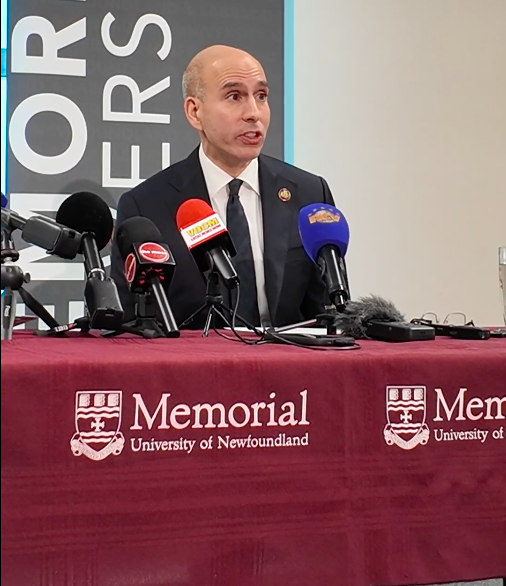
Yesterday at a press conference at the Bruneau Centre, MUN President Janet Morrison, alongside Chair of the Board of Regents Justin Ladha spoke on the decision to sell both the Signal Hill and Harlow Campuses, the Johnson Geo Centre and the Ingstad building.
Why divest?
Ladha began the press conference by re-iterating the points he made in the press release, talking about what he says is a “disciplined, intentional approach to financial stewardship” the Board is taking.
Ladha said Memorial is “taking new measures to evolve into a more student focused, research intensive and financially resilient University,” and that by reducing investment in non-core assets, they can “further protect academic delivery, better maintain our infrastructure and ensure we [the board] remain well-positioned to support Memorial’s current and future learners.”
President Morrison said she wants “to acknowledge that this news will be disappointing for some, but Memorial must be responsive to the pressures we are facing and steadfast in the pursuit of its academic mission.”
She continued, “by making courageous choices now, we are positioning our University to be stronger, more focused and more resilient for the generation of students and scholars yet to come.”
Both President Morrison and Ladha said in their opening remarks that these infrastructures are “not central to Memorial’s academic mission.”
Increasing ‘challenges’ at Memorial
President Morrison said that “the challenges that Memorial is facing, decreasing enrolments, declining revenue, increasing costs, aging infrastructure, changing labour market needs and a world increasingly defined by disruption.”
She also iterated that this decision to pursue divestment of these assets is “not a value judgement on the quality of work done in these areas, nor does it mean that activities and units within those buildings will end.”
She said that it this move reflects concerns raised by the auditor generals report in January 2025.
The future of these buildings and what it means for MUN
According to President Morrison, there are “no immediate layoffs associated with today’s decision.” She continued, “programming and services will continue while planning unfolds.”
When completed, President Morrison expects the divestment of these assets will “reduce our footprint by about 160,000 square feet and result in a reoccurring annual operating expense reduction of $3 million a year,” and that “further and overtime, the University deferred maintenance liability will be reduced by an estimated $20 million.”
The potential revenue from the sale of each property has “not yet been determined” according to President Morrison, but she did mention that net proceeds from the sale of the Harlow Campus will be “reinvested to ensure global learning opportunities are more accessible and more equitable for a broader array of students in Newfoundland and Labrador.
Too much real estate?
Ladha touched on the fact that Memorial has “a lot of real estate” and said that they must be “more efficient” with their utilization of the real estate.
He continued, “in so doing, we are confident that we can deliver the important mission of Memorial to the people of this province and all our learners, while doing this, and we have to continue to look, because every time we find an efficiency, that allows us to realize upon that, but still keep excelling our academic space, we’re doing a service to the people of the province, we’re being efficient with the use of their money, and we’re bringing this university forward.”
Harlow Campus
President Morrison said that the learning experience at Harlow is “transformative,” but that only less than “one percent” of Memorial’s total enrolment population is able to attend the campus per year, however, the University is commited “to ensure that those types of learning experiences are more accessible to more students as we move forward.”
According to a statement in the Gazette, “academic programming and events at Harlow Campus will continue until Aug. 31, 2026.”
The Geo Centre
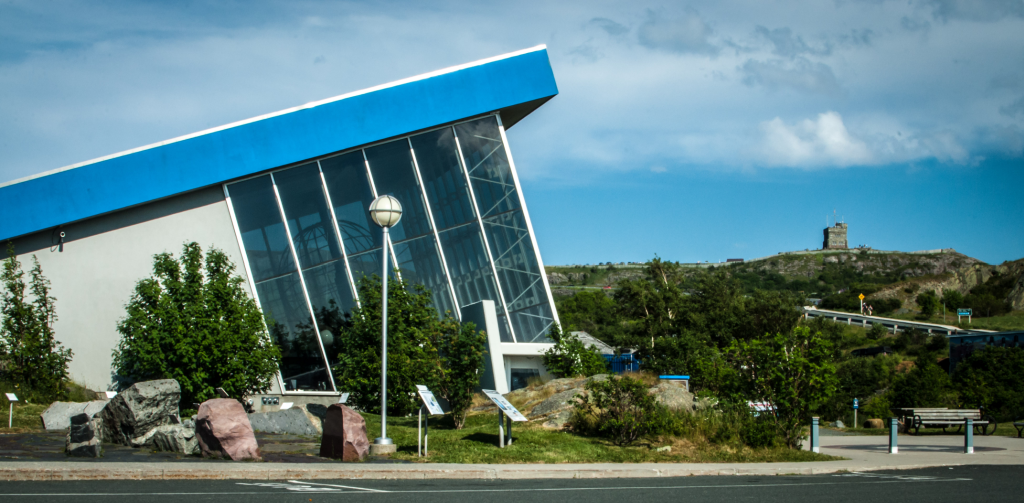
In 2019, MUN accepted a donation from the Johnson family for the Geo Centre, which was supposed to help the University build greater community connections while enhancing teaching, learning and research.
When MUN accepted the donation, President Morrison said the expectation was that the Geo Centre would be “cost neutral” and that operations would be “self sustaining,” which, according to her, has not been the case.
She continued by saying the expectation with divesting from the Geo Centre will reduce the University’s operating expenses by around “$670,000 a year” and relieve the University of deferred maintenance costs of around “$4.5 million.”
According to a statement in the Gazette, “GEO Centre will reopen as usual in April following its seasonal closure. If a sale or transfer is not completed by December 2026, operations will cease and the building will close.”
Signal Hill Campus
It is unclear how long Graduate students will remain at Signal Hill residence. In a statement published in the Gazette, it says “occupancy will continue at Signal Hill Campus at this time, with support available to help students find alternative accommodations on the St. John’s campus.”
According to a statement in the Gazette, bookings at the conference centre will continue until sale, or April 2027 if no sale occurs.
Ingstad Building
The Ingstad building was another casualty of the divestment, which was used as Memorial’s print and mail service building.
These services will continue in a different building.
More resources into infrastructure?
With Memorial’s main campus in St. John’s being set to absorb more services and programs due to the divestments, the Muse’s social media editor Kaelem Tingate asked President Morrison if more resources would be put into fixing the campuses crippling infrastructure.
President Morrison said the Board of Regents “approved a multi year infrastructure plan,” where she says a focus on “academic priorities, accessibility for all community members, on health and safety.”
She continued, “most immediately, you will see the demolition of coughlan college, so that is coming down in February… there’s been money allocated in the tunnels, on elevator refurbishment and we’re just accepting bids now due in February for a new primary data centre, so a lot of that work is ongoing on the St. John’s campus, and people will see and feel that.”
President Morrison says that this move will lead to a positive impact on the energy and the animation of the St. John’s campus.