
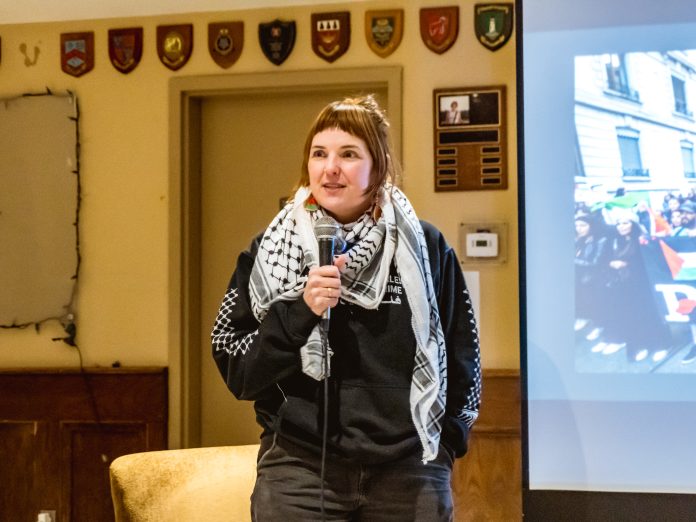
On Sunday the 25th of January at Swilers Rugby Club, a crowd gathered to hear the experiences of Elise Thorburn’s time as a doctor in Gaza.
Thorburn took attendees on a journey through her time at Ahli Hospital in November of last year.
The journey began with her arrival in Jordan, where she had to pass through the West Bank and a series of Israeli checkpoints, to eventually enter Gaza, where the UN Human Rights Commission has determined that Israel is committing a genocide against Palestinians.
Upon her arrival in Gaza, Dr. Thorburn described the scene as full with life, an improvement due to the ceasefire. She found that “there was life at night in Gaza, post-ceasefire, where there wasn’t before… After the ceasefire, there was life on the streets, people were out, they would stay up late, lit by candlelight, playing cards, drinking tea, and talking.”
But that atmosphere of “slightly lessened anxiety” was short-lived.
“It became clear very quickly that the ceasefire meant little in terms of continued bombings; there was bombing all day everyday,” said Thorburn.
The state of the Ahli Hospital, as she found it, was in direct consequence of a previous series of bombings. Thorburn said the hospital had lost its Emergency and Reception Department due to Israeli strikes and had now operated out of tents since April 2025. According to the World Health Organization 94% of all hospitals are damaged or destroyed in Gaza.
The ability to rebuild has been next to impossible, “supplies can’t get in, they can’t get out. Even basic infrastructural supplies for rebuilding houses, or tents, etc. Anything that can be deemed as ‘dual-use’, that can be potentially used as a weapon as well as a supply, is restricted. That limits how the healthcare system can operate.”
According to Thorburn, she nor her colleagues were allowed to bring in simple medical tools, like a stethoscope. According to Thorburn, many of those who brought medical tools or even simple First Aid kits had them confiscated, or were refused entry.
Thorburn also said that despite the shortage of aid, Palestinians have been able to adapt and exercise their “health sovereignty.”
In her presentation, Thorburn explained how medical practitioners had created external fixators, a sort of exoskeleton to help mend broken bones, using 3D printers.
Palestinians have adapted in other areas, such as their electrical infrastructure, which Thorburn says is targeted by Israeli strikes.
“One thing Palestinians did in the last twenty years is start to build solar panels on the roofs of every hospital to create energy sovereignty… Palestinians are very good at figuring out where they’re going to be targeted and how to adapt to that.”
This comes in the face of an infrastructure crisis in Gaza. Thorburn documented her time there with pictures and videos, and in them, you could see the vast extent of the Israeli strikes on Gaza.
In the final moments of her presentation, Thorburn showed onlookers a video of a child playing with a blown-up medical glove.
One child she met, “who was 12, which is the same age as my child. was shot by a quadcopter missile, had their pelvis destroyed, and their knee blown out. That child was attacked by the drone in the neighbourhood of Zaytun, which in Arabic translated into English means Olive, and my child’s name is Olive.”
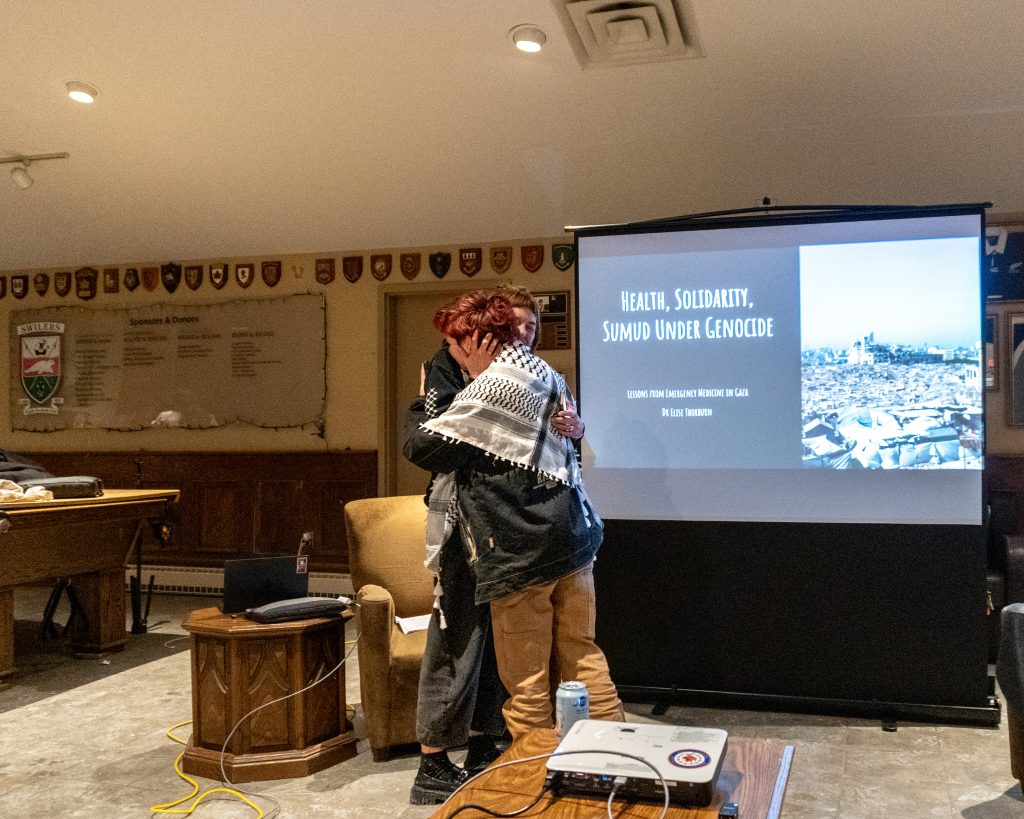
Thorburn said she found that one of the hardest parts was “watching people go through that and having to accept and know that there will never be accountability, that the international community was never going to call Israel to account for the crimes it is committing, and that the UN has stood by mostly impotent and done nothing. That felt really hard for me.”
“I asked my colleague once, ‘Aren’t you angry?’ And he said, ‘I stopped being angry, I can’t feel anything.’”