

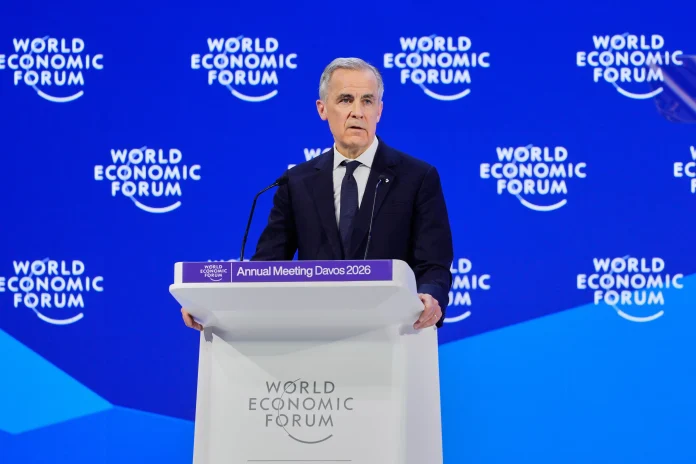
Prime Minister Mark Carney’s speech at Davos on January 20 may mark a turning point in our collective understanding of international relations and power structures alike.
However, the contents and lessons of Carney’s speech ring too little, too late. While, for many across the Western world, this signifies what the prime minister describes as the end of the “rules-based international order,” the final straw for Western countries is telling.
Carney’s speech will likely go down in history. While I understand the importance, gravitas, and eloquence of Carney’s speech—and even conditionally agree with most of it—there is a large, looming elephant in the room. The world order he describes has not “ruptured”—it never existed to begin with.
“What does it mean for middle powers to ‘live the truth?’ First it means naming reality. Stop invoking ‘rules-based international order’ as though it still functions as advertised,” said Carney towards the end of his speech.
His wording is important here: “as though it still functions as advertised” implies that the old international system used to function as advertised, based on shared principles.
Carney said that we must rebuild our international order upon the mutual cooperation of middle powers, implying there is something to be rebuilt. There is not. There is nothing to go back to.
This is my issue with Carney’s speech. It is impossible to decry the facade of the liberal international order while also implying that it can be rebuilt or reformed.
We are only now speaking up against the “recent” shift because it threatens our economy.
We are only now speaking up because it threatens our allies.
We are only now speaking up because the victims look like us, because the victims will be us if we do not speak up.
Carney’s use of Vaclav Havel’s analogy of the shopkeepers under Soviet rule is clever. It implicitly denounces any alternative form of governance than neoliberal capitalism (he is speaking at the World Economic Forum, after all), and it cutely places the so-called “middle powers in the shoes of the powerless and oppressed.
But we did not just happen into the situation we find ourselves in, and we were certainly not oppressed into it.
Why did we not speak out when the United States destabilized Latin America and the Middle East through foreign intervention?
Were we oppressed into helping the United States kill millions of people in the War on Terror?
Were we oppressed into shipping arms to Saudi Arabia and Israel, making us complicit in genocide in Yemen and Gaza? I think not.
We have upheld the collective illusion of rules-based international order so long as it served our interests. As long as we benefited from it, the system was functioning as intended.
Carney admitted this, listing the benefits of American hegemony: trade, stability, security. Those benefits did not magically appear just because agreements were signed—they were killed for.
Here we find the hypocrisy of the liberal world order: economic coercion and threats to Western countries’ sovereignty are unacceptable, yet the atrocities mentioned above have been met with silence.
For too long we have treated the United States as our hitman. Sometimes we supplied the ammo. Other times we drove the getaway car. What we are experiencing now is a perverted form of blowback.
I am sure many international relations experts and political junkies alike watched Carney’s speech, mouths agape. For the first time since the liberal world order began, we saw a Western world leader reveal its hypocrisy to Canada and the world.
Carney’s analysis is an important first step, but it is incomplete. While he recognizes the problem with the liberal world order, his solution is simply more liberalism—mutual cooperation, free trade agreements, and the formation of international organizations—hollow, empty liberal institutions.
They are exactly what got us here. Carney’s solutions clearly have not met his analysis.
Carney is right—we should not mourn nor feel nostalgic towards the old world order. However, that does not mean we should not reflect on it; if we do not learn about the reality of our role in international history, then we will be doomed to repeat it.
The world order we once thought existed can never be brought back, because it never did exist, not even for a second.