

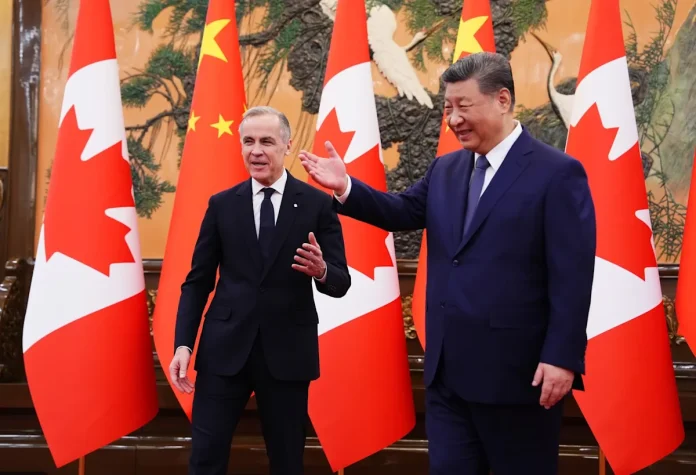
Last week, Prime Minister Carney travelled to Beijing to meet with Chinese leaders including President Xi Jinping and Premier Li Qiang, and secured a new “strategic partnership” between Canada and China.
This marks a notable turning point in relations between the two countries, as the previous decade had seen a souring of diplomatic ties between Ottawa and the Chinese government during Justin Trudeau’s tenure as Prime Minister.
This new partnership comes in the face of increasing instability and uncertainty in Canada’s relationship with the United States, as President Trump and his administration have not only targeted Canada with tariffs and restrictive trade policy, but have also made unsettling claims about making Canada the 51st State.
Under the second Trump administration, Canadian opinion of the United States is at a historic low, and a majority of Canadians support diversifying Canada’s trading partners.
When it comes to relations with China in particular, there has been a staggering turnaround in Canadian public opinion. A recent Ipsos poll found that 54 percent of Canadians support “closer trade ties and economic agreements with China,” compared to data from 2020 in which eight out of ten Canadians wanted less reliance on the Chinese market.
However, the stark change in how the Canadian public feels about Chinese relations is much less surprising when considered in the context of a seemingly rogue United States, which has not only been unreliable and unpredictable on trade, but has also been reckless in their foreign policy more broadly, including the latest row over Greenland and threats to several Latin American countries.
There is a reckoning that needs to happen regarding the failure of Canada’s decades long policy of economic and security integration with the United States, and how this policy has left us vulnerable and dependent as a nation.
But as the past cannot be changed, it is critical we instead use this unprecedented geopolitical climate to start fostering more independence and self-sufficiency in our economy at home, while also diversifying and expanding our partnerships abroad.
In this vein, Prime Minister Carney’s announcement of a new strategic partnership with China is a welcome one.
First of all, China is a massive market for Canadian exporters, in particular our farmers and fishing industry, and both of these sectors will benefit from the new partnership.
Chinese tariffs on Canadian canola seed are expected to fall to 15% from 85%, and “Canadian canola meal, lobsters, crabs, and peas will not be subject to relevant anti-discrimination tariffs from March 1, 2026, until at least the end of this year.”
Secondly, China is one of the premier nations in technological development, and greater access to their technology at lower import costs can help fuel Canada’s economic growth.
This deal specifically allows for 49,000 Chinese electric vehicles to enter the Canadian market at a tariff rate of 6.1%, a significant reduction from the previous 100% rate.
While some, including Canadian auto unions, are concerned that this will negatively affect Canada’s auto industry, and indeed these concerns are valid, this partnership also outlines the intention for Chinese EV companies to eventually manufacture their vehicles in Canada, which would create jobs here at home.
Chinese EVs are also renowned as some of the best in the industry, and having access to those vehicles at a low import cost can be beneficial for consumers.
Finally, in my view, the most consequential aspect of this new strategic partnership is not what’s in the initial deal itself, but the broader significance of closer diplomatic and trading relations between Canada and China.
In the face of an emerging “new world order,” as Carney illustrated quite powerfully in his recent speech at the World Economic Forum, it is paramount that Canada pursue strategic relationships with nations such as China in order to both manage geopolitical risk, and to decrease our dependence on the United States.
Having a varied and diverse portfolio of trading partners, as well as increasing our self-sufficiency at home, is the key to maintaining and sharpening our sovereignty.
We may have our disagreements with China, but working with them on areas of mutual alignment is the responsible and pragmatic thing to do.