

The US-Israel joint attacks against Iran, beginning with the first strikes around 9:27am in Tehran, signal the latest and most significant escalation in conflict since US-Israel strikes on Iranian nuclear and military facilities in June 2025.
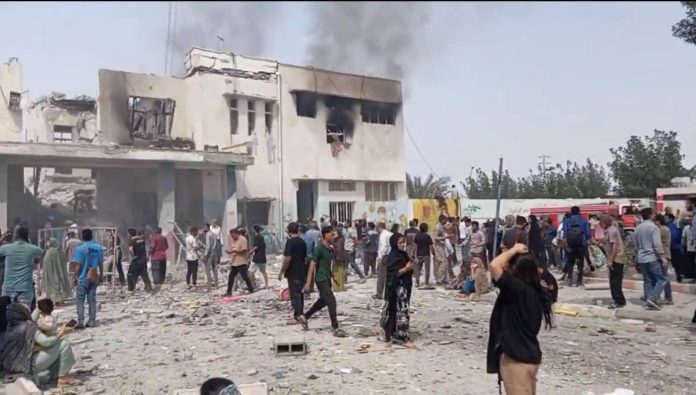
The latest air strikes targeted military and government infrastructure in Tehran, Iran’s capital, with Iranian media reporting attacks on the Ministry of Intelligence, the Ministry of Defence, the Atomic Energy Organization of Iran, and a military complex.
Missiles also struck University Street, killing at least two students at a school in the east of Tehran, as well as a girls’ primary school in southern Iran, killing at least 108, bringing the death toll from airstrikes to an estimated 201, so far.
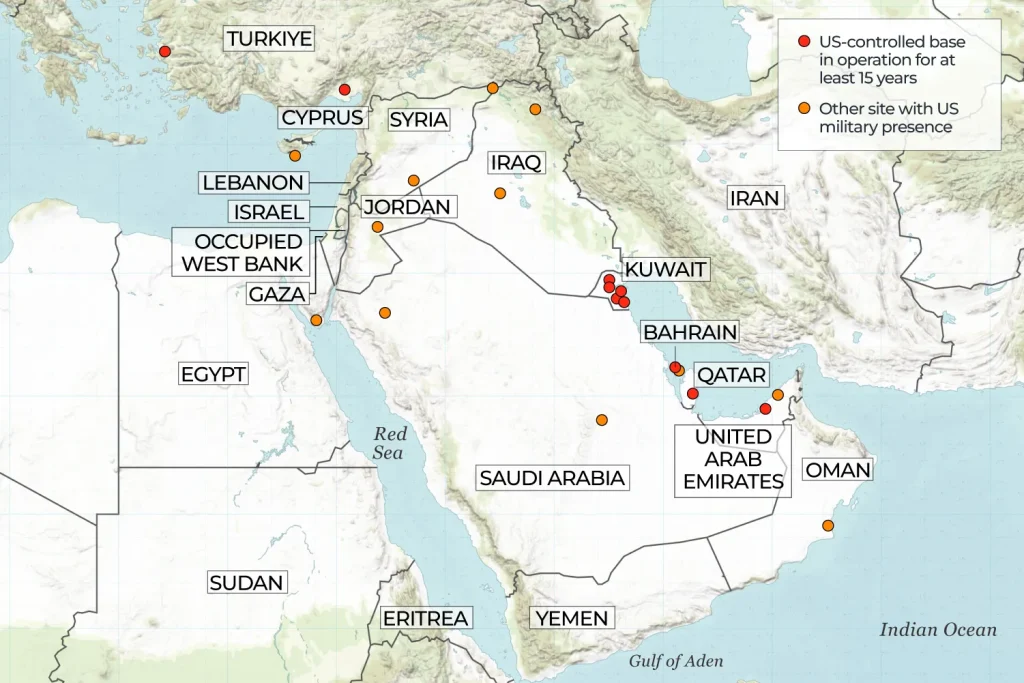
Iran responded to the US-Israel attacks by sending retaliatory strikes against Israel and US military infrastructure in Qatar, Bahrain, Kuwait, Saudi Arabia, UAE, with explosions reported in Saudi Arabia, UAE, Bahrain and northern Israel.
There has been one confirmed death in Abu Dhabi, UAE from falling debris and one man received minor injuries in northern Israel.
Iran’s government had previously warned of severe action against US military bases in the region if the US resorted to military force, in order to defend its sovereignty and territorial integrity.
Global responses to the joint US-Israel strikes have varied—countries struck by Iranian missiles have condemned Iran’s retaliation and asserted their “right to respond,” China expressed that Iran’s sovereignty must be respected and urged an end to military action.
Russia accused the US of manipulating ongoing negotiations between the US and Israel to distract from the impending strikes, and Norway contradicted the assertion touted by US and Israel government officials that strikes against Iran were “preventive,” stating that it is “not in line with international law” since preventive strikes “require an immediately imminent threat.”
This is further complicated by statements from Israeli defence officials affirming that the joint strikes were planned for months prior, with a specific date selected weeks before.
Other nations have released statements with varying degrees of support for US-Israel military action, including a joint statement from Germany, the UK, and France condemning “Iranian attacks on countries in the region.”
Canada’s statement, released by Prime Minister Mark Carney and Minister of Foreign Affairs, Anita Anand, follows in this vein, stating that Iran is “the principal source of instability and terror throughout the Middle East” and that Canada “supports the United States acting to prevent Iran from obtaining a nuclear weapon.”
At the time of the US-Israel attacks, the US and Iran had been embroiled in a third round of nuclear negotiations taking place in Switzerland, amid increasing US sanctions on Iran and rising American military presence in the Middle East.
The talks have largely stalled, with the two sides unable to come to an agreement. United States government representatives have long claimed that Iran’s nuclear program poses a significant threat to international security as they claim Iran grows closer to developing nuclear weapons capabilities.
Iran refuses to include their missile programs in the agreement, saying that Iran’s missiles are for “defence only.”
The purported concern about Iran’s nuclear weapons has been a leading explanation for the attacks on Iran by American and Israeli authorities, even though US President Donald Trump previously stated that the US-initiated ‘12-Day War,’ in June 2025 had “obliterated” Iran’s nuclear operations.
Further shedding doubt on this claim is testimony from the US’ own Director of Intelligence, Tulsi Gabbard, who testified in March 2025 that US intelligence “continued to assess that Iran is not building a nuclear weapon and Supreme Leader Khamenei has not authorized the nuclear weapons program he suspended in 2003.”
For students of history or those who simply remember history, the statements from US and Israeli officials manufacturing support for their attacks on Iran are eerily similar, nearly identical, to the pattern the world saw play out during and after the American invasion of Iraq in 2003—now widely condemned and understood to be one of the United States’ most detrimental foreign policy decisions.
Following the September 11, 2001 attacks, president George W. Bush exploited public fear to pursue military action against Saddam Hussein’s regime in Iraq.
He had argued that Iraq had not dismantled their nuclear, biological, and chemical weapons programs, as was dictated by the United Nations after the 1991 Gulf War, which presented a massive risk to international security; particularly, American security.
The 2003 invasion of Iraq, which swiftly toppled the Iraqi government and military, led to a prolonged American occupation of Iraq which lasted until December 2011, when the US had fully withdrawn.
By the end of the Iraq war, the country had been totally destabilized, an estimated 300,000 Iraqis were killed, including approximately 200,000 civilians, 4,500 American soldiers were killed and 32,000 were wounded. No weapons of mass destruction were ever found.
Canada’s support for the aggression clearly initiated by the United States and Israel raises serious concerns about further Canadian complicity in violations of international law and possible war crimes.
Prime Minister Carney’s statement lends credence to the unfounded claim that the United States is pursuing military action against Iran for a righteous reason: to defend and protect the international community from a rogue state with nuclear weapons.
This is despite the UN Attorney General’s condemnation of the US and Israel’s actions as “military escalation.”
It is also deeply ironic due to Canada’s ongoing complicity and passivity in the state of Israel’s continuing genocide in Gaza, a state which, unlike Iran, already possesses nuclear weapons and is one of only five nations worldwide that has declined to sign the Nuclear Non-Proliferation Treaty, which Iran has signed.
Even Prime Minister Jean Chretien refused to publicly support the US invasion of Iraq at the time—primarily due to a lack of authorization from the UN Security Council—and Chretien did not directly involve Canada in hostilities.
The UN Security council is set to hold an emergency meeting this afternoon to discuss the growing crisis across the Middle East. Canada would do well to remember the harrowing legacies of the Iraq war, and the lessons we should already be familiar with—war begets war, bloodshed begets bloodshed.
It is wise to be skeptical about the actions of a military power who has a lengthy track record of misrepresenting information and fabricating narratives to the benefit of no one but the most wealthy and powerful.
When the rich wage war, it’s the poor who die.