


Though it’s known in most above-board circles for its use as a dental anesthetic, nitrous oxide has seen use as a recreational or experimental intoxicant for approximately two hundred and fifty years – forty years longer than it has been used in dentistry. The lightheaded, floaty, and giddily euphoric feelings induced by nitrous inhalation have long enticed users, especially in party or social contexts.
Its long, well-documented history and consistently changing cultures make nitrous oxide an excellent case study for how drug users, institutions, and societies interact with these substances and their economies.
Nitrous oxide has been used in party and concert environments in the form of silk bags in the early nineteenth century, large steel tanks liberated from dentist’s offices or acquired semi-legally from wholesalers, small steel containers used in baking, and most recently, containers modelled after the brand ‘Galaxy Gas’: 1-2kg tanks branded colourfully in a manner which evokes streetwear, rap, and internet cultures, popularized by the Atlanta, GA-based brand founded in 2021.
Each of these delivery methods reflects the cultures in which they emerged and were embraced – the silk bag perfectly embodies the stuffy debauchery of the European elites who enjoyed them; the large, communal tanks found in Studio 54-esque nightclubs, or Grateful Dead lots, were exemplary of the semi-public, pro-social drug culture of flower-child era love-ins; Whippets became popular in of end-of-history-era party culture, a live fast, die young ethos evidenced in the drug’s association with cultural products like Jackass.
While the Whippet-style containers are still internationally the most popular, Galaxy Gas-style products increasingly embody a distinctly ‘Gen Z’ ethos. An endless series of short-lived, meaningless bursts of instantaneous entertainment, simultaneous with an increase in risky ‘challenge’ uses, documented by an increase in related injuries reported from medical journals across Europe, North America, and Australia.
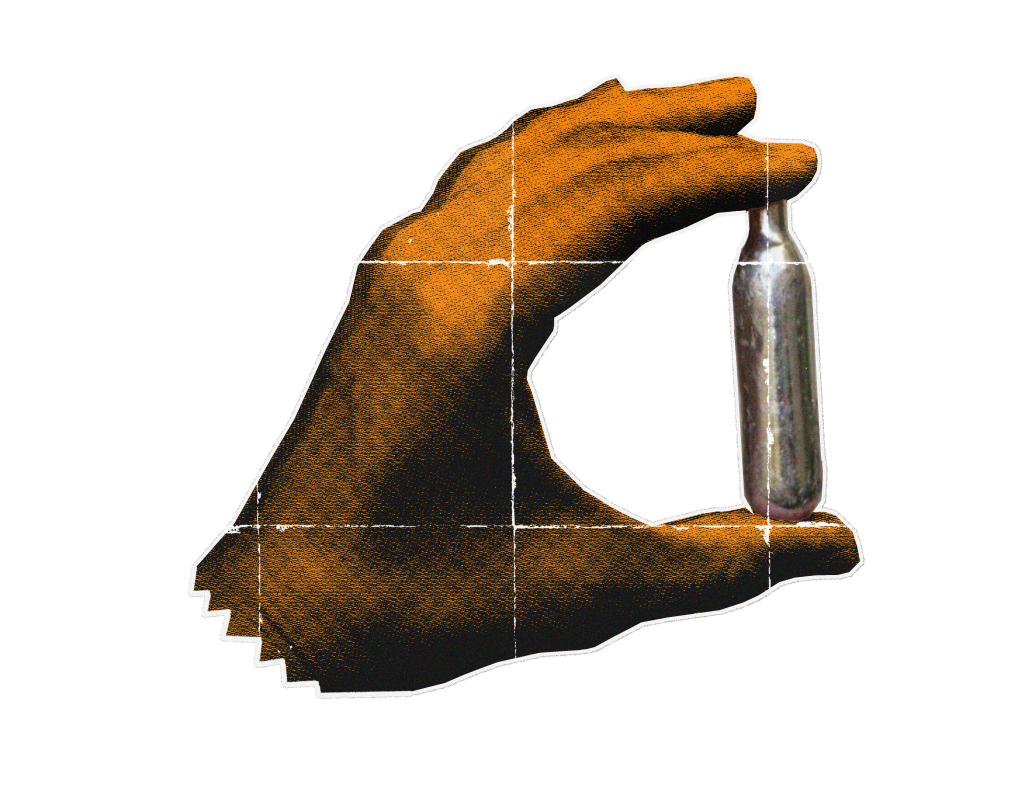
While relating the twentieth-century delivery methods to their surrounding cultures is mostly interpretive, i.e., these products were not designed with these uses in mind, so embodiment is incidental, it can’t be argued that the newer brands don’t have certain demographics in mind. While these products are still sold in most markets as nominal cream whippers, their branding lives and breathes in the realm of colourful, gonzo internet hyperculture.
Galaxy Gas in particular worked overtime to enmesh itself into the Atlanta rap scene. This marketing tactic would prove successful in advertising nitrous oxide to a new, younger market. The substance would explode in popularity across short-form and livestream video sites, appearing in turns as the subject of a challenge, as the detached object, or as an accessory to any variety of bizarre and surreal memes; it would be the former that would result in TikTok, Meta, YouTube, and Kick banning videos depicting recreational use throughout 2024.
Beyond the branding, Galaxy Gas containers provide their users, for the first time in nitrous oxide’s history, a large, but still handheld tank, with an ‘incidental’ mouthpiece. This changes the dynamic of use in a major way, as nitrous oxide users now have the option to inhale for significantly longer periods of time, as opposed to the balloon-filled methods of earlier models – a pattern noted in the increasing reports of injuries associated primarily with prolonged nitrous oxide exposure.
Across nearly two and a half centuries, nitrous oxide has descended from wealthy academic socialite parties to its now-cemented role in concert, rave, and party cultures. Historically, nitrous oxide’s recreational use has been at the mercy of the substance’s perfectly legal uses, until the recent trend towards direct market advertising.
This latest innovation has thoroughly tested the boundaries of legal loopholes through which nitrous oxide users find this pastime, begging the question of how this relationship will evolve from here? As Canadian social attitudes and legislation steer towards further drug decriminalization, is nitrous oxide on the docket?
*This article first appeared in The Muse’s Sex, Drugs, and Rock and Roll print edition, published September 2026.