


*This article first appeared in The Muse’s Sex, Drugs, and Rock and Roll print edition, published September 2026.
We all know the joke, “I watch _ for the plot,” but, in cinema, how much does sex actually contribute to the plot of a film? Typically in romance films, the sex scene – or multiple scenes – is expected at some point. Sex has become so emphasized within romantic relationships that a truly authentic film about the wonder and magic of a relationship would not be complete without a bit of intimacy, sometimes being the main hook of the film.
While romance is the genre intended for sex scenes, the concept has since slithered its way into other genres, including, but not limited to, dramas and horror films. In a romance film, the sex scene usually embodies the connection and passion between the two – or more – characters, increasing the stakes of any issue that may jeopardize said connection; however, in other genres, the sex scene becomes a part of the stakes, and often it can be seen as a main force of tension; in this scenario, it would be more appropriate to refer to these moments as scenes involving sex, rather than scenes about sex.
An example of a scene about sex in a film outside of the romance genre can be found in Edgar Wright’s Scott Pilgrim vs. the World (2010), where Ramona leads an unsuspecting Scott into her bedroom after making tea. While Scott and Ramona do not actually have sex during this scene, it nonetheless carries all of the magic and wonder that Hollywood imagines sex to be – noted by the calm, upbeat music and the glowing pink heart that appears behind the couple.
In addition, Scott is still satisfied despite not having sex with Ramona, stating that he just needed “this” – while lying in bed next to her. For Scott Pilgrim vs. the World, sex is not the driving force of Scott and Ramona’s connection; instead, it is just another method of expression, something that many other films fail to establish.
While Wright chose to make sex a light-hearted topic, Christopher Nolan chose a dramatically different approach in Oppenheimer (2023). During the biographical drama, there are two scenes involving sex that play out in different ways: one intended to raise suspense, and the other thrown in haphazardly.
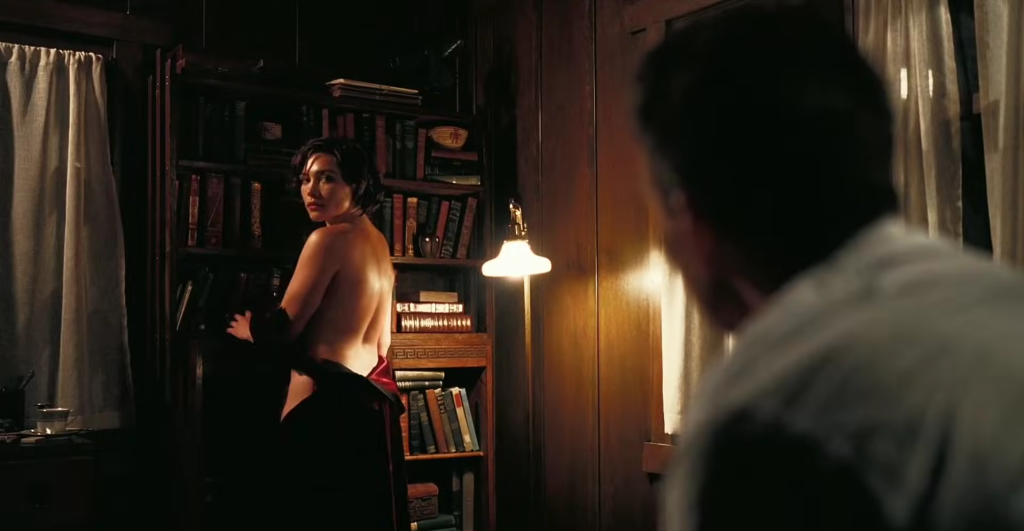
The first scene involving sex in Oppenheimer comes when Robert is introduced to Jean Tatlock, a member of the Communist Party. While the two immediately hit it off, the scene concludes with Jean making Robert recite the famous line from the Bhagavad Gita: “Now I am become Death, destroyer of worlds.”
The second scene involving sex comes during an interrogation, where it is revealed that Robert cheated on his wife Kitty with Jean. During the reveal, Kitty imagines Jean and her husband having sex in front of her, while Jean makes eye contact with her. This interrogation scene works in a drama because it not only strains the couple’s relationship, but also reveals that Robert had deep connections with members of the Communist Party, therefore straining the US government’s level of trust in him as well.
Because all is revealed during the interrogation, Oppenheimer’s initial scene involving sex loses all of its significance, and ultimately feels shoehorned in just to get the famous Gita quote. Robert and Jean did not need to have sex to recite the Gita quote; they could have been reading together in the common area, Robert could have been reciting something he remembered to Jean; in fact, Jean did not need to be there at all. Robert could have said the Gita quote to anybody else in the movie, and the line would have been delivered the same; he only has sex with Jean because the director wanted them to.
While the interrogation scene leaves the audience feeling uncomfortable, the Gita scene only exists to get you to point and say, “hey, I know that!” while a naked Cillian Murphy and Florence Pugh flash across the screen.
Despite the scenes happening an hour apart, Oppenheimer showcases one of the many problems with sex scenes in Hollywood: they do not know how to do it right, at least not consistently.
Nolan touches on the idea of sex being uncomfortable in Oppenheimer, but Curry Barker goes even further in his debut film Obsession (2026). The scene involving sex in Obsession comes after Nikki and Bear share a confession about “their” feelings; a soft tune begins to play over a montage of the couple sharing romantic moments, making the audience feel like everything is going to plan.
However, after the infamous dinner scene, the movie jumpcuts to the new couple having sex on Bear’s bed. While the jumpcut alone is jarring, it is also important to notice that Nikki’s face is completely neutral during the sex, giving the audience another clue that Nikki is not in control of her own body and is instead subject to Bear’s dark desires, increasing the level of discomfort in the audience.
While the scene involving sex in Obsession is meant to make you squeamish, the entire film is a critique of Hollywood’s rose-tinted outlook on romance.

In Scott Pilgrim vs. the World, Scott’s crush on Ramona is the main conflict, while in Oppenheimer, the physicist’s affair with Jean becomes a point of tension – and an excuse to have sex on screen – but is still presented as a pure-hearted, emotional connection; in Obsession, Nikki and Bear’s romance appears to be pure-hearted – at least through Bear’s perspective – but quickly spirals out of Bear’s control once the scene involving sex is over, shifting the focus towards the consequences of Bear’s actions and the trauma he puts Nikki through.
Instead of pulling the audience in, Barker’s use of sex in Obsession pushes the audience away, turning what Hollywood normally considers a sweet subject into a sour and sore part of the gross-out madness that comes with Bear’s wish.
Out of these three movies, the best example of a well-executed sex scene is the one where nobody has sex at all. While one could argue Obsession’s sex scene is more impactful, it still goes against what the sex scene is intended to be, but is nonetheless justified through contributing to the plot, unlike Oppenheimer’s Gita scene.
In 2024, The Guardian’s Andrew Pulver noted that sex scenes in films have dropped by 40% since 2000, which coincides with a fading interest in sex scenes from movie-goers; it is now more difficult than ever for films to justify having a scene that is about or involves sex. A good scene about sex must establish how deep the connection is between the two – or more – characters having sex, such as with Scott and Ramona; meanwhile, a good scene involving sex must add an additional layer to the story, such as with Robert and Jean or with Bear and Nikki. If the sex scene fails to establish connections or drive the plot forward, then it is unnecessary attention-bait.
Having a sex scene for the sake of having one is no longer good enough; more and more people are now watching for the plot, and without a justification for sex, these scenes are no longer good enough to stand on their own.