
Come From Away, the 2017 Broadway Musical, is one of the most fascinating phenomena in terms of its impact on Gander’s cultural identity.
The community of Gander and its surrounding areas impacted by the international passengers who made emergency landings in Gander during 9/11—a communal area I refer to in this article as the Gander-scape—had their stories told on the international stage to glowing reviews.
To many, this show is incredible, and I am inclined to agree; the story itself is very powerful, it brings this powerful story to an international audience, and I, like many other locals, appreciate the show’s broadly positive portrayal of Newfoundlanders and island culture.
Stories like these make me and other locals proud to call ourselves Newfoundlanders.
However, I began noticing some patterns, particularly in Gander, which concerned me: advertisements.
From billboards to merchandising, it feels impossible to escape from the Come From Away advertising. Advertisements in and of themselves are not problematic, though some of Come From Away’s promotional material seemingly exist only to inadvertently overshadow the Gander-scape’s broader historical identity.
This is why I believe Come From Away should not be the face of the Gander-scapes cultural identity: The branding of the Gander-scape’s cultural history through the phenomenon of Come From Away obscures the communities broader cultural identity, reshaping how locals and tourists understand community memory, and transforming 9/11 Heritage places into Come From Away places.
The consequences of this phenomenon are prominent through the sudden transformation of personal experience into marketable assets;
Former politician Derm Flynn uses his likeness as a character within Come From Away as a selling-point to exchange the commodity of first-hand experience with money; you can book an appointment to talk with him about 9/11 heritage and Come From Away with an initial payment of 70 dollars.
These lived experiences are shared community memories and are very special to the Gander-scape’s identity, and so I find it deeply uncomfortable to see these sacred pieces of vernacular history become something which can be bought and sold.
Further consequences of this phenomenon exist within how people imagine the Gander-scape’s cultural identity;
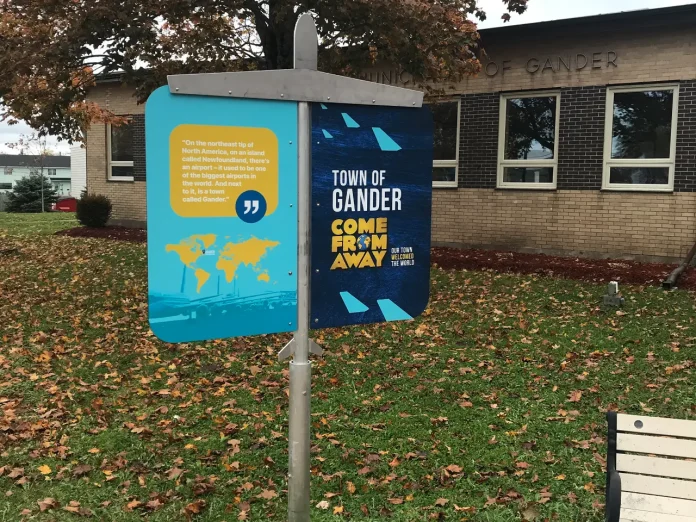
“Come From Away interpretive panels” for instance—tourism advertisements displayed outside of almost every major community centre across Gander—transform the communities schools, public service centres, and museums into tourist attractions.
Children going to Gander Academy, volunteers working at the Fire Rescue building, and tourists going to the North Atlantic Aviation Museum (NAAM) look at the “Come From Away interpretive panels” outside of these buildings and feel a sense of eerie surrealism as Come From Away overshadows the vernacular history associated with these community centres, ultimately altering how we think about cultural identity.
Come From Away has changed the way people learn about local Gander-scape histories.
The NAAM, a museum featuring aviation history dating back to 1935, has its visitors almost exclusively interested in the contents of the 9/11 “Safe Haven” exhibit, which features 9/11 heritage and history alongside Come From Away advertisements and memorabilia.
Reporting from PNI Atlantic News shows a tourism boom at the NAAM following the Come From Away off-Broadway production, highlighting the overlap between Come From Away and tourist education.
While this boom in tourism is beneficiary to local businesses, and while the “Safe Haven” exhibit is undeniably historically significant, the traffic it receives in relation to the rest of the exhibits the NAAM has to offer highlights how the Come From Away phenomenon has flattened how we engage and learn about Gander’s extensive aviation history.
Come From Away as a Broadway production is nearing 10 years of stardom coming March 2027, and is performing in Gander once again for the 25th anniversary of 9/11 remembrance in September 2026; a major milestone in both world history and the local performing arts.
Come From Away belongs within the community as an artistic achievement, and frankly it deserves that right.
However, it’s within the communities schools, museums, and public service centres—places with historically important roles in relation to the community’s 9/11 heritage—that Come From Away’s promotional-saturation becomes more problematic.
Artistic commemoration is not equivalent to historical interpretation within these contexts.
So in conclusion, with regard to Come From Away’s impact on the Gander-scapes cultural geography, and acknowledging that the identity of the communities heritage is transforming into a more marketable narrative, the question must be asked: at what point does remembrance become branding?
I hope that, moving forward, the Gander-scape will begin to reclaim its original and historical cultural identity; an identity based within vernacular history and people’s personal experiences rather than marketing and presentation.
The Gander-scape is first and foremost a 9/11 heritage community, and the face of its cultural identity should reflect those histories directly.